How Long Can Zepbound Side Effects Last?
Nausea, vomiting, and diarrhea were reported most often during dose escalation and decreased over time, though there’s no set timeline for an individual symptom.
Zepbound’s nausea, vomiting, and diarrhea occurred mainly during dose escalation and decreased over time in weight-reduction trials, but that pattern can’t tell you how many days your symptoms will last.1 Tell your prescriber right away if vomiting or diarrhea won’t go away. For severe abdominal pain that won’t go away, stop Zepbound and call your prescriber right away.1
What the timing can tell you
Nausea, vomiting, and diarrhea are among the digestive symptoms associated with Zepbound. In pooled weight-reduction trials, most of these events occurred during dose escalation and decreased over time. A separate trial of adults with obesity found that gastrointestinal events were mostly mild to moderate and occurred mostly during escalation. These are reassuring group-level patterns, but they don’t establish how many days an episode will last for you or promise that it will ease after a dose change.15
If symptoms begin after starting Zepbound or after a dose increase, the timing may fit that pattern. It isn’t a reason to wait out symptoms that persist or make it hard to keep fluids down. Your prescriber can help assess what’s happening and advise you about your next dose.1
What a dose change can and cannot predict
Zepbound’s labeled schedule starts with four weeks at the initial dose, followed by a dose increase. Any further increases are spaced at least four weeks apart; the schedule is designed in part to reduce gastrointestinal adverse reactions. Those four-week steps describe treatment decisions, not the expected length of nausea, vomiting, or diarrhea.1
Dose and duration answer different questions. An analysis of seven randomized trials involving 6,609 adults with type 2 diabetes found that nausea was more likely with tirzepatide than with placebo, particularly at the highest dose studied. It measured how often people reported adverse events, not how long each episode lasted. Those diabetes-trial results also shouldn’t be treated as a personal timeline for someone taking Zepbound for weight management.4
Likewise, “mostly mild to moderate” describes events across the obesity trial, not a promise about what you should tolerate. A symptom can start around a dose increase and still need attention if it persists or interferes with drinking. Rather than counting days since your injection, pay attention to whether you can take in fluids and whether the pain or other symptoms are becoming more concerning.51
Questions about contraception and pregnancy
The reported dose-escalation pattern in adults with obesity does not establish a women-specific symptom timeline or tell you how long any individual’s symptoms will last. But starting treatment or increasing a dose does raise a separate question if you use an oral hormonal contraceptive: Zepbound may make it less effective because it delays stomach emptying. The prescribing information advises switching to a non-oral contraceptive or adding a barrier method for four weeks after starting Zepbound and for four weeks after each dose increase. That four-week window is contraception guidance, not a prediction of how long side effects will last.51
If you’re planning a pregnancy, raise that before starting or changing treatment rather than using the side-effect timeline to make the decision. Human pregnancy data are insufficient to assess Zepbound’s risks, and the prescribing information says to stop it when a pregnancy is recognized. It does not establish a side-effect duration or a pre-pregnancy stopping interval.1
When digestive symptoms need attention
The Zepbound medication guide says to tell your prescriber right away about nausea, vomiting, or diarrhea that does not go away. These symptoms can lead to dehydration, which has been associated with acute kidney injury in people taking the medication. The prescribing information highlights this risk during treatment initiation and dose escalation.1
Feeling very thirsty or dizzy can be a sign of dehydration. If you’re unable to keep liquids down, tell your prescriber rather than assuming the symptoms will pass. Confusion alongside dehydration symptoms calls for immediate medical help.3
If nausea makes drinking difficult, small sips of water or sucking on ice chips may help you take in fluid. That’s a practical step for mild dehydration, not a reason to delay reporting vomiting or diarrhea that continues.31
Severe abdominal pain that won’t go away needs a different response from ordinary stomach upset. The Zepbound label describes possible pancreatitis symptoms as persistent or severe abdominal pain, sometimes spreading to the back, with or without nausea or vomiting. If you have severe pain that won’t go away, stop Zepbound and call your prescriber right away.1
Abdominal pain can have causes other than a medication side effect, so its timing alone can’t tell you what’s wrong. Sudden, sharp abdominal pain calls for immediate medical help rather than waiting to see whether it follows the usual dose-escalation pattern.2
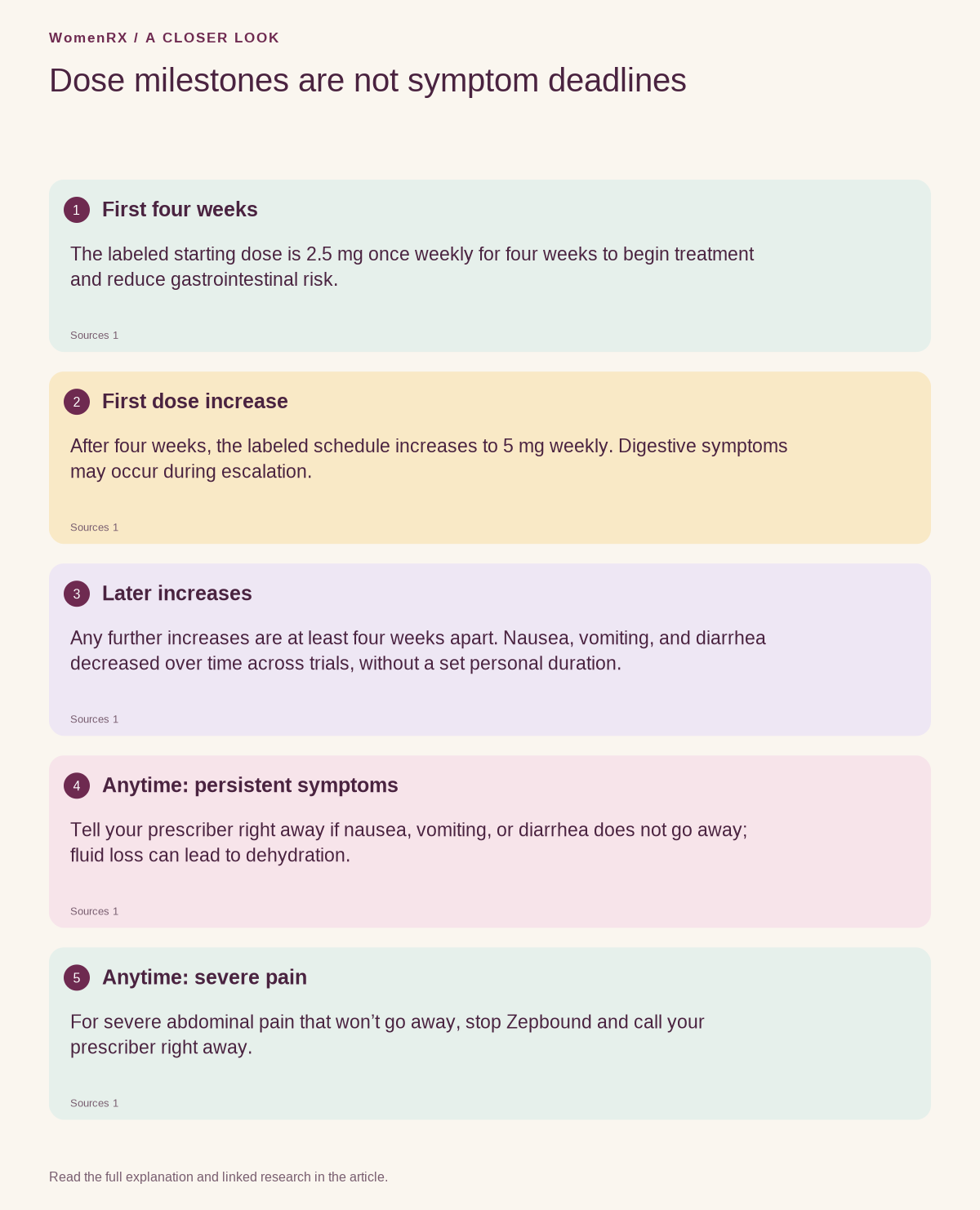
Dose milestones are not symptom deadlines
First four weeks: The labeled starting dose is 2.5 mg once weekly for four weeks to begin treatment and reduce gastrointestinal risk.1
First dose increase: After four weeks, the labeled schedule increases to 5 mg weekly. Digestive symptoms may occur during escalation.1
Later increases: Any further increases are at least four weeks apart. Nausea, vomiting, and diarrhea decreased over time across trials, without a set personal duration.1
Anytime: persistent symptoms: Tell your prescriber right away if nausea, vomiting, or diarrhea does not go away; fluid loss can lead to dehydration.1
Anytime: severe pain: For severe abdominal pain that won’t go away, stop Zepbound and call your prescriber right away.1
Read the figure as text
The first three points show the labeled escalation schedule. The final two are warning-sign pathways that apply at any point, not later stages of treatment.- First four weeks: The labeled starting dose is 2.5 mg once weekly for four weeks to begin treatment and reduce gastrointestinal risk.1
- First dose increase: After four weeks, the labeled schedule increases to 5 mg weekly. Digestive symptoms may occur during escalation.1
- Later increases: Any further increases are at least four weeks apart. Nausea, vomiting, and diarrhea decreased over time across trials, without a set personal duration.1
- Anytime: persistent symptoms: Tell your prescriber right away if nausea, vomiting, or diarrhea does not go away; fluid loss can lead to dehydration.1
- Anytime: severe pain: For severe abdominal pain that won’t go away, stop Zepbound and call your prescriber right away.1
Sources you can check
- ZEPBOUND (TIRZEPATIDE) INJECTION, SOLUTION ZEPBOUND (TIRZEPATIDE) INJECTION, SOLUTION ZEPBOUND KWIKPEN (TIRZEPATIDE) INJECTION, SOLUTION [ELI LILLY AND COMPANY] | US prescribing information and patient instructionsAccessed 2026-09-25Return to first citation
- Abdominal Pain | MedlinePlusAccessed 2026-09-25Return to first citation
- Dehydration: MedlinePlusAccessed 2026-09-25Return to first citation
- Management of type 2 diabetes with the dual GIP/GLP-1 receptor agonist tirzepatide: a systematic review and meta-analysis.Karagiannis T, Avgerinos I, Liakos A, Del Prato S, Matthews DR, Tsapas A, Bekiari E. · Diabetologia · 2022Return to first citation
- Tirzepatide for maintenance of bodyweight reduction in people with obesity in the USA (SURMOUNT-MAINTAIN): a multicentre, double-blind, randomised, placebo-controlled trial.Horn DB, Aronne LJ, Wharton S, Bays HE, le Roux CW, Srinath R, Gomez-Valderas E, Arad AD, Das S, Dunn JP, Ribeiro A, Glass LC, Lee CJ. · Lancet (London, England) · 2026Return to first citation