Do Ozempic Side Effects Differ for Women?
Stomach side effects are common with Ozempic, but the evidence does not clearly show whether women taking Ozempic experience them more often than men.
Nausea, vomiting and diarrhea are among the stomach problems reported with Ozempic, especially while the dose is being increased. Its trial data show more gastrointestinal side effects than with placebo, but the reported figures aren’t broken down by sex. Severe or persistent stomach symptoms need a call to your prescriber; signs of a serious allergic reaction need emergency help. 61
What’s common, and what the numbers mean
Ozempic’s US prescribing information identifies gastrointestinal problems as its main common side-effect pattern. In pooled placebo-controlled trials, gastrointestinal adverse reactions were reported by 15.3% of people receiving placebo, 32.7% receiving Ozempic 0.5 mg and 36.4% receiving Ozempic 1 mg. Most reports of nausea, vomiting or diarrhea occurred while the dose was being increased. Those figures cover participants overall, not women separately, and they describe the tested doses and trial populations rather than your individual odds. 6
That distinction matters if you’ve heard that women are more likely to feel sick on these medicines. A 2025 review reported more adverse events, including nausea and vomiting, among females using newer anti-obesity medications. But that review discusses medications including semaglutide and tirzepatide; it does not give you a reliable women-versus-men rate for Ozempic injection specifically. A real-world semaglutide study included mostly women and reported gastrointestinal side effects as a reason some people stopped treatment, but the results presented do not compare side-effect rates by sex. It’s reasonable to take the possibility seriously without treating it as a settled Ozempic-specific finding. 54
When a stomach symptom changes the next move
A familiar side effect can still deserve attention. Ozempic’s labeling says to contact your prescriber about stomach symptoms that are severe or won’t go away. Repeated nausea, vomiting or diarrhea can also leave you short of fluids; the labeling warns that dehydration associated with gastrointestinal side effects can contribute to acute kidney injury and advises promptly reporting persistent symptoms. You don’t have to decide whether a symptom is “normal” before making that call. 6
Persistent or severe abdominal pain is a different warning sign, particularly if it reaches toward your back, with or without vomiting. Ozempic’s labeling identifies that pattern as a possible sign of pancreatitis. Seek prompt medical assessment rather than assuming it’s ordinary nausea from the medicine. The symptom alone cannot tell you what the cause is. 6
Get emergency help for signs of a serious allergic reaction, such as swelling of the face, lips, tongue or throat; difficulty breathing or swallowing; fainting; or a severe rash with other concerning symptoms. Ozempic’s Medication Guide says to stop using it and get medical help right away if these occur. 1
These are distinctions for deciding how quickly to act, not a way to diagnose yourself. For example, nausea during a dose increase fits a pattern seen in trials, while severe pain that persists and goes toward your back calls for prompt assessment even if you’ve also felt nauseated. 6
Pregnancy and breastfeeding are separate questions
Pregnancy plans and breastfeeding deserve their own conversation about using Ozempic. They aren’t evidence that women have a different rate of nausea or other side effects. For breastfeeding, the Ozempic injection labeling says there are no human data showing whether semaglutide enters breast milk or affects a breastfed infant or milk production. If either situation applies to you, bring it up when discussing whether the medicine fits your care. 1
A useful question for your prescriber is: “If stomach symptoms start or worsen, which changes should I report promptly?” If you’ve had a particular symptom before starting Ozempic, say so too. That context can help you discuss what’s new without assuming every symptom has the same cause.
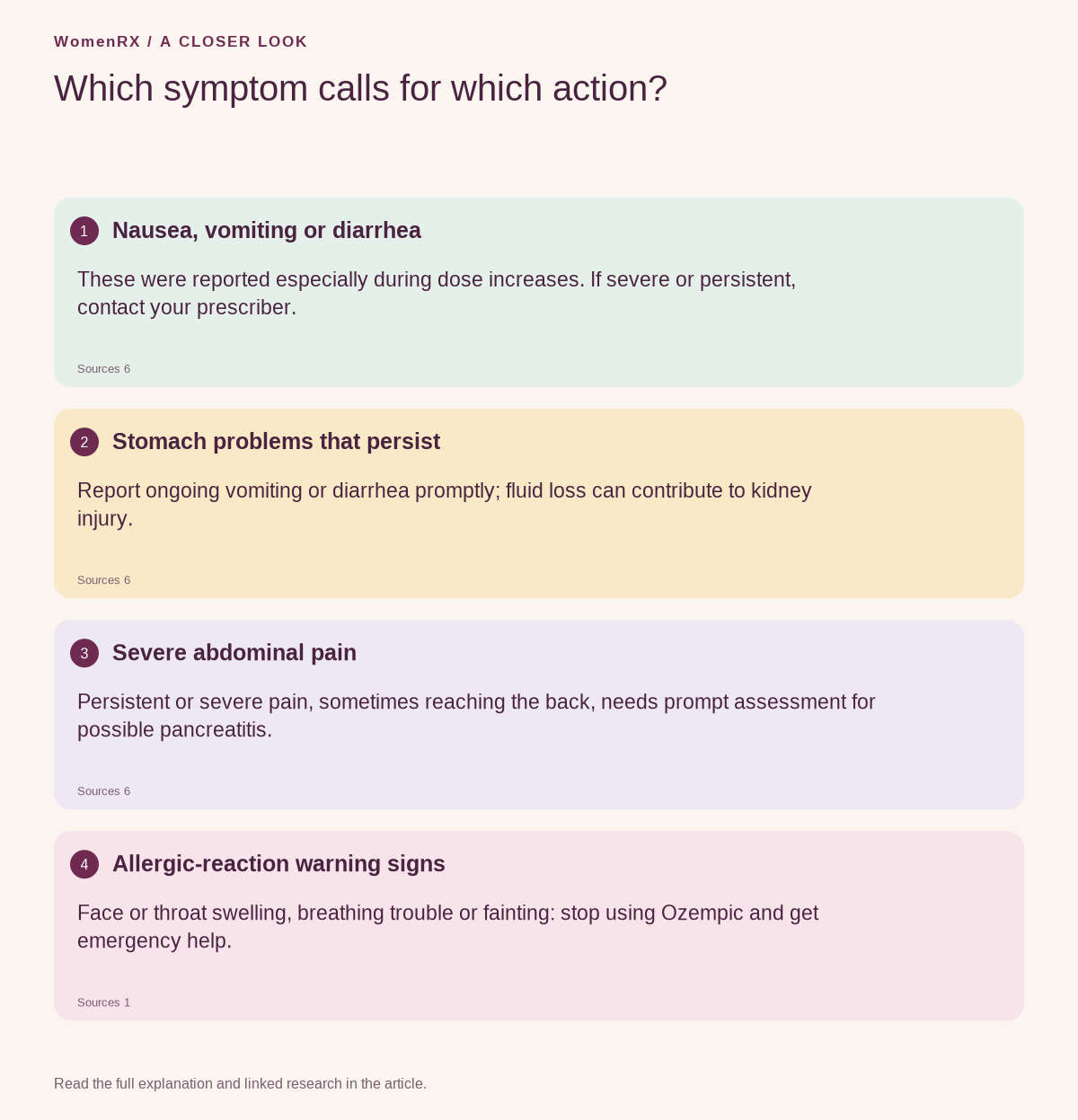
Which symptom calls for which action?
Nausea, vomiting or diarrhea: These were reported especially during dose increases. If severe or persistent, contact your prescriber.6
Stomach problems that persist: Report ongoing vomiting or diarrhea promptly; fluid loss can contribute to kidney injury.6
Severe abdominal pain: Persistent or severe pain, sometimes reaching the back, needs prompt assessment for possible pancreatitis.6
Allergic-reaction warning signs: Face or throat swelling, breathing trouble or fainting: stop using Ozempic and get emergency help.1
Read the figure as text
Use the type and persistence of a symptom to decide how quickly to seek help; this is not a diagnostic checklist.- Nausea, vomiting or diarrhea: These were reported especially during dose increases. If severe or persistent, contact your prescriber.6
- Stomach problems that persist: Report ongoing vomiting or diarrhea promptly; fluid loss can contribute to kidney injury.6
- Severe abdominal pain: Persistent or severe pain, sometimes reaching the back, needs prompt assessment for possible pancreatitis.6
- Allergic-reaction warning signs: Face or throat swelling, breathing trouble or fainting: stop using Ozempic and get emergency help.1
More questions, answered
Does a study showing similar results in women and men prove side effects are the same?
No. Similar treatment benefits are not the same measure as similar side-effect rates. Semaglutide studies have reported results by sex for outcomes such as weight loss or cardiovascular benefit, but those findings cannot establish whether women and men experience Ozempic side effects at the same rate. 32
Sources you can check
- OZEMPIC (SEMAGLUTIDE) INJECTION, SOLUTION [A-S MEDICATION SOLUTIONS] | US prescribing information and patient instructionsAccessed 2026-09-25Return to first citation
- Semaglutide and cardiovascular outcomes in patients with obesity and prevalent heart failure: a prespecified analysis of the SELECT trial.Deanfield J, Verma S, Scirica BM, Kahn SE, Emerson SS, Ryan D, Lingvay I, Colhoun HM, Plutzky J, Kosiborod MN, Hovingh GK, Hardt-Lindberg S, Frenkel O, Weeke PE, Rasmussen S, Goude... · Lancet (London, England) · 2024Return to first citation
- Semaglutide versus placebo in people with obesity-related heart failure with preserved ejection fraction: a pooled analysis of the STEP-HFpEF and STEP-HFpEF DM randomised trials.Butler J, Shah SJ, Petrie MC, Borlaug BA, Abildstrøm SZ, Davies MJ, Hovingh GK, Kitzman DW, Møller DV, Verma S, Einfeldt MN, Lindegaard ML, Rasmussen S, Abhayaratna W, Ahmed FZ, Be... · Lancet (London, England) · 2024Return to first citation
- Real-world semaglutide in obesity cohort: effectiveness, safety and persistence across sex, BMI, and prior GLP-1RA treatment.Milani I, Parrotta ME, Chinucci M, Franzò E, Gintoli E, Franco F, Sbraccia P, Guglielmi V, Capoccia D. · Frontiers in endocrinology · 2026Return to first citation
- Sex Differences in Obesity and Its Treatment.Ghanta A, Wilson E, Chao AM. · Current psychiatry reports · 2025Return to first citation
- OZEMPIC (SEMAGLUTIDE) INJECTION, SOLUTION [NOVO NORDISK PHARMACEUTICAL INDUSTRIES, LP] | US prescribing information and patient instructionsAccessed 2026-09-25Return to first citation