Can Ozempic Be Linked to Heartburn or Reflux?
Reflux is listed among reported Ozempic side effects, but symptoms alone can’t show whether the medication is the cause.
Yes. Ozempic’s prescribing information lists gastroesophageal reflux disease among reported adverse reactions, and semaglutide’s effects on stomach movement offer a plausible explanation. But heartburn has other possible causes, and a symptom’s timing can’t prove what caused it. Track when it happens and whether it changes after starting treatment or a dose change; discuss recurring or worsening symptoms with your prescriber. 2 4
What the reported link tells you
Ozempic’s U.S. prescribing information lists gastroesophageal reflux disease (GERD) among reported adverse reactions. In the cited trial results, GERD was reported in 0% of people receiving placebo, 1.9% receiving Ozempic 0.5 mg, and 1.5% receiving 1 mg. These figures show that reflux was reported during treatment; they can’t determine whether Ozempic caused an individual person’s symptoms. 2
There’s a plausible reason for a connection: semaglutide can slow stomach emptying. Changes in stomach movement could make reflux more likely for some people, but that mechanism doesn’t prove the cause of any one episode. 4 5
A 2026 analysis of adverse-event reports also found a reporting signal for GERD with semaglutide. These databases collect reports, not a complete count of everyone taking the medicine. The finding supports paying attention to new or changing symptoms, but it doesn’t tell you your personal chance of reflux or establish that semaglutide caused it. 3
Heartburn often feels like a burning in the chest; reflux can also cause a sour taste. Symptoms may be worse after eating, lying down, or bending over, with or without medication. 1
Make the pattern easier to explain
If symptoms are mild, keep a brief record so you can describe what’s changed. Note:
- When the burning or sour taste starts, how long it lasts, and how often it returns.
- When you started Ozempic, and whether symptoms changed after starting or after a dose change.
- Whether symptoms follow meals, lying down, or bending over.
- Any related nausea, vomiting, or diarrhea, and whether you can keep fluids down.
- What seems to ease the symptoms.
This won’t diagnose the cause, but it can make it easier to distinguish an occasional episode from a recurring pattern. Smaller, more frequent meals may help reduce reflux symptoms. 1
When to bring it up
Tell your prescriber if heartburn keeps returning, is getting worse, or is disrupting your usual activities. The timing and pattern can help them consider Ozempic alongside other possible causes. Don’t change your dose on your own.
Get medical advice promptly if vomiting or diarrhea makes it difficult to keep fluids down. The Ozempic prescribing information describes acute kidney injury reports, most often in people whose gastrointestinal symptoms led to dehydration. 2
What research says about women and life stages
A 2026 adverse-event database analysis says it examined results by sex, but its reported abstract does not give sex-specific findings. It also reports no results about menstrual-cycle or menopause stages, so it can’t answer whether reflux or tolerability differs across those stages. 3
Pregnancy can itself contribute to heartburn. Separately, Ozempic’s prescribing information says human pregnancy data are limited and notes potential fetal risk based on animal studies. If you’re pregnant, contact your prescriber to discuss the medication; reflux by itself doesn’t show that Ozempic is the cause. 1 2
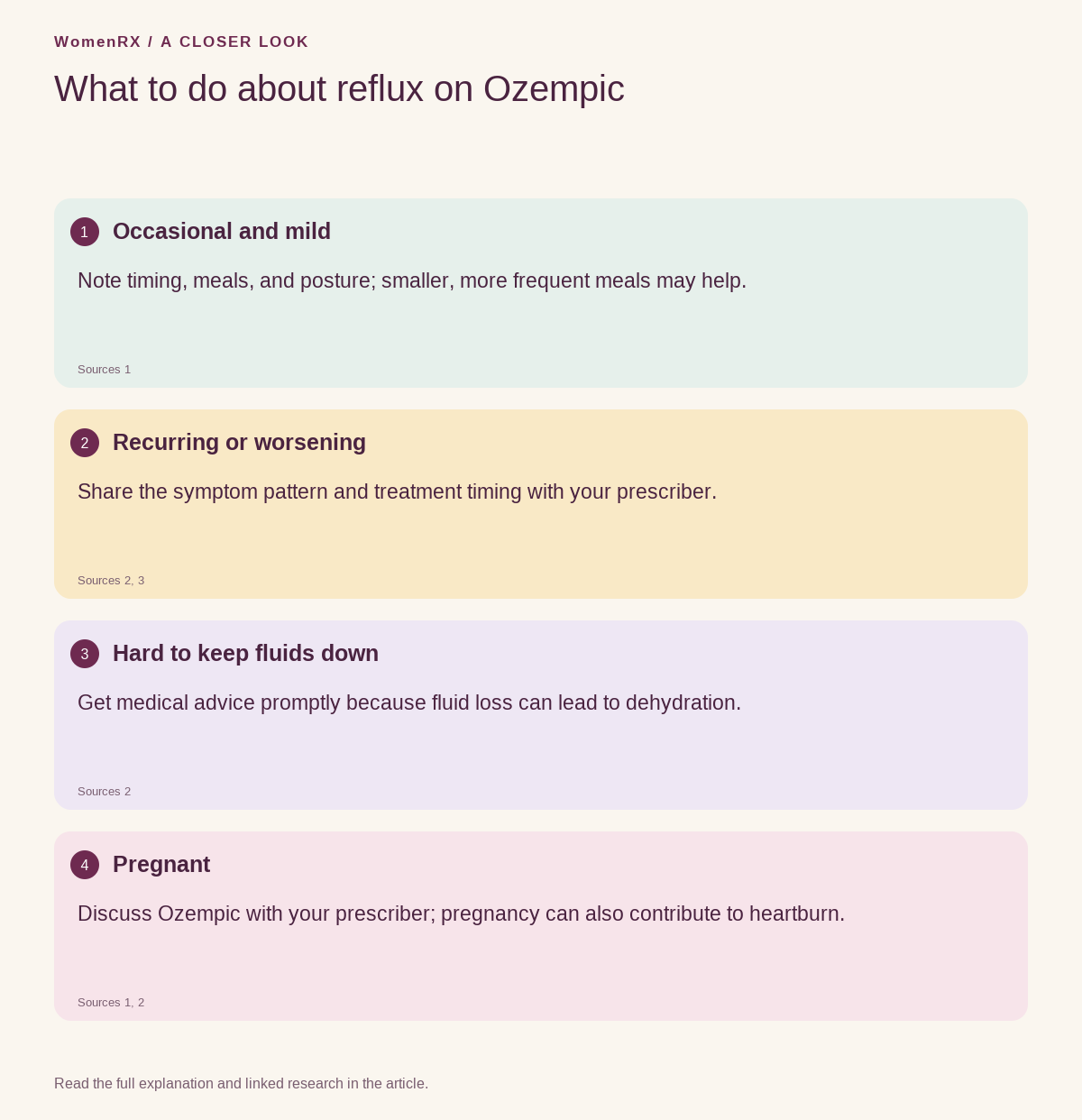
What to do about reflux on Ozempic
Occasional and mild: Note timing, meals, and posture; smaller, more frequent meals may help.1
Recurring or worsening: Share the symptom pattern and treatment timing with your prescriber.23
Hard to keep fluids down: Get medical advice promptly because fluid loss can lead to dehydration.2
Pregnant: Discuss Ozempic with your prescriber; pregnancy can also contribute to heartburn.12
Read the figure as text
Use the pattern and severity of symptoms to choose what to do next; these steps can guide a conversation but can’t diagnose the cause.- Occasional and mild: Note timing, meals, and posture; smaller, more frequent meals may help.1
- Recurring or worsening: Share the symptom pattern and treatment timing with your prescriber.23
- Hard to keep fluids down: Get medical advice promptly because fluid loss can lead to dehydration.2
- Pregnant: Discuss Ozempic with your prescriber; pregnancy can also contribute to heartburn.12
Sources you can check
- Heartburn and acid reflux - NHSAccessed 2026-09-25Return to first citation
- OZEMPIC (SEMAGLUTIDE) INJECTION, SOLUTION [A-S MEDICATION SOLUTIONS] | US prescribing information and patient instructionsAccessed 2026-09-25Return to first citation
- Multi-Database Pharmacovigilance Analysis of Gastroesophageal Reflux Disease Associated with GLP-1 Receptor Agonists: A Cross-National Signal Validation Study.Choi JG, Gong EJ, Bang CS, Lee JJ. · Gut and liver · 2026Return to first citation
- Semaglutide-Induced Silent Aspiration: An Unrecognised Cause of Organising Pneumonia.Essilfie-Quaye K, Maule G, Hashim H, Khraisat M, Okonoboh P, Jantz M. · Respirology case reports · 2025Return to first citation
- Gastrointestinal Symptoms in Obesity Therapy: Mechanisms, Epidemiology, and Management Strategies.Witaszek T, Biesiada A, Iskra-Trifunović J, Babicki M, Mastalerz-Migas A, Kłoda K. · Biomedicines · 2025Return to first citation