Heartburn on Ozempic: What to Check and When to Call
Reflux is listed among reported Ozempic reactions, and noting when heartburn happens can help your prescriber judge what to do next.
Ozempic’s US prescribing information lists gastroesophageal reflux disease among reported reactions: 1.9% of people taking 0.5 mg and 1.5% taking 1 mg, compared with 0% in the placebo group shown. Note when reflux began, any recent dose changes, and whether meals or lying down affect it. If heartburn keeps happening, a pharmacist may recommend an antacid or alginate. Contact your prescriber if symptoms persist or worsen. 13
Start with the pattern, not a guess
Heartburn usually feels like burning in the middle of the chest, sometimes with a sour taste. Reflux symptoms can be more noticeable after eating, when lying down, or when bending over. These patterns can help you describe what’s happening. 1
Ozempic’s US prescribing information lists gastroesophageal reflux disease, or GERD, among gastrointestinal reactions reported in its clinical data. The listed percentages were 1.9% with the 0.5 mg dose and 1.5% with the 1 mg dose, compared with 0% in the placebo group shown. The label lists these reactions among those occurring in fewer than 5% of participants. These are trial observations, not a guarantee that Ozempic caused reflux in any one person. 3
What to check before you contact your prescriber
Make a brief note of:
- When the heartburn started, and whether it began or changed after an Ozempic dose increase.
- Whether it tends to follow meals or gets worse when you lie down or bend over.
- How often it happens, whether it is getting worse, and whether you’re also having nausea, vomiting, or diarrhea.
- Any other recent changes that might matter, such as a new medicine or a change in your usual routine.
If heartburn keeps happening, ask a pharmacist whether an antacid or alginate might help. 1
This isn’t a diagnostic checklist. It gives your prescriber a clearer picture than “I have heartburn,” and can help your prescriber assess possible causes. Don’t change or stop your medication based on the percentages alone; ask the prescriber who manages it what to do about persistent or worsening symptoms.
What the Ozempic evidence can, and can’t, tell you
The reflux figures above are specific to Ozempic injection and the doses listed in its prescribing information. They are not rates for every semaglutide product or every person taking semaglutide. For example, data for oral semaglutide tablets shouldn’t be substituted for Ozempic injection data. 23
A separate analysis of adverse-event reports found a GERD reporting signal for semaglutide and other GLP-1 medicines. That kind of analysis can flag a pattern worth studying, but reports don’t show how often an event occurs among everyone taking a medicine, and they can’t establish that the medicine caused an individual’s reflux. 4
GLP-1 medicines can delay stomach emptying, one reason gastrointestinal effects are relevant to this drug class. That mechanism alone doesn’t show that delayed emptying is the reason you have heartburn. 5
The available Ozempic reflux percentages aren’t broken out by sex. The cited adverse-event reporting analysis does not establish whether reflux risk differs for women. 34
When to get medical advice
Contact your prescriber if heartburn keeps happening, is getting worse, or isn’t settling with measures you’ve already tried. They can assess whether the medication, another cause, or a separate reflux treatment needs attention. If you’re also having repeated vomiting or diarrhea, let your prescriber know. The Ozempic label describes postmarketing acute kidney injury reports associated with gastrointestinal reactions that lead to dehydration. 13
If you’re pregnant, planning a pregnancy, or breastfeeding, ask your prescriber for an Ozempic-specific medication plan. The reflux information here doesn’t answer whether treatment should continue in those circumstances.
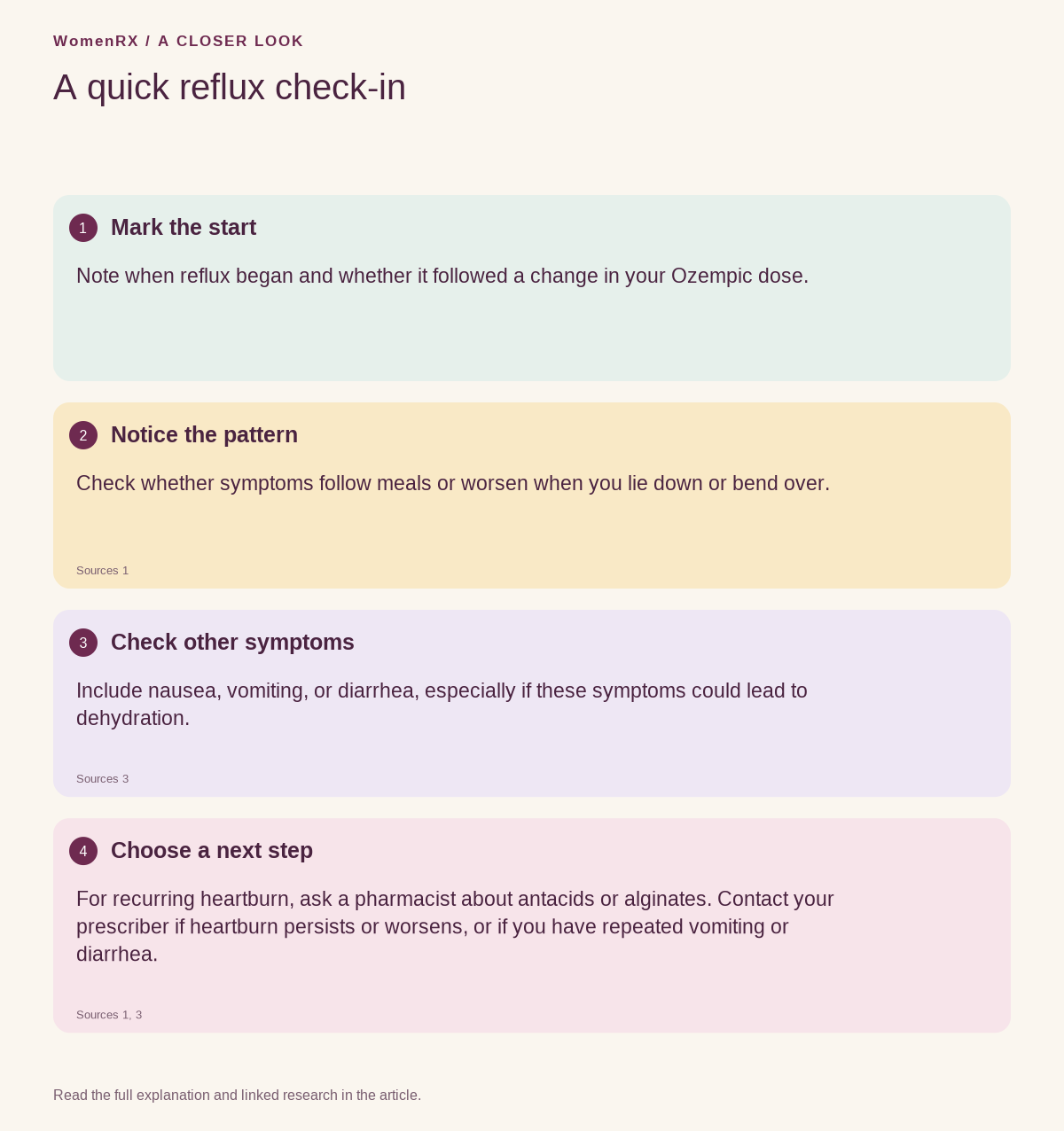
A quick reflux check-in
Mark the start: Note when reflux began and whether it followed a change in your Ozempic dose.
Notice the pattern: Check whether symptoms follow meals or worsen when you lie down or bend over.1
Check other symptoms: Include nausea, vomiting, or diarrhea, especially if these symptoms could lead to dehydration.3
Choose a next step: For recurring heartburn, ask a pharmacist about antacids or alginates. Contact your prescriber if heartburn persists or worsens, or if you have repeated vomiting or diarrhea.13
Read the figure as text
Use this simple sequence to organize what changed and decide what to raise with your prescriber. It is not a diagnostic tool.- Mark the start: Note when reflux began and whether it followed a change in your Ozempic dose.
- Notice the pattern: Check whether symptoms follow meals or worsen when you lie down or bend over.1
- Check other symptoms: Include nausea, vomiting, or diarrhea, especially if these symptoms could lead to dehydration.3
- Choose a next step: For recurring heartburn, ask a pharmacist about antacids or alginates. Contact your prescriber if heartburn persists or worsens, or if you have repeated vomiting or diarrhea.13
More questions, answered
Does heartburn mean Ozempic is causing a serious problem?
Not by itself. GERD is listed among reported Ozempic reactions. A pharmacist can advise you about recurring heartburn, including whether an antacid or alginate might help. Discuss persistent or worsening symptoms with your prescriber. 13
Can I use reflux rates for oral semaglutide to estimate my Ozempic risk?
No. Oral semaglutide tablets and Ozempic injection are different products, and their product-specific data shouldn’t be treated as interchangeable. 23
Sources you can check
- Heartburn and acid reflux - NHSAccessed 2026-09-25Return to first citation
- OZEMPIC (ORAL SEMAGLUTIDE) TABLET RYBELSUS (ORAL SEMAGLUTIDE) TABLET [NOVO NORDISK PHARMACEUTICAL INDUSTRIES, LP] | US prescribing information and patient instructionsAccessed 2026-09-25Return to first citation
- OZEMPIC (SEMAGLUTIDE) INJECTION, SOLUTION [A-S MEDICATION SOLUTIONS] | US prescribing information and patient instructionsAccessed 2026-09-25Return to first citation
- Multi-Database Pharmacovigilance Analysis of Gastroesophageal Reflux Disease Associated with GLP-1 Receptor Agonists: A Cross-National Signal Validation Study.Choi JG, Gong EJ, Bang CS, Lee JJ. · Gut and liver · 2026Return to first citation
- Harnessing Facebook to Investigate Real-World Mentions of Adverse Events of Glucagon-Like Peptide-1 Receptor Agonist (GLP-1 RA) Medications: Observational Study of Facebook Posts From 2022 to 2024.Alibilli AS, Jain V, Mane H, Yue X, Ratzki-Leewing A, Merchant JS, Criss S, Nguyen QC, McCoy RG, Nguyen TT. · JMIR infodemiology · 2025Return to first citation