Heartburn While Taking Zepbound: What to Check
Reflux was reported more often with Zepbound than placebo in weight-management trials, but the reported rates don’t tell you what’s causing your symptoms.
In two weight-management trials, gastroesophageal reflux disease was reported in 4% to 5% of adults taking Zepbound, compared with 2% taking placebo. That makes reflux a recognized reported side effect, but it doesn’t prove Zepbound is the cause of your heartburn. Note when symptoms occur and whether they began after starting or changing treatment, then share that pattern with your prescriber. 2
What the Zepbound trials show
The US prescribing information lists gastroesophageal reflux disease among adverse reactions reported in the two placebo-controlled weight-reduction trials. It was reported by 4% of participants taking 5 mg, 4% taking 10 mg, and 5% taking 15 mg of Zepbound, compared with 2% taking placebo. The trial participants were adults with obesity or overweight in weight-reduction and long-term maintenance studies. 2
These figures are the share of participants who had the reported adverse event during the trials. They aren’t a prediction of your personal risk, and the label’s term, “gastroesophageal reflux disease,” isn’t an exact count of every brief episode of heartburn. The rates also don’t show a simple increase at every dose step: the reported percentage was the same at 5 mg and 10 mg, then slightly higher at 15 mg. 2
So, reflux is worth raising with your prescriber, especially if it started after treatment began or changed alongside other symptoms. But the trial figures alone can’t determine whether Zepbound, an existing reflux tendency, meals, or another factor explains what you’re feeling.
Look for the pattern, not just the label
Heartburn often feels like burning in the middle of the chest; reflux can also leave a sour taste in the mouth. Symptoms may be worse after eating, when lying down, or when bending over. Those details can help distinguish an occasional meal-related episode from a pattern that’s becoming frequent or disruptive. 1
Before you contact your prescriber, it may help to jot down:
- When the burning or sour taste happens, and how often.
- Whether it follows meals, lying down, or bending over.
- Whether it started after beginning Zepbound or after a treatment change.
- Whether you’re also having nausea, vomiting, or other digestive symptoms.
This isn’t a diagnostic checklist. It’s a way to give your prescriber a clearer picture than “I have heartburn.” The Zepbound trial table also reports nausea, vomiting, indigestion, and belching more often with treatment than with placebo, but it doesn’t establish that these symptoms cause reflux. 2
What may help while you sort it out
Smaller, more frequent meals are one general measure that may ease heartburn. It can also be useful to notice whether symptoms reliably follow meals or lying down, since those are common patterns with reflux. These are general reflux measures, not proof that a particular eating change will address a Zepbound-related side effect. 1
If you’re considering an over-the-counter product or a change to your treatment, ask your prescriber or pharmacist what fits your situation. Don’t assume that a general reflux suggestion is a Zepbound-specific recommendation. Your prescriber can consider how bothersome the symptoms are, when they began, and the rest of your treatment picture.
When to get in touch
Contact your prescriber if reflux keeps recurring or is getting worse. General reflux guidance recommends seeking advice for recurring heartburn and contacting a doctor if symptoms worsen. 1 If you’re pregnant, trying to become pregnant, or breastfeeding, mention that when discussing Zepbound and reflux so your care can be considered individually. The trial table does not report a women-specific reflux rate, and it doesn’t answer pregnancy- or breastfeeding-specific questions. 2
The most useful question for your prescriber is specific: “My symptoms began around this time, happen this often, and are worse in these situations. Could they be related to Zepbound, and what should I do next?”
From reflux symptoms to a useful conversation
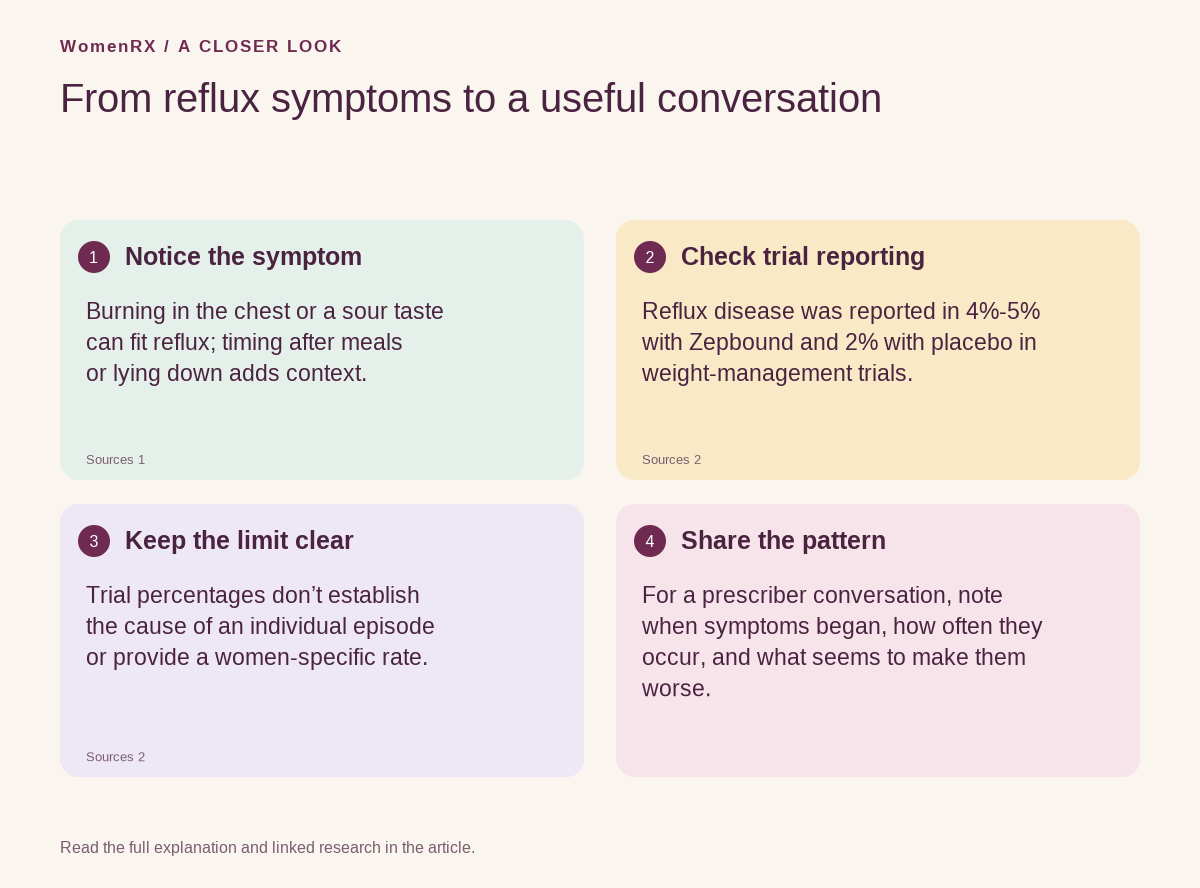
Notice the symptom: Burning in the chest or a sour taste can fit reflux; timing after meals or lying down adds context.1
Check trial reporting: Reflux disease was reported in 4%-5% with Zepbound and 2% with placebo in weight-management trials.2
Keep the limit clear: Trial percentages don’t establish the cause of an individual episode or provide a women-specific rate.2
Share the pattern: For a prescriber conversation, note when symptoms began, how often they occur, and what seems to make them worse.
Read the figure as text
Separate the symptom pattern from what the Zepbound trials can establish, then identify what to discuss with your prescriber.- Notice the symptom: Burning in the chest or a sour taste can fit reflux; timing after meals or lying down adds context.1
- Check trial reporting: Reflux disease was reported in 4%-5% with Zepbound and 2% with placebo in weight-management trials.2
- Keep the limit clear: Trial percentages don’t establish the cause of an individual episode or provide a women-specific rate.2
- Share the pattern: For a prescriber conversation, note when symptoms began, how often they occur, and what seems to make them worse.
Sources you can check
- Heartburn and acid reflux - NHSAccessed 2026-09-25Return to first citation
- ZEPBOUND (TIRZEPATIDE) INJECTION, SOLUTION ZEPBOUND (TIRZEPATIDE) INJECTION, SOLUTION ZEPBOUND KWIKPEN (TIRZEPATIDE) INJECTION, SOLUTION [ELI LILLY AND COMPANY] | US prescribing information and patient instructionsAccessed 2026-09-25Return to first citation