Tirzepatide Weight Loss: What Changes After the First Month?
The first few weeks aren’t a reliable preview of your eventual weight change, because tirzepatide results are measured over months, not as a guaranteed amount lost each month.
There’s no dependable amount of weight you can expect to lose in your first month on tirzepatide. In a trial analysis, week 8 was an early checkpoint after participants had spent four weeks receiving 5 mg and were scheduled for dose escalation. Both early-response groups had weight reductions by week 72, but those group results aren’t a personal forecast or monthly target. 3
Why month one can be hard to interpret
A monthly number can sound reassuringly clear, but it can make treatment look more predictable than it is. Your weight can include changes in water as well as fat and muscle, and the scale doesn’t tell the whole story. 2 Tirzepatide weight changes are better understood as a trend over time than as a promised amount for each month.
A post hoc analysis of two phase 3 trials used week 8 as an early-response checkpoint. In those trials, participants had been receiving 5 mg for four weeks by week 8 and were scheduled for dose escalation. That describes the trial’s standardized treatment exposure, not a universal schedule for every person taking tirzepatide. Participants who had lost at least 5% of their starting weight by the checkpoint were classified as early responders; those below 5% were classified as non-early responders. That cutoff was used to study patterns. It is not a pass/fail test for an individual or a reason to change treatment on your own. 3
The longer-term results tell a different story
The same analysis found weight reductions from baseline through week 72 in both response groups. On average, early responders lost more by week 72 than non-early responders. For example, among participants without type 2 diabetes in the study’s 10 mg group, average reductions were 25.3% for early responders and 14.8% for non-early responders. These are study-group averages, not a prediction for you, and they don’t mean that weight comes off at the same rate each month. 3
The analysis included participants with overweight or obesity, with and without type 2 diabetes. It was a post hoc look at trial data, so its week-8 categories help describe patterns but can’t tell you exactly what your own results will be. 3
To make a percentage easier to picture, as an example, 5% of a starting weight of 200 pounds is 10 pounds. At follow-up, you might find it useful to look at your weight as a percentage change from your own starting point, alongside how you’re feeling and any side effects. A simple record of your starting weight, later measurements, treatment stage, and side effects can make the conversation more specific than a single monthly number. This is a tracking aid, not a required scorecard.
What to discuss at follow-up
Bring the trend, not just the latest weigh-in. You can ask whether your weight change and side effects fit the treatment plan, and what factors might affect the next steps. Don’t increase or otherwise change your treatment based on a monthly target from someone else’s experience.
If you’re pregnant or planning a pregnancy while using Zepbound, raise that with your healthcare provider. The Zepbound medication guide says it may harm an unborn baby and advises telling your healthcare provider if you’re pregnant or plan to become pregnant. 1
There’s also a practical birth-control detail: Zepbound may make oral hormonal contraceptives work less well. Its prescribing information advises using a non-oral method or adding a barrier method for four weeks after starting treatment and for four weeks after each dose increase. 1
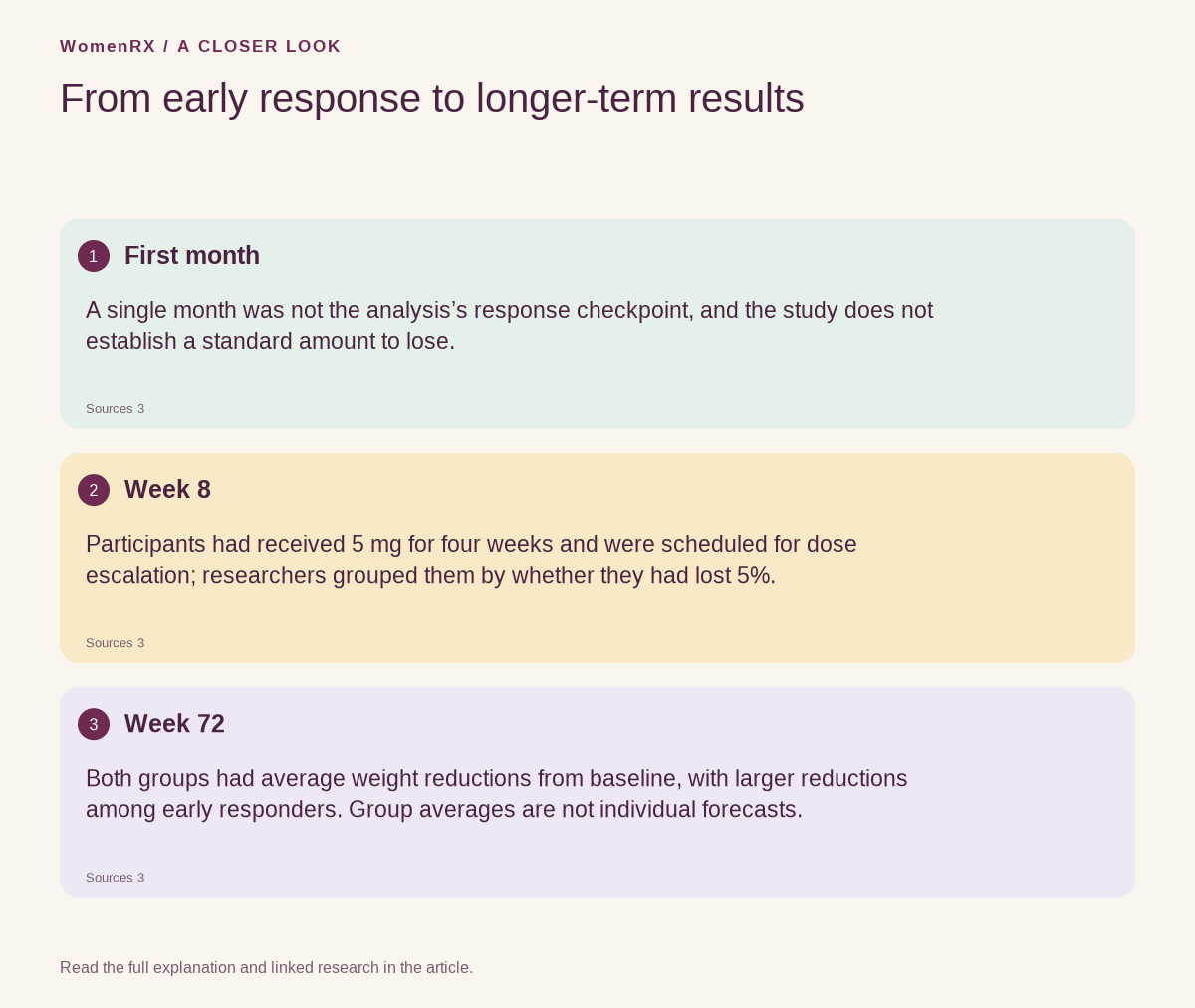
From early response to longer-term results
First month: A single month was not the analysis’s response checkpoint, and the study does not establish a standard amount to lose.3
Week 8: Participants had received 5 mg for four weeks and were scheduled for dose escalation; researchers grouped them by whether they had lost 5%.3
Week 72: Both groups had average weight reductions from baseline, with larger reductions among early responders. Group averages are not individual forecasts.3
Read the figure as text
This timeline separates the trial’s early checkpoint from its later outcome period and shows the treatment exposure at week 8. It describes trial measurements, not a personal dosing plan.- First month: A single month was not the analysis’s response checkpoint, and the study does not establish a standard amount to lose.3
- Week 8: Participants had received 5 mg for four weeks and were scheduled for dose escalation; researchers grouped them by whether they had lost 5%.3
- Week 72: Both groups had average weight reductions from baseline, with larger reductions among early responders. Group averages are not individual forecasts.3
More questions, answered
Does losing less than 5% by week 8 mean tirzepatide won’t work for me?
No. In a post hoc analysis, participants below the 5% week-8 cutoff still had weight reductions by week 72. The cutoff separated groups for analysis; it wasn’t a test of whether treatment would work for an individual. 3
Should I judge progress by pounds or percentage?
Percentage change puts weight change in context of your own starting weight. For example, 10 pounds is 5% of a 200-pound starting weight. The scale is still only one part of the picture. 2
Sources you can check
- ZEPBOUND (TIRZEPATIDE) INJECTION, SOLUTION ZEPBOUND (TIRZEPATIDE) INJECTION, SOLUTION ZEPBOUND KWIKPEN (TIRZEPATIDE) INJECTION, SOLUTION [ELI LILLY AND COMPANY] | US prescribing information and patient instructionsAccessed 2026-09-25Return to first citation
- Body Weight: MedlinePlusAccessed 2026-09-25Return to first citation
- Tirzepatide Efficacy and Tolerability According to Early Weight Response: A Post Hoc Analysis of the SURMOUNT-1 and SURMOUNT-2 Trials.Kokkinos A, Thethi T, Lee CJ, Neff LM, Stefanski A, Cao D, Rodriguez A, Bartee A. · Diabetes, obesity & metabolism · 2026Return to first citation