What to Expect From Weight Change in Zepbound’s First Month
A first-month scale reading is an early snapshot, while tirzepatide studies measure response after more treatment time.
There isn’t a dependable amount you should expect to lose in your first month on Zepbound. The scale includes water and other body tissues, not just fat. A tirzepatide trial analysis used week 8 as an early checkpoint, after participants had received 5 mg for four weeks, then followed outcomes through week 72. Those later group results can’t forecast your first month. 23
Why a first-month number can mislead
It’s natural to want an early sign that treatment is working. But there’s no dependable first-month amount to use as a personal target. A scale reading measures total body weight, which includes water, muscle, and bone as well as fat; everyday factors, including diet, can affect it too. One weigh-in can’t show which part changed. 2
That doesn’t mean your early experience is irrelevant. It means a single number is a limited snapshot, not a verdict on whether Zepbound will work for you. Whether your first-month change seems striking or barely visible, it can’t reliably forecast your longer-term result.
Early treatment and later outcomes are different windows
A post hoc analysis of two phase 3 trials looked at weight response at week 8, not at the end of the first month. By week 8, participants had received tirzepatide 5 mg for four weeks and were scheduled for dose escalation. Researchers grouped them by whether they had lost at least 5% of body weight at that checkpoint, then followed outcomes through week 72. Both groups lost weight over the longer study period, though the early-response group lost more on average. This makes week 8 a different treatment and measurement window from your first month, not a first-month target or a prediction for you. 3
The Zepbound prescribing information also presents weight-change results over 72 weeks. A result measured across that much time can’t be divided into a reliable monthly expectation: people’s early changes and longer-term results aren’t interchangeable. 1
So, if your first month doesn’t match a number you saw online, that alone doesn’t tell you what your eventual result will be. Your prescriber can interpret your progress alongside your treatment course and how you’re feeling, rather than judging it against a promised monthly pace.
What to bring to your follow-up
A short, useful update is more helpful than trying to explain every scale fluctuation. Consider bringing:
- Your treatment start date and the dose schedule you were given.
- A few recent weights, if you’ve been tracking them, with enough context to interpret the trend rather than just the highest or lowest reading.
- How treatment has affected your appetite, eating, and day-to-day well-being, including any symptoms that are making it hard to continue.
- Other medications or supplements you take, and any questions about how the treatment fits with your care.
- Whether you’re pregnant, planning a pregnancy, or breastfeeding.
You can also ask when your prescriber wants to review progress and what information they’ll use to assess it. That gives you a shared plan without turning one early number into a pass-or-fail test.
Pregnancy and breastfeeding belong in the review
Tell your prescriber if you’re pregnant or planning a pregnancy. Zepbound’s prescribing information says weight loss offers no benefit during pregnancy and may cause fetal harm; available human data are insufficient to evaluate medication-related pregnancy risks. It says to discontinue Zepbound when pregnancy is recognized. 1
Also bring up breastfeeding as part of the medication review. Ask about breastfeeding specifically; pregnancy guidance doesn’t answer that separate question.
The practical takeaway: use the first month to notice your experience and share useful context, not to grade your future results. A longer view and a conversation tailored to your situation are more informative than a monthly number taken on its own.
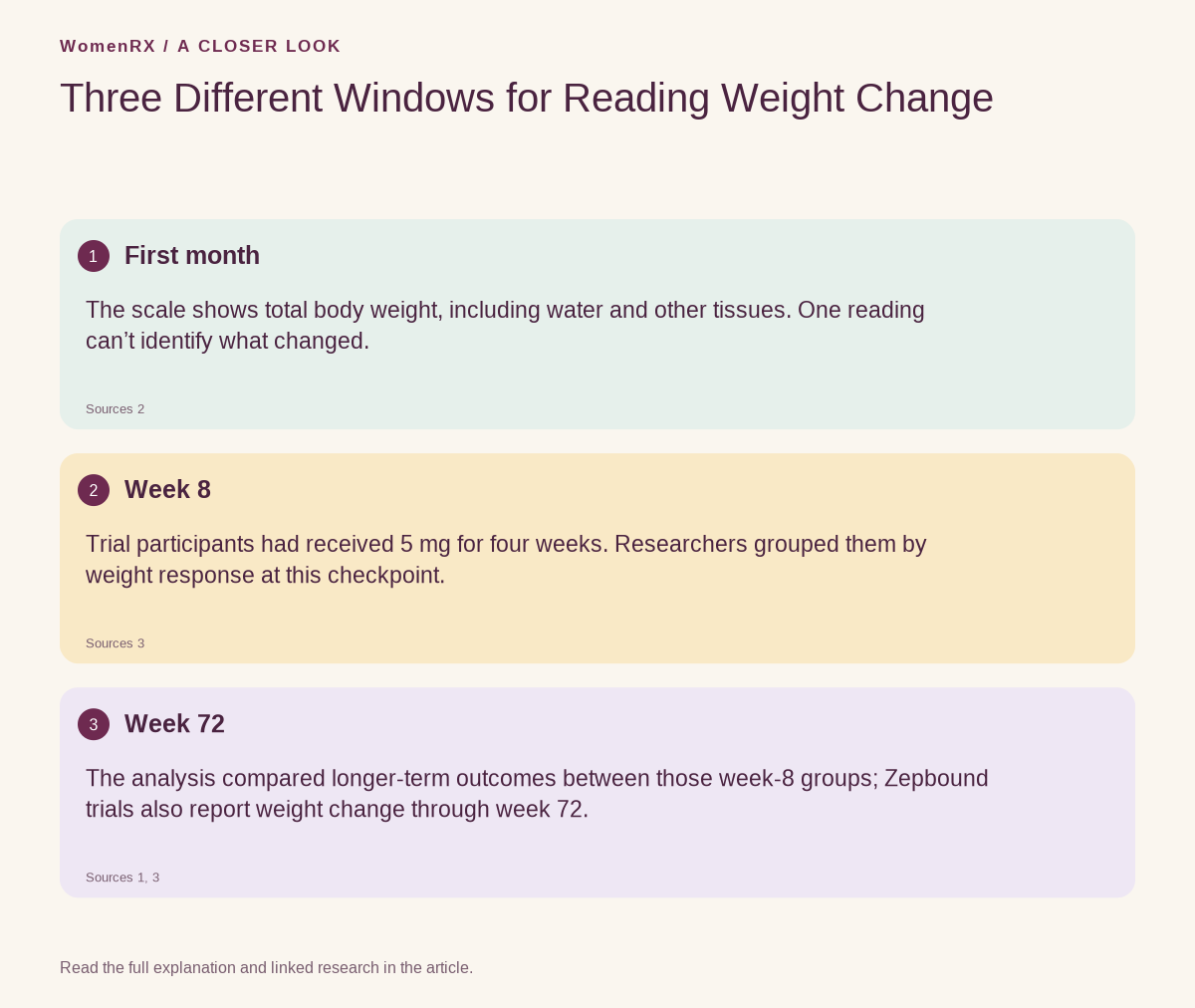
Three Different Windows for Reading Weight Change
First month: The scale shows total body weight, including water and other tissues. One reading can’t identify what changed.2
Week 8: Trial participants had received 5 mg for four weeks. Researchers grouped them by weight response at this checkpoint.3
Week 72: The analysis compared longer-term outcomes between those week-8 groups; Zepbound trials also report weight change through week 72.13
Read the figure as text
A first-month scale reading comes before the trial’s week-8 treatment checkpoint; neither is the same as a 72-week outcome.- First month: The scale shows total body weight, including water and other tissues. One reading can’t identify what changed.2
- Week 8: Trial participants had received 5 mg for four weeks. Researchers grouped them by weight response at this checkpoint.3
- Week 72: The analysis compared longer-term outcomes between those week-8 groups; Zepbound trials also report weight change through week 72.13
More questions, answered
Does losing little in the first month mean Zepbound won’t work?
Not by itself. A trial analysis compared weight response at week 8 and found that participants who had not reached the analysis’s early-response threshold still lost weight through week 72 on average. That group result can’t predict your individual outcome, but it does show why one early checkpoint isn’t the whole story. 3
Should I weigh myself every day to see whether it’s working?
A single reading can’t separate fat from water or other parts of body weight, and everyday factors can affect the scale. If you track weight, bring a trend rather than relying on one reading; ask your prescriber what follow-up approach makes sense for you. 2
Sources you can check
- ZEPBOUND (TIRZEPATIDE) INJECTION, SOLUTION ZEPBOUND (TIRZEPATIDE) INJECTION, SOLUTION ZEPBOUND KWIKPEN (TIRZEPATIDE) INJECTION, SOLUTION [ELI LILLY AND COMPANY] | US prescribing information and patient instructionsAccessed 2026-09-25Return to first citation
- Body Weight: MedlinePlusAccessed 2026-09-25Return to first citation
- Tirzepatide Efficacy and Tolerability According to Early Weight Response: A Post Hoc Analysis of the SURMOUNT-1 and SURMOUNT-2 Trials.Kokkinos A, Thethi T, Lee CJ, Neff LM, Stefanski A, Cao D, Rodriguez A, Bartee A. · Diabetes, obesity & metabolism · 2026Return to first citation