What Your First Month on Mounjaro Can (and Can't) Tell You
A month gives you an early snapshot, not a reliable forecast of where your weight will go.
A month on Mounjaro can show what has happened so far, but it can’t predict your eventual weight change. In tirzepatide trials, treatment began at a starting dose and increased every four weeks, while outcomes were assessed over much longer periods. Starting circumstances also differed, and menstrual-cycle fluid changes can affect a short-term scale comparison for some women. 3 2
Month one is a snapshot, not a promise
It’s natural to look at the scale after a few weeks and wonder whether your progress is “enough.” But a single month can’t tell you how much weight you’ll lose later, or whether your treatment is working as intended. It records one short stretch during a changing treatment period.
In the SURMOUNT-1 and SURMOUNT-2 trials, people taking tirzepatide started at 2.5 mg once weekly, then increased their dose every four weeks until they reached their assigned study dose. The researchers used week eight as an early-response checkpoint because participants had then spent four weeks at 5 mg. That study schedule helps explain why the first month wasn’t treated as a complete test of longer-term results. 3
Those trials followed participants for 72 weeks. They included people with overweight or obesity, with and without type 2 diabetes. Their results describe those study groups over time, not a guaranteed monthly amount for every person prescribed Mounjaro. 3
Your starting point changes the comparison
A percentage change depends on the weight you started from: the same number of pounds represents a different share of two different starting weights. Health circumstances matter to interpretation, too. The tirzepatide trials included a group without type 2 diabetes and another with type 2 diabetes, so their participants didn’t all begin from the same clinical situation. 3
A post hoc analysis of those trials also found that people who had lost at least 5% by week eight tended, on average, to have greater weight reduction by week 72 than those below that threshold. But that week-eight cutoff was a way researchers grouped participants for analysis. It is not a one-month goal or a rule for judging an individual’s treatment. Both groups had clinically meaningful weight reduction at week 72. 3
The practical takeaway: compare your own measurements with your own starting point, and interpret them alongside your dose stage and health context. Don’t use a study-group average as a personal deadline.
A weigh-in can reflect fluid, too
For some women who menstruate, cycle timing can make two weigh-ins harder to compare. In a study of 42 women measured twice weekly across a menstrual cycle, average weight during menstruation was about 0.45 kg higher than in the first week of the cycle. The researchers also measured an increase in extracellular water. This small study doesn’t mean everyone’s weight changes this way, but it shows how fluid can affect a short-term reading. 2
If your first-month weigh-in falls around menstruation, note that as context rather than assuming the change represents fat loss or gain. The study examined cycle-related measurements, not whether cycle phase changes response to tirzepatide. 2
Make the follow-up comparison more useful
Bring the details that help put the number in context: your starting weight, the dates of your measurements, your current dose stage, and any relevant change in your health circumstances. If you menstruate and notice a recurring pattern, you can note where in your cycle the weigh-ins fell. These details can help make a short-term comparison less dependent on one number.
Useful questions include: “How should we interpret my change at this stage of the dose schedule?” and “When will we review my progress over a longer interval?” If side effects are affecting your ability to eat or drink, mention that too. The U.S. medication guide advises telling your healthcare provider about severe or persistent stomach problems, or nausea, vomiting, or diarrhea that does not go away. 1
The first month matters as a record of how treatment is starting. It just isn’t a forecast. A longer view, interpreted in light of your starting point and treatment stage, is more informative than treating one early weigh-in as a verdict.
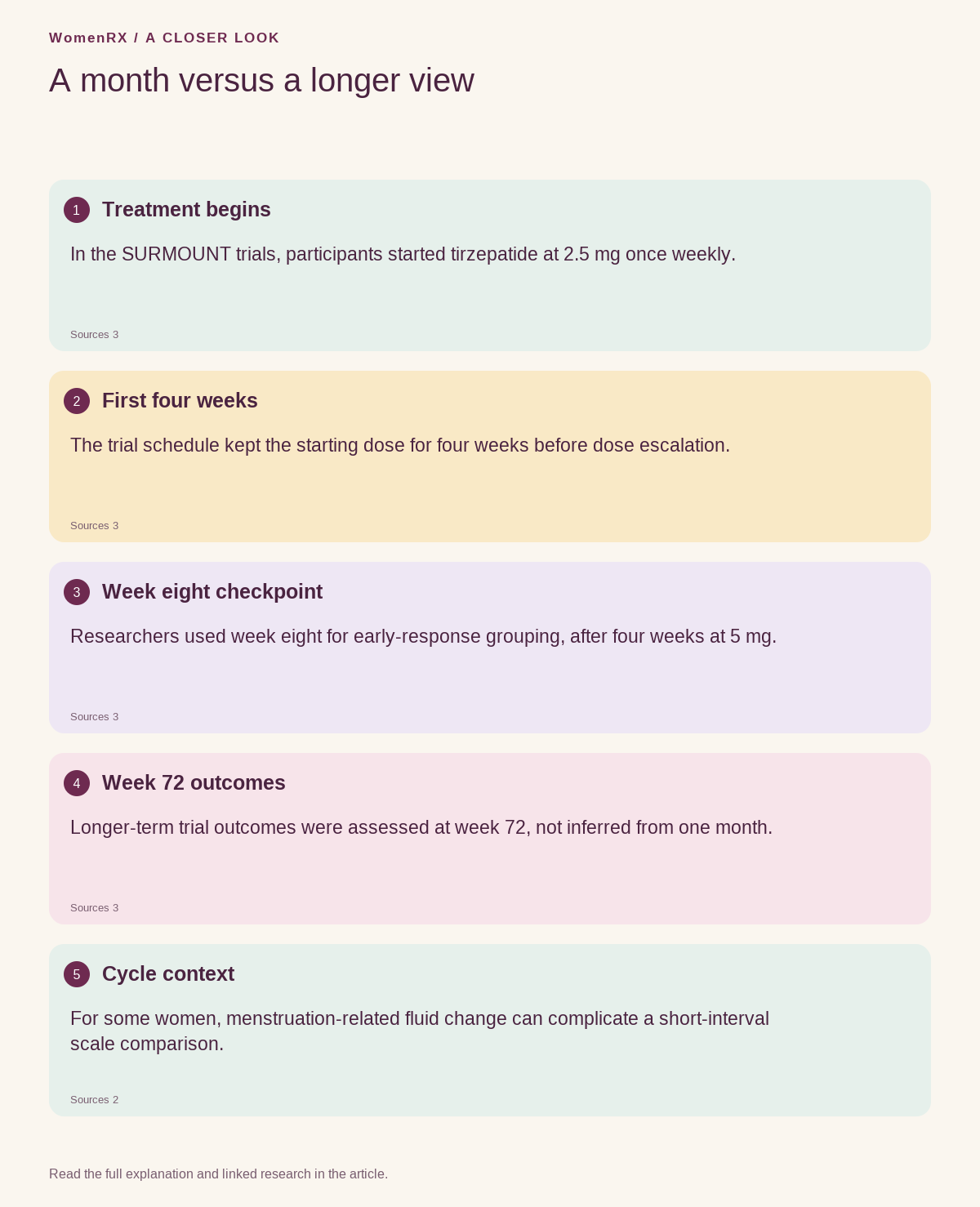
A month versus a longer view
Treatment begins: In the SURMOUNT trials, participants started tirzepatide at 2.5 mg once weekly.3
First four weeks: The trial schedule kept the starting dose for four weeks before dose escalation.3
Week eight checkpoint: Researchers used week eight for early-response grouping, after four weeks at 5 mg.3
Week 72 outcomes: Longer-term trial outcomes were assessed at week 72, not inferred from one month.3
Cycle context: For some women, menstruation-related fluid change can complicate a short-interval scale comparison.2
Read the figure as text
This trial-based timeline shows why the first month is an early treatment snapshot, not a forecast of longer-term weight change.- Treatment begins: In the SURMOUNT trials, participants started tirzepatide at 2.5 mg once weekly.3
- First four weeks: The trial schedule kept the starting dose for four weeks before dose escalation.3
- Week eight checkpoint: Researchers used week eight for early-response grouping, after four weeks at 5 mg.3
- Week 72 outcomes: Longer-term trial outcomes were assessed at week 72, not inferred from one month.3
- Cycle context: For some women, menstruation-related fluid change can complicate a short-interval scale comparison.2
More questions, answered
Does little weight change in the first month mean tirzepatide won’t work for me?
Not by itself. The available trial analysis assessed early response at week eight and longer-term outcomes at week 72; it doesn’t establish a first-month cutoff that predicts an individual’s result. The week-eight grouping was a research analysis, not a personal pass-or-fail target. 3
Can my menstrual cycle affect what the scale shows?
It can for some people. One study of 42 women found average weight was about 0.45 kg higher during menstruation than in the first week of the cycle, alongside increased extracellular water. That finding is a possible source of short-term variation, not a prediction for every woman or evidence about medication response. 2
Sources you can check
- MOUNJARO (TIRZEPATIDE) INJECTION, SOLUTION MOUNJARO KWIKPEN (TIRZEPATIDE) INJECTION, SOLUTION [ELI LILLY AND COMPANY] | US prescribing information and patient instructionsAccessed 2026-09-25Return to first citation
- Changes in body weight and body composition during the menstrual cycle.Kanellakis S, Skoufas E, Simitsopoulou E, Migdanis A, Migdanis I, Prelorentzou T, Louka A, Moschonis G, Bountouvi E, Androutsos O. · American journal of human biology : the official journal of the Human Biology Council · 2023Return to first citation
- Tirzepatide Efficacy and Tolerability According to Early Weight Response: A Post Hoc Analysis of the SURMOUNT-1 and SURMOUNT-2 Trials.Kokkinos A, Thethi T, Lee CJ, Neff LM, Stefanski A, Cao D, Rodriguez A, Bartee A. · Diabetes, obesity & metabolism · 2026Return to first citation