What One Month on Semaglutide Can Tell You
A month of weigh-ins can show an early pattern, but it can’t predict your eventual weight loss.
After one month, the most useful clues are whether your measurements are comparable and what stage of treatment you’re in, not whether you’ve reached a particular number. Semaglutide weight-loss research follows people over many months, and some Wegovy studies included weeks of dose escalation before longer follow-up. A single month is early evidence, not a verdict. 1
A month is a snapshot, not a forecast
It’s natural to look for a clear sign that treatment is working. But a month of scale readings can’t reliably predict your longer-term result. Your weight includes water, muscle, bone, and fat, so a change on the scale doesn’t tell you exactly what changed. 2
The longer timelines in semaglutide research help put that first month in perspective. Wegovy studies assessed weight over 68 weeks; in one study, participants had a 20-week run-in that included 16 weeks of dose escalation before randomization. That’s a specific study design for Wegovy injection, not a promise about what you should lose or a schedule that applies to every semaglutide product. 1
A time-course model built from trials in adults with type 2 diabetes also treated weight change as a response that can develop over time, rather than a result fully captured by an early weigh-in. It was a model, not a month-by-month prediction for an individual. 3
Make the comparison fair
If you’re weighing yourself, try to compare like with like. Use the same scale in the same place, and weigh under similar conditions each time. A simple weekly log can be easier to interpret than reacting to every daily change. These are practical ways to make readings more comparable, not a validated test of whether the medication is working.
Alongside the number, record a few details that could change how you interpret it:
- Treatment context: Note the product you’re taking and whether you’re still following its dose-escalation plan. Don’t compare your first month on one formulation with results from a trial of another.
- Measurement context: Keep the time and conditions similar, and note anything that made a reading less comparable.
- Your experience: Briefly note appetite, eating patterns, or side effects if they’re relevant to how treatment is going. This adds context; it doesn’t replace the scale or establish a medical response.
- Cycle timing, if useful: If you menstruate and notice short-term weight changes around your period, jotting down cycle timing may help you see whether that pattern repeats. Water is part of what the scale measures, so a short-term change needn’t represent a change in body fat. 2 Your log cannot show that semaglutide has a predictable cycle-related effect.
Weight is only one measure of health, and the scale can’t distinguish fat from muscle or water. 2 A log is most useful when it helps you and your prescriber review a pattern alongside your treatment stage and how you’re feeling, rather than treating one reading as a pass or fail.
What to bring into a progress conversation
At your next check-in, a practical summary is: your starting weight, the dates and conditions of your measurements, your current stage of treatment, and any changes or difficulties you’ve noticed. Ask how your progress should be interpreted for the specific product and treatment plan you’re using, and what timeframe makes sense before drawing conclusions.
If the numbers are flat or moving unevenly after a month, that alone doesn’t establish that treatment will or won’t work for you. The available time-course model describes group-level patterns in adults with type 2 diabetes; it can’t predict one person’s result, and it isn’t a direct comparison of every semaglutide formulation. 3
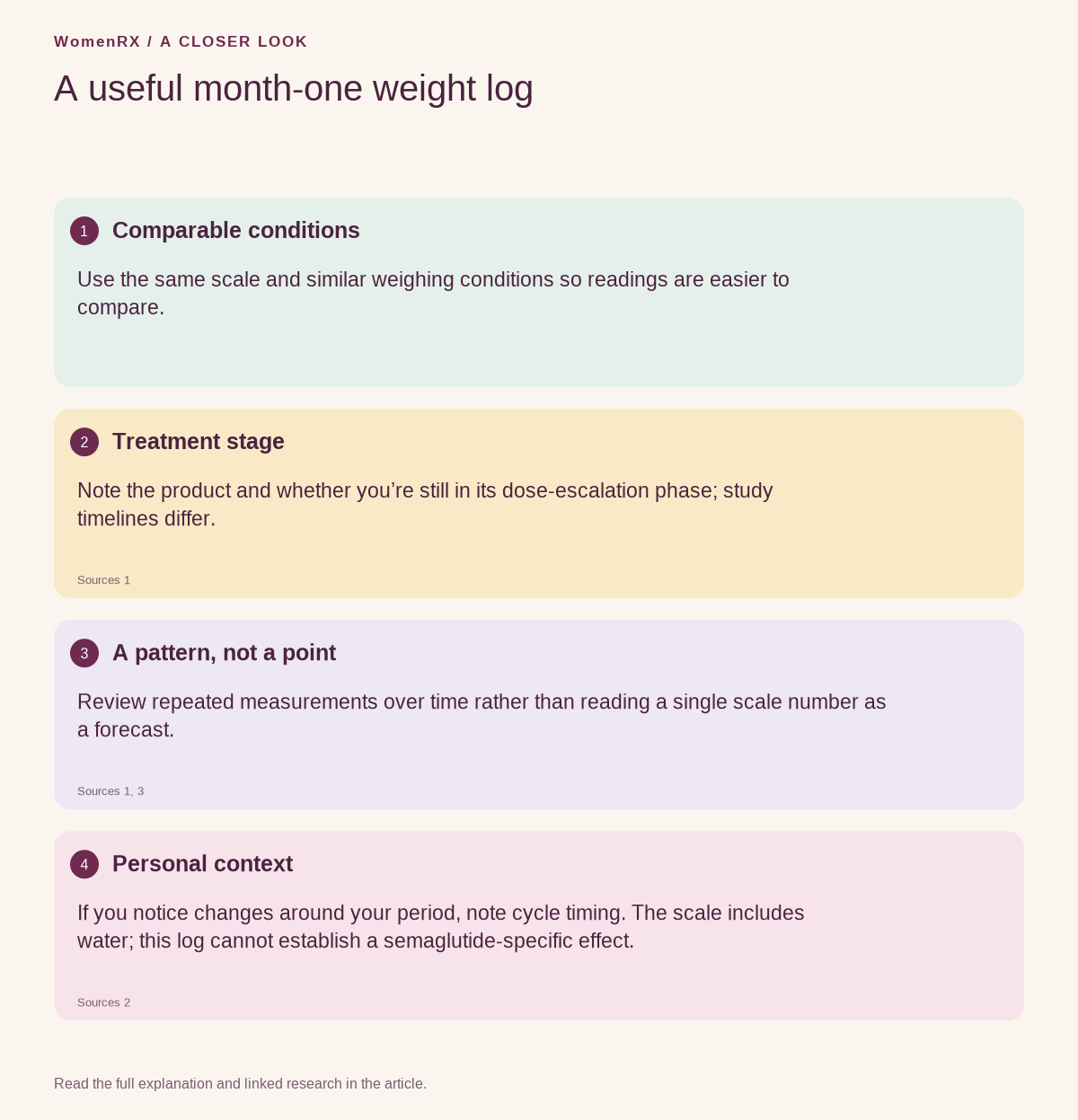
A useful month-one weight log
Comparable conditions: Use the same scale and similar weighing conditions so readings are easier to compare.
Treatment stage: Note the product and whether you’re still in its dose-escalation phase; study timelines differ.1
A pattern, not a point: Review repeated measurements over time rather than reading a single scale number as a forecast.13
Personal context: If you notice changes around your period, note cycle timing. The scale includes water; this log cannot establish a semaglutide-specific effect.2
Read the figure as text
Record enough context to compare measurements fairly without treating one weigh-in as a treatment verdict.- Comparable conditions: Use the same scale and similar weighing conditions so readings are easier to compare.
- Treatment stage: Note the product and whether you’re still in its dose-escalation phase; study timelines differ.1
- A pattern, not a point: Review repeated measurements over time rather than reading a single scale number as a forecast.13
- Personal context: If you notice changes around your period, note cycle timing. The scale includes water; this log cannot establish a semaglutide-specific effect.2
More questions, answered
Should I compare my progress with a semaglutide weight-loss percentage online?
Be cautious about comparing a one-month change with a percentage reported after a much longer study. The timeframe, study population, treatment product, and dose-escalation period affect what those results mean. The Wegovy trial details cited here are product- and study-specific, not a personal month-one target. 1
Sources you can check
- WEGOVY (SEMAGLUTIDE) INJECTION, SOLUTION WEGOVY (SEMAGLUTIDE) TABLET [NOVO NORDISK PHARMACEUTICAL INDUSTRIES, LP] | US prescribing information and patient instructionsAccessed 2026-09-25Return to first citation
- Body Weight: MedlinePlusAccessed 2026-09-25Return to first citation
- A model-based simulation of glycaemic control and body weight when switching from semaglutide to 3.0- and 4.5-mg doses of once-weekly dulaglutide.Tham LS, Pantalone KM, Dungan K, Munir K, Tang CC, Konig M, Kwan AYM. · Diabetes, obesity & metabolism · 2022Return to first citation