What One Month on Ozempic Can Tell You About Weight
An early scale reading shows what’s changed so far, not what you’ll lose over the course of treatment.
The first month can tell you how your scale weight has changed, but it can’t give you a dependable personal forecast. Ozempic trial results report group averages after months of treatment, while a scale reading includes water as well as body fat. Neither tells you how many pounds you should have lost after four weeks or what will happen next. 41
Why the first month isn’t a monthly forecast
It’s natural to look at your first month’s weigh-in and wonder whether treatment is working. But weight change doesn’t arrive in equal monthly installments. In a model built from semaglutide trials in people with type 2 diabetes, researchers simulated weight changes through 26 weeks, including an initial period of dose escalation. They didn’t treat the opening four weeks as the final pattern. That’s a model of trial data, not a rule for any one person. 2
There’s also a measurement issue. The number on the scale includes muscle, bone, fat, and water. For example, an unchanged reading on two mornings can’t tell you whether body fat stayed exactly the same: a change in water could affect the total. A single lower reading can’t tell you that every pound changed was body fat, either. 1
Check which semaglutide result you’re reading
Ozempic is a semaglutide injection used in adults with type 2 diabetes for the purposes described in its prescribing information. That doesn’t make every published semaglutide weight-loss figure an Ozempic result for your situation. 4
Here’s a product-specific comparison. In a 30-week trial of adults with type 2 diabetes whose blood sugar was inadequately controlled with diet and exercise, average weight fell by 3.8 kg with Ozempic 0.5 mg, 4.7 kg with Ozempic 1 mg, and 1.2 kg with placebo. Those are group averages measured at week 30, not first-month targets. The trial included women and men, but the weight results shown in the prescribing information weren’t broken out for women. 4
One other set of estimates comes from models using the SUSTAIN trials in people with type 2 diabetes. A separate body of research, the STEP program, studied semaglutide for obesity; a 2026 review reports different average weight-loss results for participants with and without type 2 diabetes. Wegovy injection is a semaglutide product with an indication for weight reduction in certain adults. Those obesity-program averages shouldn’t be divided into monthly targets or presented as a first-month Ozempic expectation. The product, study population, and point at which weight was measured all matter. 235
Even a figure that sounds closer to your circumstances may be a prediction rather than a directly observed average. For instance, one simulation based on semaglutide diabetes trials predicted mean losses from baseline of up to 3.44 kg and 4.96 kg at 26 weeks for two modeled semaglutide doses. These are group-level, model-predicted changes after roughly six months, not pounds a person should lose in month one. The analysis did not report a women-specific first-month outcome. 2
How to make sense of your own early reading
Treat the first month as one observation, not a pass-or-fail test. If you record your weight, comparing readings taken under similar conditions can make changes easier to interpret, though it won’t remove every influence on the scale. Look at the pattern over time rather than multiplying one month’s change to predict the next several months. 12
If you experience premenstrual water-retention symptoms, remember that water contributes to scale weight. A small study found differences in measured body water between women with those symptoms and women without PMS. It did not establish how much an individual’s weight changes across a cycle or test whether menstrual status changes semaglutide’s effect. 61
If an early change is very different from what you expected, the useful question is not “What number was I supposed to hit?” It’s “Which result am I comparing myself with: an Ozempic diabetes trial, a semaglutide obesity study, or someone else’s personal account?” The studies can offer context, but neither can turn your first month into a dependable prediction. 43
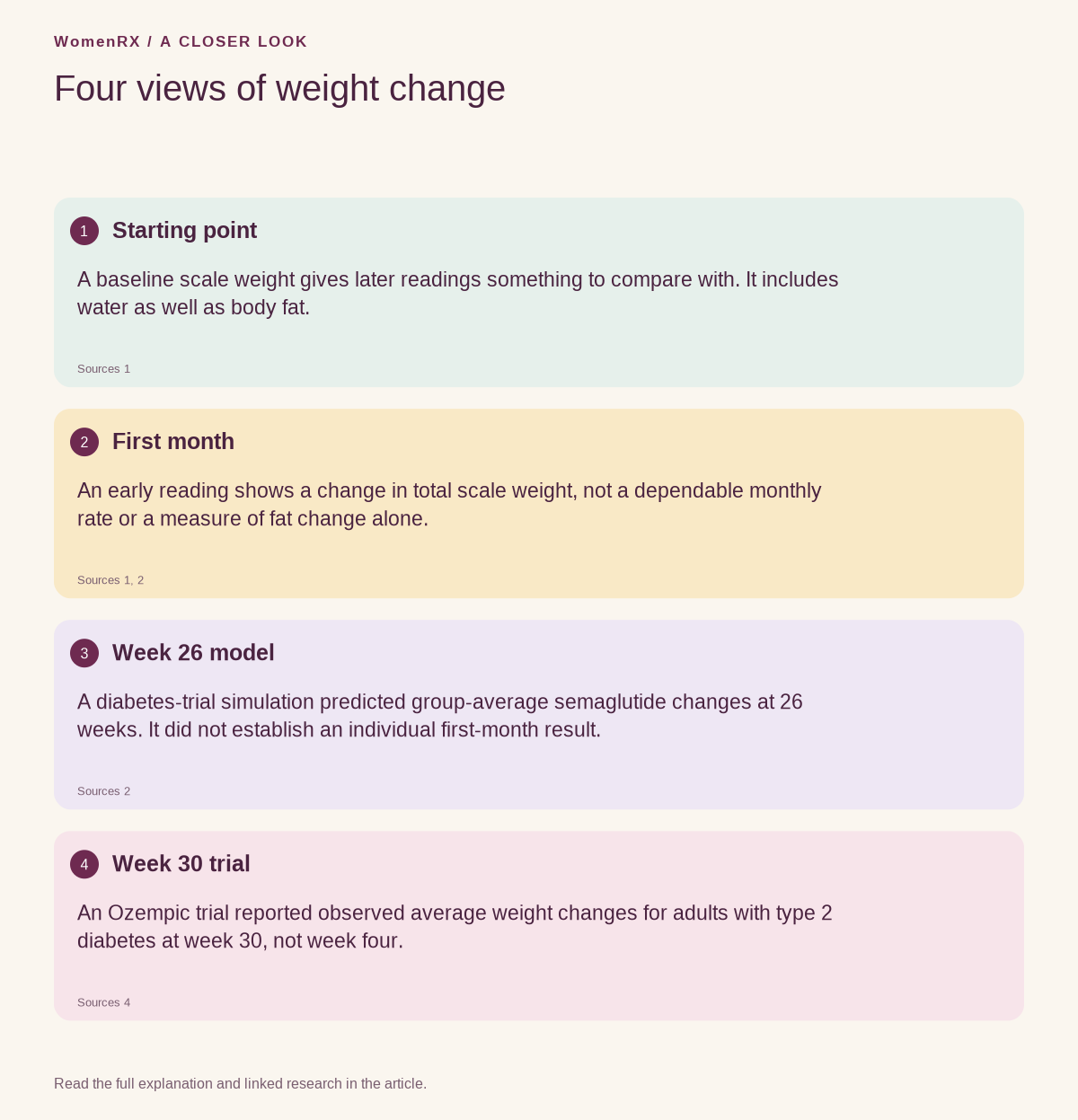
Four views of weight change
Starting point: A baseline scale weight gives later readings something to compare with. It includes water as well as body fat.1
First month: An early reading shows a change in total scale weight, not a dependable monthly rate or a measure of fat change alone.12
Week 26 model: A diabetes-trial simulation predicted group-average semaglutide changes at 26 weeks. It did not establish an individual first-month result.2
Week 30 trial: An Ozempic trial reported observed average weight changes for adults with type 2 diabetes at week 30, not week four.4
Read the figure as text
These readings and research results differ in both timing and what they measure.- Starting point: A baseline scale weight gives later readings something to compare with. It includes water as well as body fat.1
- First month: An early reading shows a change in total scale weight, not a dependable monthly rate or a measure of fat change alone.12
- Week 26 model: A diabetes-trial simulation predicted group-average semaglutide changes at 26 weeks. It did not establish an individual first-month result.2
- Week 30 trial: An Ozempic trial reported observed average weight changes for adults with type 2 diabetes at week 30, not week four.4
Sources you can check
- Body Weight: MedlinePlusAccessed 2026-09-25Return to first citation
- A model-based simulation of glycaemic control and body weight when switching from semaglutide to 3.0- and 4.5-mg doses of once-weekly dulaglutide.Tham LS, Pantalone KM, Dungan K, Munir K, Tang CC, Konig M, Kwan AYM. · Diabetes, obesity & metabolism · 2022Return to first citation
- [Peptide hormone analogue-based pharmacotherapy for obesity is effective : What is the evidence on hard end points and the long-term course?]Hussain M, Miras AD. · Chirurgie (Heidelberg, Germany) · 2026Return to first citation
- OZEMPIC (SEMAGLUTIDE) INJECTION, SOLUTION [NOVO NORDISK PHARMACEUTICAL INDUSTRIES, LP] | US prescribing information and patient instructionsAccessed 2026-09-25Return to first citation
- WEGOVY (SEMAGLUTIDE) INJECTION, SOLUTION WEGOVY (SEMAGLUTIDE) TABLET [NOVO NORDISK PHARMACEUTICAL INDUSTRIES, LP] | US prescribing information and patient instructionsAccessed 2026-09-25Return to first citation
- Effect of an oral contraceptive containing 30 microg ethinylestradiol plus 3 mg drospirenone on body composition of young women affected by premenstrual syndrome with symptoms of water retention.Fruzzetti F, Lazzarini V, Ricci C, Quirici B, Gambacciani M, Paoletti AM, Genazzani AR. · Contraception · 2007Return to first citation