Semaglutide and Menopause: What the Evidence Can Tell You
Semaglutide can support weight loss in adults with overweight or obesity, but current results don’t show whether it works differently before or after menopause.
Semaglutide has shown meaningful weight loss in adults with overweight or obesity, but the results don’t establish a menopause-specific effect. A study included many women, yet its reported results don’t separate outcomes by menopause stage. For weight management, the starting point is obesity or overweight with a weight-related condition, not menopause alone. Benefits, side effects, and your health goals matter too. 3 5
What semaglutide can, and can’t, answer about menopause
Weight changes during perimenopause or after menopause can be frustrating. Semaglutide may be a weight-management option for some adults, but evidence that it helps with weight loss generally is not the same as evidence that it specifically counteracts menopause-related changes.
In a meta-analysis of nine randomized trials involving 6,239 adults with overweight or obesity without diabetes, injectable semaglutide reduced body weight by an average of 12.04 percentage points more than placebo. The pooled results do not break outcomes out by menopause stage, so that average can’t tell you what to expect specifically during perimenopause or after menopause. 5
A separate real-world study included 8,177 adults starting semaglutide, 83.6% of whom were women. It reported weight changes over follow-up, but the results provided do not identify participants’ menopause status or give a menopause-specific comparison. Having many women in a study is useful, but it does not answer whether the effect differs by menopause stage. 3
This means the available findings don’t establish that semaglutide treats menopause or reverses menopause-related weight change. It also doesn’t prove that no menopause-focused studies exist; it means these results don’t settle that question.
Start with the reason you’re considering it
Semaglutide is a medicine for weight management in some people, not a treatment for menopause itself. Brand names matter: semaglutide products have distinct approved uses, and Wegovy is the brand identified for chronic weight management. Don’t assume that a brand prescribed for another reason is automatically the right product or use for weight loss. 3 4
For weight management, the starting point is obesity, or overweight with at least one weight-related health condition. Menopause alone is not the reason for this treatment. 3
A useful decision starts with your health and goals, not menopause status alone. Consider whether weight is affecting a health concern you want to address, what approaches you’ve already tried, and what outcome would matter to you. A number on the scale is one possible measure. Waist circumference can also be relevant: the meta-analysis found a greater reduction with semaglutide than placebo, though it did not report a menopause-specific result. 5
BMI is one tool used in obesity assessment, but it doesn’t distinguish fat from muscle or bone, and it can be less informative for some people, including older adults. Weight history, overall health, and related conditions can add context. 2
Balance potential benefit with the tradeoffs
Stomach and bowel symptoms are common in weight-management trials of injectable Wegovy. In those adult trials, 73% of participants receiving Wegovy and 47% receiving placebo reported gastrointestinal reactions. Nausea, vomiting, and diarrhea were among the reported effects; severe gastrointestinal reactions occurred in 4.1% and 0.9%, respectively. 1
The prescribing information also warns about acute pancreatitis. Persistent or severe abdominal pain, sometimes spreading to the back, is a symptom the label says may occur with pancreatitis, with or without nausea or vomiting. 1
These are not the only considerations, and a short summary can’t cover an individual’s full medical history or the complete risk profile. The practical question is whether the possible benefit fits your health needs and whether the side effects and ongoing treatment feel acceptable to you.
Compare medication with the rest of your options
Weight care can include nutrition and activity changes, counseling or support, medication, and, for some people with severe obesity or serious related health problems, procedures or surgery. These approaches aren’t an all-or-nothing choice; a treatment plan may combine them or change over time. 2
If you’re deciding whether to discuss semaglutide, bring the conversation back to a few concrete points: what health outcome you hope to improve, how success will be assessed beyond the scale, what side effects would matter most in your daily life, and what the plan would be if the medicine isn’t tolerable or doesn’t meet your goals. The menopause-specific effect remains uncertain, but that doesn’t prevent you from making a decision based on your own health priorities and the evidence for weight management overall.
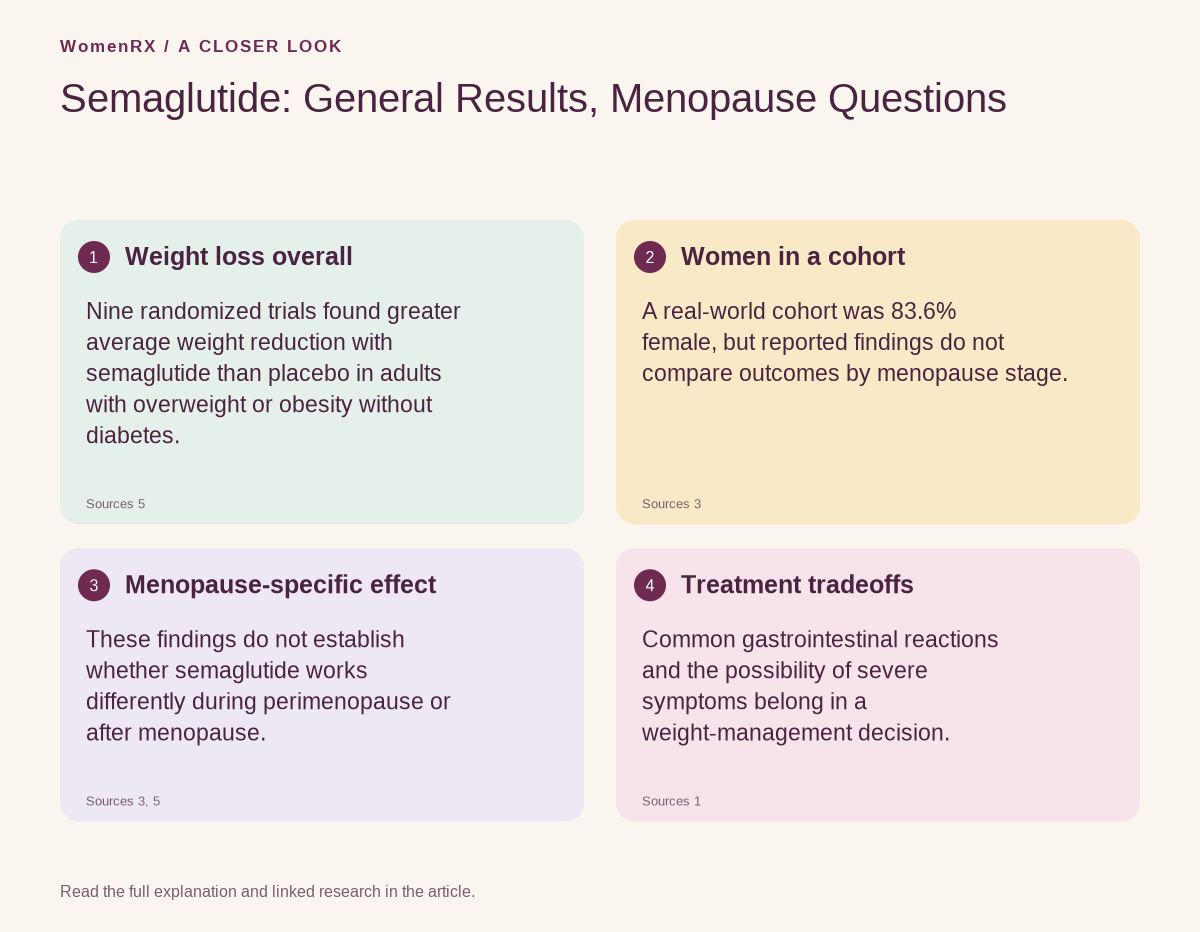
Semaglutide: General Results, Menopause Questions
Weight loss overall: Nine randomized trials found greater average weight reduction with semaglutide than placebo in adults with overweight or obesity without diabetes.5
Women in a cohort: A real-world cohort was 83.6% female, but reported findings do not compare outcomes by menopause stage.3
Menopause-specific effect: These findings do not establish whether semaglutide works differently during perimenopause or after menopause.35
Treatment tradeoffs: Common gastrointestinal reactions and the possibility of severe symptoms belong in a weight-management decision.1
Read the figure as text
The distinction is between evidence that semaglutide can support weight loss in adults and evidence that would show a menopause-specific effect.- Weight loss overall: Nine randomized trials found greater average weight reduction with semaglutide than placebo in adults with overweight or obesity without diabetes.5
- Women in a cohort: A real-world cohort was 83.6% female, but reported findings do not compare outcomes by menopause stage.3
- Menopause-specific effect: These findings do not establish whether semaglutide works differently during perimenopause or after menopause.35
- Treatment tradeoffs: Common gastrointestinal reactions and the possibility of severe symptoms belong in a weight-management decision.1
More questions, answered
Does Ozempic treat menopause-related weight gain?
This evidence does not establish Ozempic as a treatment for menopause or show that semaglutide reverses menopause-related weight change. Semaglutide products have different approved uses; Wegovy is the brand identified for chronic weight management. 3 4
Does weight loss on semaglutide mean the effect is proven for postmenopausal women?
No. A study can include many women without reporting results separately for postmenopausal participants. The real-world study described here was 83.6% female, but its reported findings don’t provide a menopause-stage comparison. 3
Sources you can check
- WEGOVY (SEMAGLUTIDE) INJECTION, SOLUTION WEGOVY (SEMAGLUTIDE) TABLET [NOVO NORDISK PHARMACEUTICAL INDUSTRIES, LP] | US prescribing information and patient instructionsAccessed 2026-09-25Return to first citation
- Obesity: MedlinePlusAccessed 2026-09-25Return to first citation
- Real-World Weight Loss Among Patients Initiating Semaglutide 2.4 mg and Enrolled in WeGoTogether, a Digital Self-Support Application.Toliver JC, Divino V, Ng CD, Wang J. · Advances in therapy · 2025Return to first citation
- SemaglutideKommu S, Whitfield P. · 2024Return to first citation
- Effects of subcutaneous semaglutide on weight loss and inflammatory markers in adults with overweight or obesity without diabetes: a systematic review and meta-analysis.Milluzzo A, Oteri V, Manuella L, Pulvirenti A, Frittitta L. · International journal of obesity (2005) · 2026Return to first citation