Berberine vs. Ozempic: What the Evidence Can Tell You
Berberine has shown a small average weight change in one review, but it hasn’t been directly compared with semaglutide.
This evidence doesn’t directly compare berberine with semaglutide. A berberine review found an average weight reduction of 0.88 kg versus control; a separate review of semaglutide weight-management trials found a larger percentage change versus placebo. Those trials aren’t an Ozempic-specific test, and the figures aren’t head-to-head results. The berberine studies also leave medication interactions and pregnancy or breastfeeding safety unresolved. 2 3 4
“Nature’s Ozempic” makes berberine sound like a natural, interchangeable version of a prescription drug. The research doesn’t support that comparison. Ozempic is a semaglutide product, but the weight-management trials discussed below aren’t identified as Ozempic-specific trials. Berberine and semaglutide also haven’t been directly compared in these findings. 2 3 4
The weight results aren’t a head-to-head test
A 2026 review included 23 articles on randomized studies of berberine in adults and found an average weight reduction of 0.88 kg compared with control groups. It also reported small average changes in BMI. The review noted that trial reporting and measurement of product characteristics, such as purity and potency, need improvement. 4
A separate review pooled four placebo-controlled randomized trials of subcutaneous semaglutide in adults with overweight or obesity who didn’t have type 2 diabetes. It found an average weight change of 11.85 percentage points more than placebo. The review assessed semaglutide used for weight management, not an Ozempic-specific comparison with berberine. 3
The semaglutide review reports a larger pooled weight-loss estimate, but that isn’t a demonstrated advantage over berberine in a head-to-head trial. The reviews covered different studies, and the berberine result is reported in kilograms while the semaglutide result is a percentage difference versus placebo. The berberine abstract also doesn’t give enough detail to align study duration or participant characteristics with the semaglutide trials. 3 4
An earlier berberine review illustrates why the result needs care: across 10 studies, it found no significant average change in body weight, though it reported changes in BMI and waist circumference. It considered a different set of trials from the later review, so the two estimates aren’t directly interchangeable. 5
Blood sugar is a separate question
The weight findings don’t establish that berberine controls blood sugar as well as semaglutide. The berberine reviews described here focused on weight-related measures, not a direct comparison of blood-sugar outcomes. Semaglutide’s US prescribing information describes its use to improve blood-sugar control in adults with type 2 diabetes, but that doesn’t provide a berberine comparison. 1 4 5
It helps to keep the question specific: evidence about weight isn’t automatically evidence about blood sugar, and results in people without diabetes don’t answer the same question as results in people with type 2 diabetes.
Safety questions the studies don’t settle
In the semaglutide review, gastrointestinal side effects, including nausea, vomiting, diarrhea, and constipation, were more common than with placebo. More participants also stopped treatment because of side effects. 3
The berberine reviews don’t identify specific medication interactions or establish safety during pregnancy or breastfeeding. That’s an unanswered safety question, not proof that a particular interaction or harm occurs. If you’re pregnant, breastfeeding, planning pregnancy, or taking medication, get individualized advice before using berberine. For semaglutide, US prescribing information says to stop it at least two months before a planned pregnancy. 2 4 5
Product details matter, too. A pooled review’s call for better reporting of berberine purity, potency, and amount is a limitation of the research, not proof about the quality of any specific supplement on sale. 4
A useful way to weigh the choice
If your question is whether berberine has evidence comparable to semaglutide for weight loss, these results don’t support treating them as equivalents. Berberine’s pooled weight finding is modest, and another review found no significant weight change. Separate placebo-controlled trials of semaglutide for weight management report a larger pooled weight-loss estimate, but they don’t establish an Ozempic-specific result or a direct comparison with berberine. Semaglutide also has side effects and specific pregnancy guidance. 2 3 4 5
If your main concern is blood sugar, ask about evidence for that outcome specifically, rather than relying on a supplement’s weight-loss reputation. And if you’re considering berberine, bring the exact product label and your medication list to a clinician or pharmacist; these studies don’t tell us which product or combination is safe for you.
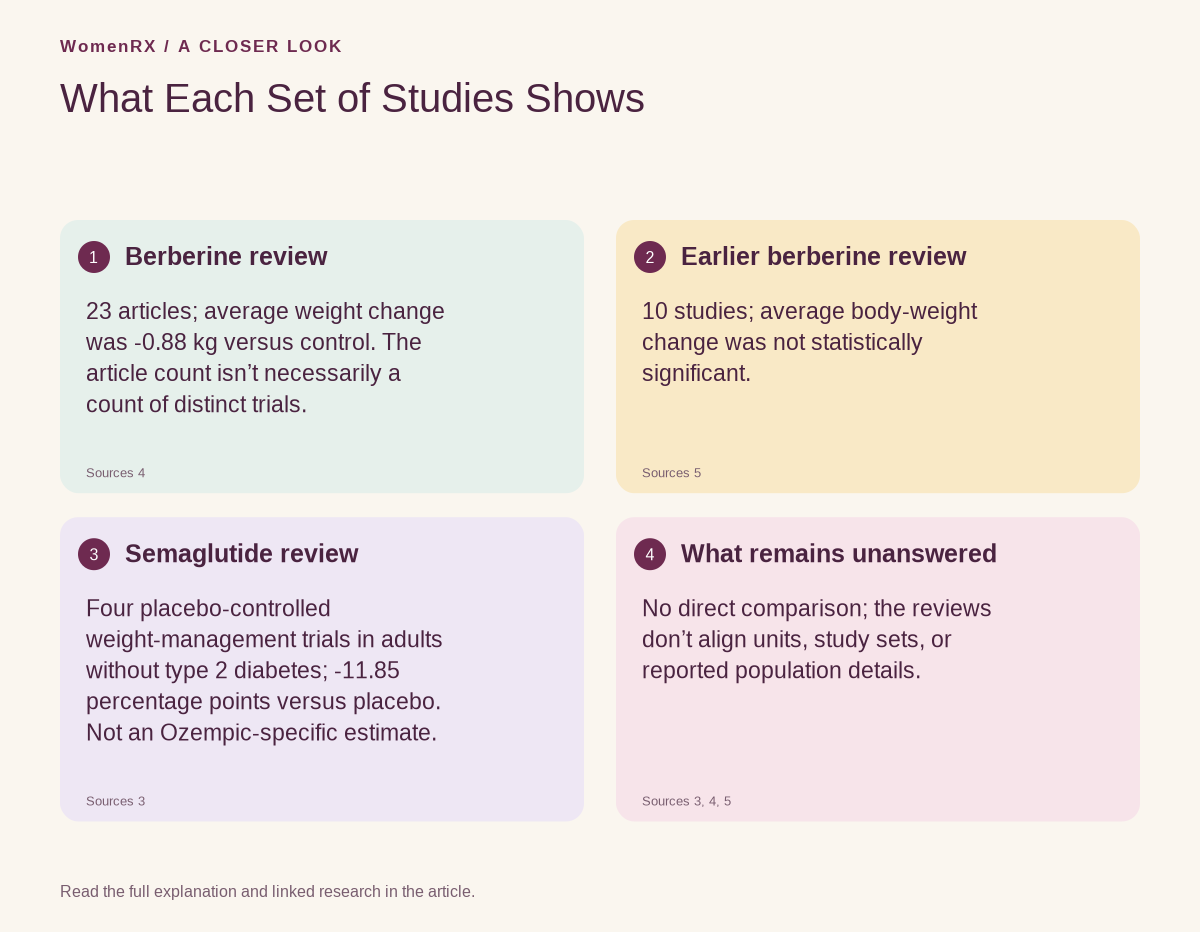
What Each Set of Studies Shows
Berberine review: 23 articles; average weight change was -0.88 kg versus control. The article count isn’t necessarily a count of distinct trials.4
Earlier berberine review: 10 studies; average body-weight change was not statistically significant.5
Semaglutide review: Four placebo-controlled weight-management trials in adults without type 2 diabetes; -11.85 percentage points versus placebo. Not an Ozempic-specific estimate.3
What remains unanswered: No direct comparison; the reviews don’t align units, study sets, or reported population details.345
Read the figure as text
These findings come from separate reviews, not a trial that assigned participants to berberine or semaglutide.- Berberine review: 23 articles; average weight change was -0.88 kg versus control. The article count isn’t necessarily a count of distinct trials.4
- Earlier berberine review: 10 studies; average body-weight change was not statistically significant.5
- Semaglutide review: Four placebo-controlled weight-management trials in adults without type 2 diabetes; -11.85 percentage points versus placebo. Not an Ozempic-specific estimate.3
- What remains unanswered: No direct comparison; the reviews don’t align units, study sets, or reported population details.345
More questions, answered
Do berberine studies report results specifically for women?
The review abstracts don’t report whether results differed for women or provide sex-specific outcomes. That means these findings can’t show whether berberine works differently for women. 4 5
Is berberine proven safe during pregnancy or breastfeeding?
The berberine reviews described here don’t establish pregnancy or breastfeeding safety. For semaglutide, US prescribing information says to stop it at least two months before a planned pregnancy. 2 4 5
Sources you can check
- OZEMPIC (ORAL SEMAGLUTIDE) TABLET RYBELSUS (ORAL SEMAGLUTIDE) TABLET [NOVO NORDISK PHARMACEUTICAL INDUSTRIES, LP] | US prescribing information and patient instructionsAccessed 2026-09-25Return to first citation
- OZEMPIC (SEMAGLUTIDE) INJECTION, SOLUTION [A-S MEDICATION SOLUTIONS] | US prescribing information and patient instructionsAccessed 2026-09-25Return to first citation
- Effectiveness & safety of semaglutide in weight reduction in obese nondiabetic patients: A systematic review and meta-analysis.Naz F, Qaiser F, Mumtaz A, Din SU, Mustafa A, Ullah A, Perveen A, Malik J. · Medicine · 2026Return to first citation
- The effect of berberine on obesity indices: a systematic review and meta-analysis.Elahi Vahed I, Shahir-Roudi E, Nojumi S, Golmohammadi S, Moradi Shahrebabak M, Sharafi Tafreshi Moghadam N, Bagheryan AS, Moftakhar M, Shamsipour F, Jafari M, Soltaninejad H, Rahma... · International journal of obesity (2005) · 2026Return to first citation
- The effect of berberine supplementation on obesity indices: A dose- response meta-analysis and systematic review of randomized controlled trials.Xiong P, Niu L, Talaei S, Kord-Varkaneh H, Clark CCT, Găman MA, Rahmani J, Dorosti M, Mousavi SM, Zarezadeh M, Taghizade-Bilondi H, Zhang J. · Complementary therapies in clinical practice · 2020Return to first citation