Berberine vs. Semaglutide: What Weight-Loss Evidence Can Tell You
Each has been studied for weight management, but separate study results can’t tell you how the two would compare head to head.
The cited reviews assess berberine and semaglutide separately, not against each other. Berberine studies report an average weight difference in kilograms versus control groups; trials of subcutaneous semaglutide report a percentage-based difference versus placebo in different participants. Those findings can’t establish which produces greater weight loss. Semaglutide is a prescription medicine, while a berberine supplement can be bought without a prescribing decision. 1 4 5
Why a direct comparison matters
Berberine and semaglutide aren’t two versions of the same treatment. Berberine is an ingredient studied in supplement trials; semaglutide is a prescription medicine studied in clinical trials, including trials for weight management. Ozempic is a semaglutide product, but results from studies of semaglutide for weight reduction aren’t a recommendation to use a particular brand or formulation for that purpose. 2 4
The cited reviews examine berberine and semaglutide in separate trials. Neither gives a head-to-head result for weight management, so neither establishes how the treatments would perform if tested against each other. A study comparing each treatment with a separate control group isn’t a substitute for testing both treatments in the same trial. 4 5
What the separate studies report
A 2026 meta-analysis combined four randomized trials of subcutaneous semaglutide involving 3,613 adults with overweight or obesity who did not have type 2 diabetes. Compared with placebo, semaglutide produced an average difference of 11.85 percentage points in change in body weight. The review also found more gastrointestinal side effects and more treatment discontinuations due to side effects with semaglutide than with placebo. These figures describe a pooled result across those trials, not a prediction for any one person. 4
A separate meta-analysis of 23 berberine studies in adults reported an average weight difference of 0.88 kg compared with control groups, along with small average differences in BMI and waist circumference. The authors called for better reporting of the berberine products’ purity and potency and noted study-design concerns, including limited blinding and randomization. 5
Those figures may look easy to compare, but they come from different studies, participants, comparators, and methods. The berberine review’s average change cannot be directly subtracted from the semaglutide review’s percentage result. Neither review tested berberine against semaglutide, and the figures don’t establish that the treatments are interchangeable. 4 5
Safety and oversight aren’t the same thing
In the semaglutide meta-analysis, nausea, vomiting, diarrhea, and constipation were among the gastrointestinal effects reported more often than with placebo. Discontinuation due to adverse effects was also more frequent; the review reported a relative risk of 2.62 compared with placebo. Serious adverse events were uncommon in the included trials. 4
A separate review of berberine trials in people with metabolic syndrome reported nausea, constipation, mild abdominal discomfort, and hypoglycemia among the adverse effects described. It found no significant difference in adverse effects between berberine and placebo, but two of the 12 included studies didn’t provide safety data. That review’s population and outcomes don’t answer every question about using berberine specifically for weight management. 3
So the available findings don’t justify saying that one is safer overall. They describe different kinds of safety evidence, and the berberine review itself points to gaps in the reporting. 3 4
There’s also a practical difference in how you’d make the decision. Semaglutide is a prescription medicine, so starting it involves a prescriber who can weigh its expected effects and known risks against your health circumstances. If a berberine product is sold as a dietary supplement in the United States, you can buy it without that prescribing decision, and it doesn’t require FDA premarket review or approval before sale. That doesn’t make a supplement risk-free. NIH notes that weight-loss supplements can interfere with some medications, which makes the ingredient label worth sharing with the person managing your medicines. 1 2 4
What the evidence says about women and pregnancy
The semaglutide weight-loss meta-analysis reports results for adults overall, not a women-only estimate. The berberine meta-analysis also reports pooled adult results without a women-specific weight-effect estimate. These studies therefore don’t establish that either treatment works differently for women. 4 5
Pregnancy is a separate question from weight-loss results. The US prescribing information for Ozempic injection says human pregnancy data are limited and that animal studies raise potential fetal-risk concerns. It says the medicine should be used during pregnancy only if the potential benefit justifies the potential risk. The berberine weight-related trial summaries discussed above don’t provide pregnancy or breastfeeding safety findings, so they can’t settle those questions either. 2 3 5
The practical takeaway is to keep three questions separate: what each treatment did in its own studies, what its safety information actually reports, and whether it fits your circumstances. The published averages can describe the first question. They can’t create a direct comparison that the cited reviews don’t provide. 4 5
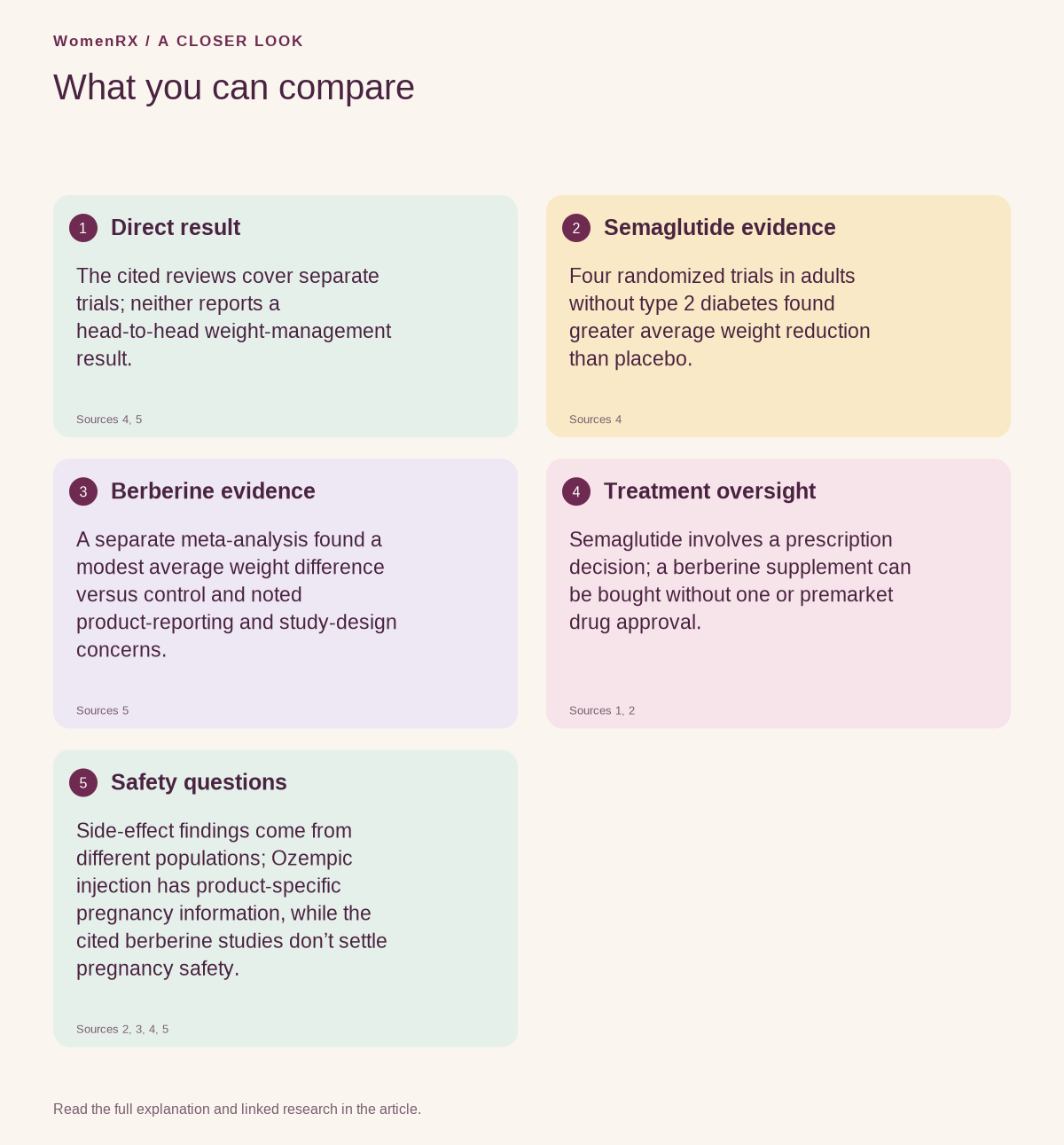
What you can compare
Direct result: The cited reviews cover separate trials; neither reports a head-to-head weight-management result.45
Semaglutide evidence: Four randomized trials in adults without type 2 diabetes found greater average weight reduction than placebo.4
Berberine evidence: A separate meta-analysis found a modest average weight difference versus control and noted product-reporting and study-design concerns.5
Treatment oversight: Semaglutide involves a prescription decision; a berberine supplement can be bought without one or premarket drug approval.12
Safety questions: Side-effect findings come from different populations; Ozempic injection has product-specific pregnancy information, while the cited berberine studies don’t settle pregnancy safety.2345
Read the figure as text
The two evidence bases answer different questions. The way each treatment reaches you differs, too.- Direct result: The cited reviews cover separate trials; neither reports a head-to-head weight-management result.45
- Semaglutide evidence: Four randomized trials in adults without type 2 diabetes found greater average weight reduction than placebo.4
- Berberine evidence: A separate meta-analysis found a modest average weight difference versus control and noted product-reporting and study-design concerns.5
- Treatment oversight: Semaglutide involves a prescription decision; a berberine supplement can be bought without one or premarket drug approval.12
- Safety questions: Side-effect findings come from different populations; Ozempic injection has product-specific pregnancy information, while the cited berberine studies don’t settle pregnancy safety.2345
More questions, answered
Does the semaglutide result mean everyone loses that much weight?
No. The 11.85-percentage-point figure is an average difference between semaglutide and placebo across four trials. It describes the study results overall, not an individual outcome. 4
Do the weight-loss studies show that either treatment works differently for women?
The pooled results reported here don’t provide women-only estimates for either treatment. They therefore can’t answer whether weight-management effects differ by sex. 4 5
Sources you can check
- Dietary Supplements for Weight Loss - Health Professional Fact SheetAccessed 2026-09-25Return to first citation
- OZEMPIC (SEMAGLUTIDE) INJECTION, SOLUTION [A-S MEDICATION SOLUTIONS] | US prescribing information and patient instructionsAccessed 2026-09-25Return to first citation
- Efficacy and safety of berberine on the components of metabolic syndrome: a systematic review and meta-analysis of randomized placebo-controlled trials.Liu D, Zhao H, Zhang Y, Hu J, Xu H. · Frontiers in pharmacology · 2025Return to first citation
- Effectiveness & safety of semaglutide in weight reduction in obese nondiabetic patients: A systematic review and meta-analysis.Naz F, Qaiser F, Mumtaz A, Din SU, Mustafa A, Ullah A, Perveen A, Malik J. · Medicine · 2026Return to first citation
- The effect of berberine on obesity indices: a systematic review and meta-analysis.Elahi Vahed I, Shahir-Roudi E, Nojumi S, Golmohammadi S, Moradi Shahrebabak M, Sharafi Tafreshi Moghadam N, Bagheryan AS, Moftakhar M, Shamsipour F, Jafari M, Soltaninejad H, Rahma... · International journal of obesity (2005) · 2026Return to first citation