What Your First Month on Tirzepatide Can Tell You
An early weigh-in shows where you are today, not how much weight you’ll lose over a full course of treatment.
There isn’t a reliable amount you should expect to lose in your first month on tirzepatide. Zepbound’s first four weeks are an introductory dose, while its main weight-reduction trials assessed results after 72 weeks. Those group results aren’t month-one targets. Your scale also measures water as well as fat, and menstrual-cycle fluid shifts can affect a short-term reading. Look at several weigh-ins together rather than judging one number. 215
Why month one isn’t a preview of the finish line
If you’ve just started tirzepatide, it’s natural to look at the scale and wonder whether the treatment is working. But a first-month change, whether it feels dramatic or barely noticeable, can’t tell you what your longer-term result will be.
The weight-reduction trials described in Zepbound’s US prescribing information assessed outcomes after 72 weeks of treatment. Participants had spent at least 52 weeks at a maintenance dose, and they also received diet and physical-activity support throughout the trials. Those results describe groups of people treated over a much longer period under trial conditions. They aren’t a benchmark for your first four weeks. 2
Zepbound’s prescribing information describes the first four weeks at 2.5 mg weekly as treatment initiation, not maintenance treatment. It describes a move to 5 mg after those four weeks, with any further increases spaced at least four weeks apart to help reduce gastrointestinal side effects. So a first-month weigh-in comes before the extended treatment period measured in the trials. An analysis using trial-group data from people with type 2 diabetes found different average weight changes across tirzepatide doses. It did not establish how much any one person should lose during dose introduction or predict her longer-term result from her first month. 23
What a changing scale number actually measures
A scale measures your total body weight, which includes water, muscle, bone, and fat. That’s why a reading can move without showing exactly how much body fat has changed. A single lower number isn’t proof that every bit of the change was fat loss; a higher number doesn’t, by itself, mean progress has stopped. 1
Try treating weigh-ins as a series rather than a set of verdicts. For example, you could record your weight under roughly similar conditions each time and look back at several readings together. If one reading rises while the broader series is moving down, that’s different from a series that has been rising consistently. This is a way to make the numbers easier to interpret, not a test with a pass mark.
If you have menstrual periods, fluid shifts across your cycle can affect short-term readings. In a study that measured 42 women twice a week during a menstrual cycle, differences in weight were largely associated with differences in extracellular water. Research doesn’t find the same pattern in everyone, though. If a weigh-in rises around your period, cycle-related water may be part of the picture, but the reading alone can’t tell you that it’s the whole explanation. 541
A better first-month question
Instead of asking, “Did I lose enough?”, ask, “What do these readings show so far, and what don’t they show?” You may see a downward pattern, little net change, or readings that move both ways. None is a sound basis for calculating your eventual weight loss from the 72-week trial results. 12
A simple record can put an isolated weigh-in in context. It helps you compare readings; weighing itself is not a measure of how well tirzepatide will work for you.
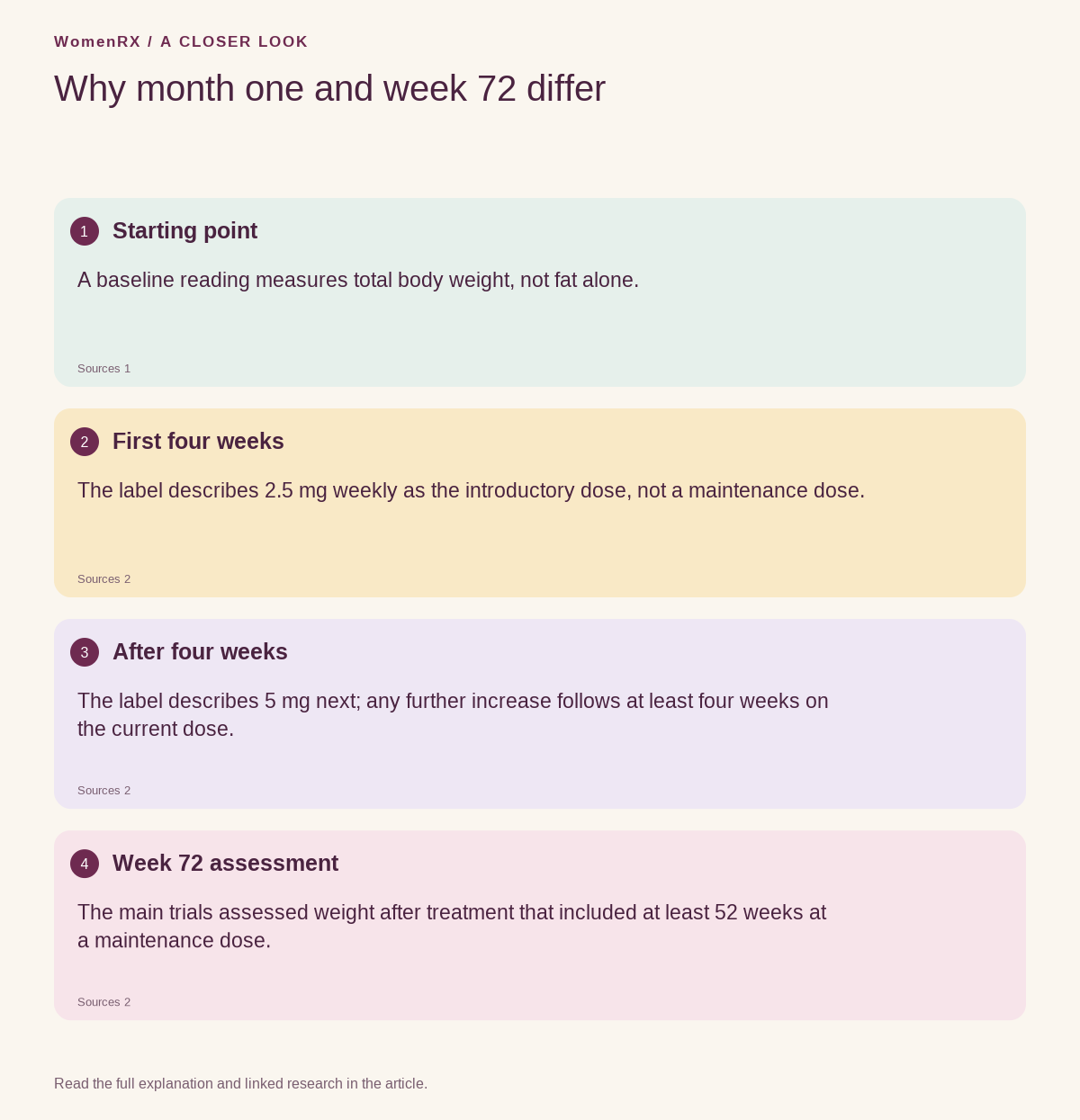
Why month one and week 72 differ
Starting point: A baseline reading measures total body weight, not fat alone.1
First four weeks: The label describes 2.5 mg weekly as the introductory dose, not a maintenance dose.2
After four weeks: The label describes 5 mg next; any further increase follows at least four weeks on the current dose.2
Week 72 assessment: The main trials assessed weight after treatment that included at least 52 weeks at a maintenance dose.2
Read the figure as text
The first four weeks introduce Zepbound treatment; the trials assessed weight after a much longer period that included maintenance treatment. 2- Starting point: A baseline reading measures total body weight, not fat alone.1
- First four weeks: The label describes 2.5 mg weekly as the introductory dose, not a maintenance dose.2
- After four weeks: The label describes 5 mg next; any further increase follows at least four weeks on the current dose.2
- Week 72 assessment: The main trials assessed weight after treatment that included at least 52 weeks at a maintenance dose.2
Sources you can check
- Body Weight: MedlinePlusAccessed 2026-09-25Return to first citation
- ZEPBOUND (TIRZEPATIDE) INJECTION, SOLUTION ZEPBOUND (TIRZEPATIDE) INJECTION, SOLUTION ZEPBOUND KWIKPEN (TIRZEPATIDE) INJECTION, SOLUTION [ELI LILLY AND COMPANY] | US prescribing information and patient instructionsAccessed 2026-09-25Return to first citation
- Dose-Response and Clinical Equivalence of Semaglutide and Tirzepatide for Weight Loss in Type 2 Diabetes: A Model-Based Analysis.Builes-Montaño CE, Suarez-Rodriguez AF, Alzate-Vinasco MA. · Diabetes therapy : research, treatment and education of diabetes and related disorders · 2026Return to first citation
- Weight Loss Trends in Women's Wrestling and Potential Implications of Menstrual Cycle: A Narrative Review.Jagim AR, Fields JB, Jones MT. · Nutrients · 2026Return to first citation
- Changes in body weight and body composition during the menstrual cycle.Kanellakis S, Skoufas E, Simitsopoulou E, Migdanis A, Migdanis I, Prelorentzou T, Louka A, Moschonis G, Bountouvi E, Androutsos O. · American journal of human biology : the official journal of the Human Biology Council · 2023Return to first citation