Your First Month on Rybelsus: A Practical Guide
The first 30 days are an initiation phase, so focus on taking the tablet consistently, noticing symptoms, and confirming your next dose with your prescriber.
Rybelsus starts with 3 mg once daily for days 1-30; this is an initiation dose, not an effective dose for blood sugar control. Take it on an empty stomach with up to 4 ounces of water, then wait at least 30 minutes before eating, drinking, or taking other oral medicines. Keep notes on stomach symptoms and confirm your next dose with your prescriber. If vomiting or diarrhea makes it hard to keep fluids down, contact them promptly rather than waiting for a planned check-in. 1 2
Make the morning routine consistent
Food and excess liquid can reduce how much oral semaglutide is absorbed. Take Rybelsus in the morning on an empty stomach with up to 4 fluid ounces of plain water. Wait at least 30 minutes before eating, drinking, or taking other oral medicines. The timing instructions may affect when you can take your other medicines, so ask your prescriber or pharmacist how to fit the schedules together. 2
The U.S. product information lists 3 mg once daily for the first 30 days. That starting dose is for initiation and is not effective for blood sugar control. Your next dose step should follow the plan your prescriber gave you; don’t increase it on your own or assume a change if the instructions aren’t clear. 1
Track symptoms in a way that helps
Nausea, vomiting, and diarrhea are among the gastrointestinal effects reported with oral semaglutide. In pooled placebo-controlled trials, gastrointestinal reactions were reported in 32% of people taking 7 mg and 41% taking 14 mg, compared with 21% taking placebo. Most reports of nausea, vomiting, or diarrhea occurred during dose escalation. These are trial rates across treatment, not a prediction of what you personally will experience during your first month. 1
A brief note can make a follow-up more useful. For example, record when a symptom happens, how often it occurs, whether you vomited or had diarrhea, and whether you could keep fluids down. Add your dose timing and any other oral medicines taken that morning. You don’t need to turn this into a detailed diary; a few clear observations can help you describe what is and isn’t manageable.
Gastrointestinal symptoms such as vomiting or diarrhea can lead to dehydration. The product information describes postmarketing reports of acute kidney injury, most of them in people who had gastrointestinal reactions leading to dehydration, and advises monitoring kidney function when reactions could cause fluid depletion, especially during dose initiation and escalation. 1
If vomiting or diarrhea makes it hard to keep fluids down, contact your prescriber promptly instead of waiting for your planned check-in. They can assess whether fluid loss or kidney monitoring needs attention. 1
Use follow-up to confirm the plan
At your planned check-in, share your symptom notes and ask what to do if symptoms continue or the next dose step is unclear. Also review the timing of your other oral medicines, since Rybelsus needs to be taken before them. Don’t skip, change, or escalate a dose based on a general online schedule. 1 2
If pregnancy is possible or you’re planning a pregnancy, bring that up with your prescriber now and ask what plan applies to you. Your medication review is also a good time to mention any new medicines or changes to medicines you already take. The product instructions and trial results summarized here don’t provide individualized pregnancy guidance.
Your first month isn’t a reliable promise of a particular weight change. The product information describes 3 mg as an initiation dose and says it isn’t effective for blood sugar control; it doesn’t establish a first-month weight target. Keep the focus on the prescribed routine, symptoms, and a clear follow-up plan. 1
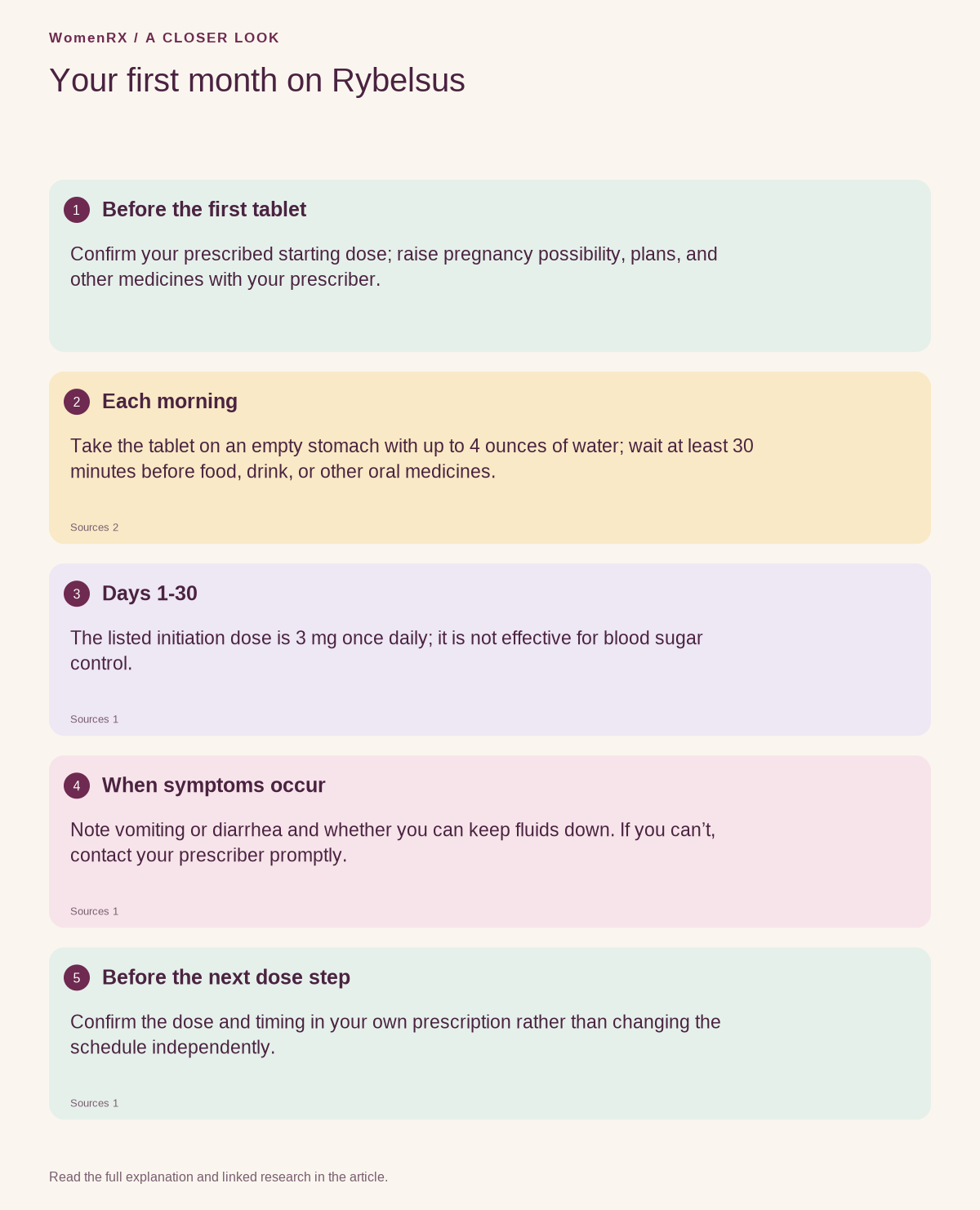
Your first month on Rybelsus
Before the first tablet: Confirm your prescribed starting dose; raise pregnancy possibility, plans, and other medicines with your prescriber.
Each morning: Take the tablet on an empty stomach with up to 4 ounces of water; wait at least 30 minutes before food, drink, or other oral medicines.2
Days 1-30: The listed initiation dose is 3 mg once daily; it is not effective for blood sugar control.1
When symptoms occur: Note vomiting or diarrhea and whether you can keep fluids down. If you can’t, contact your prescriber promptly.1
Before the next dose step: Confirm the dose and timing in your own prescription rather than changing the schedule independently.1
Read the figure as text
A practical sequence for building the morning routine, noting symptoms, and checking the next dose with your prescriber.- Before the first tablet: Confirm your prescribed starting dose; raise pregnancy possibility, plans, and other medicines with your prescriber.
- Each morning: Take the tablet on an empty stomach with up to 4 ounces of water; wait at least 30 minutes before food, drink, or other oral medicines.2
- Days 1-30: The listed initiation dose is 3 mg once daily; it is not effective for blood sugar control.1
- When symptoms occur: Note vomiting or diarrhea and whether you can keep fluids down. If you can’t, contact your prescriber promptly.1
- Before the next dose step: Confirm the dose and timing in your own prescription rather than changing the schedule independently.1
Sources you can check
- OZEMPIC (ORAL SEMAGLUTIDE) TABLET RYBELSUS (ORAL SEMAGLUTIDE) TABLET [NOVO NORDISK PHARMACEUTICAL INDUSTRIES, LP] | US prescribing information and patient instructionsAccessed 2026-09-25Return to first citation
- Integrating oral semaglutide into clinical practice in primary care: for whom, when, and how?Brunton SA, Mosenzon O, Wright EE. · Postgraduate medicine · 2020Return to first citation