How to Judge Progress in Your First Month on Wegovy
Your first month on Wegovy falls early in dose escalation, so longer-term study results aren’t a useful four-week target.
There’s no first-month number of pounds to take from the Wegovy results discussed here. In one injection study, dose escalation lasted 16 weeks. A separate study found greater weight loss with Wegovy than placebo between weeks 20 and 68, after a run-in period. That later result isn’t a four-week target. At a check-in, discuss your weight trend and how treatment is going. 1
Why month one and the trial result tell different stories
In a Wegovy injection cardiovascular-outcomes study of adults with established cardiovascular disease and overweight or obesity, participants gradually increased their dose over 16 weeks rather than starting immediately at the study dose. Month one was still early in that escalation. In a separate weight study of adults with obesity or overweight with a comorbidity, participants had a 20-week run-in before the randomized comparison began. Researchers then assessed weight change from week 20 to week 68 and found a greater reduction with Wegovy than with placebo. Those are two distinct study timelines, not stages of a single trial. 1
The second study’s starting point matters. People who stopped Wegovy during titration or didn’t reach the study dose weren’t eligible for its randomized-treatment period. Its later result may therefore not reflect the experience of everyone just starting the injection. The reported comparison doesn’t give you a first-month number of pounds or percentage to use as a personal benchmark. 1
What a month-one result can tell you
A small change, no change, or a more noticeable change on the scale doesn’t by itself tell you how treatment will work over time. At a first check-in, the useful comparison is with your own starting point: how your weight has been trending, how dose escalation is going, and whether side effects are affecting daily life. For example, little scale change while you’re tolerating treatment early in escalation raises a different question from weight loss alongside symptoms that make it hard to eat or drink.
Your prescriber can put that trend in the context of your treatment plan and tell you when a longer-term assessment makes sense. The results described above don’t provide a separate first-month weight-loss rate for women. 1
Pregnancy planning and breastfeeding change the discussion
If you’re pregnant or planning a pregnancy, bring that up before making treatment decisions. Wegovy’s prescribing information describes potential fetal risk based on animal developmental findings; those findings don’t establish safe use of Wegovy for weight loss during pregnancy. 1
Breastfeeding needs a separate discussion. In a small study, semaglutide wasn’t detected in milk samples from eight women after injection, but that finding doesn’t answer questions about longer-term infant outcomes or other effects of treatment during lactation. 2 The product information’s breastfeeding recommendation for Wegovy tablets is specific to the oral formulation and its absorption enhancer. It shouldn’t be treated as interchangeable with evidence about the injection. 1
A useful question for your first check-in
Rather than asking whether you’ve reached a trial average, ask when and how your prescriber plans to assess your progress. Bring your weight trend and any difficulties with treatment. A first month gives you information about how starting Wegovy is going; the later study comparison answers a different question.
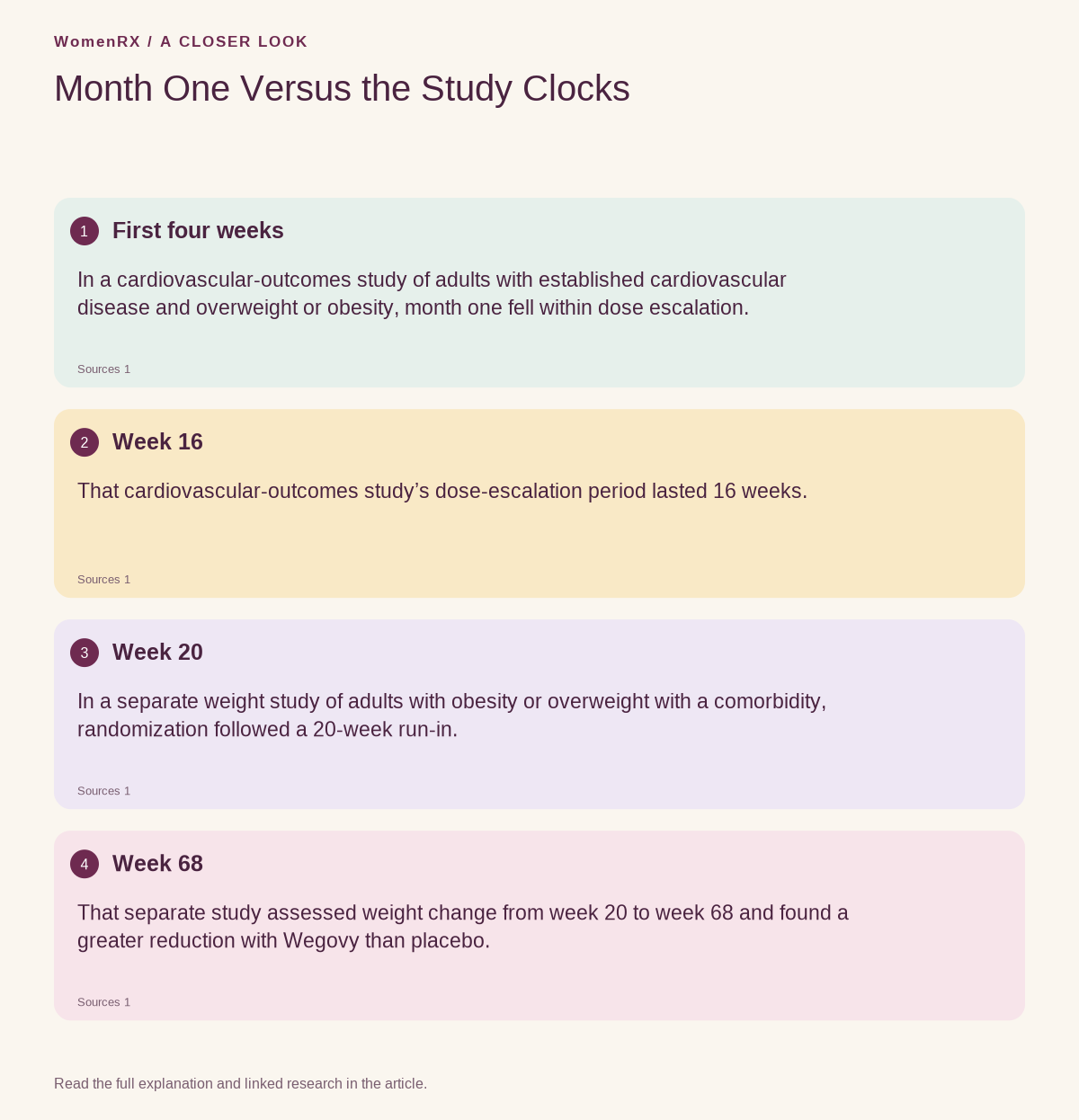
Month One Versus the Study Clocks
First four weeks: In a cardiovascular-outcomes study of adults with established cardiovascular disease and overweight or obesity, month one fell within dose escalation.1
Week 16: That cardiovascular-outcomes study’s dose-escalation period lasted 16 weeks.1
Week 20: In a separate weight study of adults with obesity or overweight with a comorbidity, randomization followed a 20-week run-in.1
Week 68: That separate study assessed weight change from week 20 to week 68 and found a greater reduction with Wegovy than placebo.1
Read the figure as text
These landmarks come from two separate Wegovy injection studies, not one continuous timeline or a predicted pattern of weight loss.- First four weeks: In a cardiovascular-outcomes study of adults with established cardiovascular disease and overweight or obesity, month one fell within dose escalation.1
- Week 16: That cardiovascular-outcomes study’s dose-escalation period lasted 16 weeks.1
- Week 20: In a separate weight study of adults with obesity or overweight with a comorbidity, randomization followed a 20-week run-in.1
- Week 68: That separate study assessed weight change from week 20 to week 68 and found a greater reduction with Wegovy than placebo.1
More questions, answered
Does a small breastfeeding study prove Wegovy injection is safe while nursing?
No. Semaglutide wasn’t detected in milk samples from eight women after injection, but the study leaves longer-term infant outcomes and other questions unanswered. 2
Sources you can check
- WEGOVY (SEMAGLUTIDE) INJECTION, SOLUTION WEGOVY (SEMAGLUTIDE) TABLET [NOVO NORDISK PHARMACEUTICAL INDUSTRIES, LP] | US prescribing information and patient instructionsAccessed 2026-09-25Return to first citation
- Subcutaneous Semaglutide during Breastfeeding: Infant Safety Regarding Drug Transfer into Human Milk.Diab H, Fuquay T, Datta P, Bickel U, Thompson J, Krutsch K. · Nutrients · 2024Return to first citation