How to Judge Flibanserin’s Results Without Before-and-After Hype
Flibanserin trials measured desire, distress, and satisfying sexual experiences, but the average difference from placebo was modest and no single measure tells the whole story.
In studies, women reported changes in sexual desire, distress about low desire, and the number of satisfying sexual events. On average, flibanserin’s advantage over placebo was small; some women reported meaningful benefit and others did not. A useful review with your clinician focuses on whether desire and distress changed in ways that matter to you, alongside side effects, rather than treating a dramatic story or event count as proof.
What the trials actually counted
The studies weren’t designed to produce a simple before-and-after verdict. They compared women taking flibanserin with women taking placebo, usually over 24 weeks, and asked about several different parts of sexual experience. The main studies enrolled premenopausal women with acquired, generalized hypoactive sexual desire disorder (HSDD), meaning persistently low desire that was causing distress. 1
One measure was sexual desire. In some trials, participants used a daily diary to rate desire; another used the desire questions from the Female Sexual Function Index (FSFI), a questionnaire about sexual function over the previous four weeks. A separate questionnaire asked how often low desire bothered the participant. Trials also counted “satisfying sexual events,” recorded in diaries. These measures capture different things: desire, distress, and the frequency of experiences a participant considered satisfying. 14
That distinction matters. A higher event count isn’t automatically a sign that desire or distress improved. A review of HSDD trials found that changes in satisfying sexual events did not consistently track with changes in desire or distress. Event counts alone can miss what the person herself considers meaningful. 5
The average difference was modest
A systematic review of eight randomized trials involving 5,914 women found that flibanserin was associated with an average of about half an additional satisfying sexual event per month compared with placebo. The pooled improvement in the FSFI desire score was 0.27 points. The review included premenopausal and postmenopausal trials, and rated the overall evidence quality as very low, so these averages don’t predict what one person will experience. 3
The placebo groups also improved. In a pooled analysis of three pivotal trials in premenopausal women, 49.8% of those taking flibanserin and 33.6% taking placebo reported clinically meaningful improvement on a patient global-impression measure. In a separate postmenopausal analysis, the figures were 40.5% and 28.7%. These are group results, not a promise or a personal forecast; they also show why a change during treatment can’t automatically be credited to the medicine. 4
A patient-rated overall impression is useful because it gives the woman’s own view a place alongside questionnaire scores and event counts. But the reported responder percentages came from trial data and analyses, not a guarantee that a particular individual will notice benefit. 4
Age and reproductive stage affect how well results apply
The strongest trial record in the prescribing information is for premenopausal women with acquired, generalized HSDD. Evidence in naturally postmenopausal women is less straightforward. In the PLUMERIA randomized trial, the sponsor stopped the study early; 45.3% of participants had completed week 16. Desire scores improved more with flibanserin than placebo at that point, but the difference in satisfying sexual events was not statistically significant. That early stop limits how confidently the results can be interpreted. 12
So, if you’re postmenopausal, don’t assume the premenopausal averages describe your likely response. The available postmenopausal trial results are a separate, less complete evidence base. The studies summarized here don’t establish how results differ during perimenopause, pregnancy, or postpartum.
Make the check-in personal, not dramatic
Before reviewing a trial of treatment with your clinician, it may help to name what you’d count as worthwhile. For example, is the main change you hope for more interest, less distress about low desire, or a more satisfying sexual life overall? Those are not interchangeable goals, and the trial measures did not all move in lockstep. 45
Then compare how you feel now with your own starting point, using the same questions over time. Include any side effects in that conversation: dizziness, sleepiness, nausea, and fatigue were among the adverse effects included in a meta-analysis of flibanserin trials, and stopping treatment because of adverse effects was more common with flibanserin than placebo. The meaningful question is not only “Did a score change?” but “Did the change matter enough to me to outweigh the downsides?” 3
The pivotal premenopausal trials assessed key outcomes at week 24. That tells you when the studies compared results, not the exact point when every individual should expect a response. A clinician can help interpret your experience in light of your goals, the outcome being tracked, and how the treatment is affecting you. 14
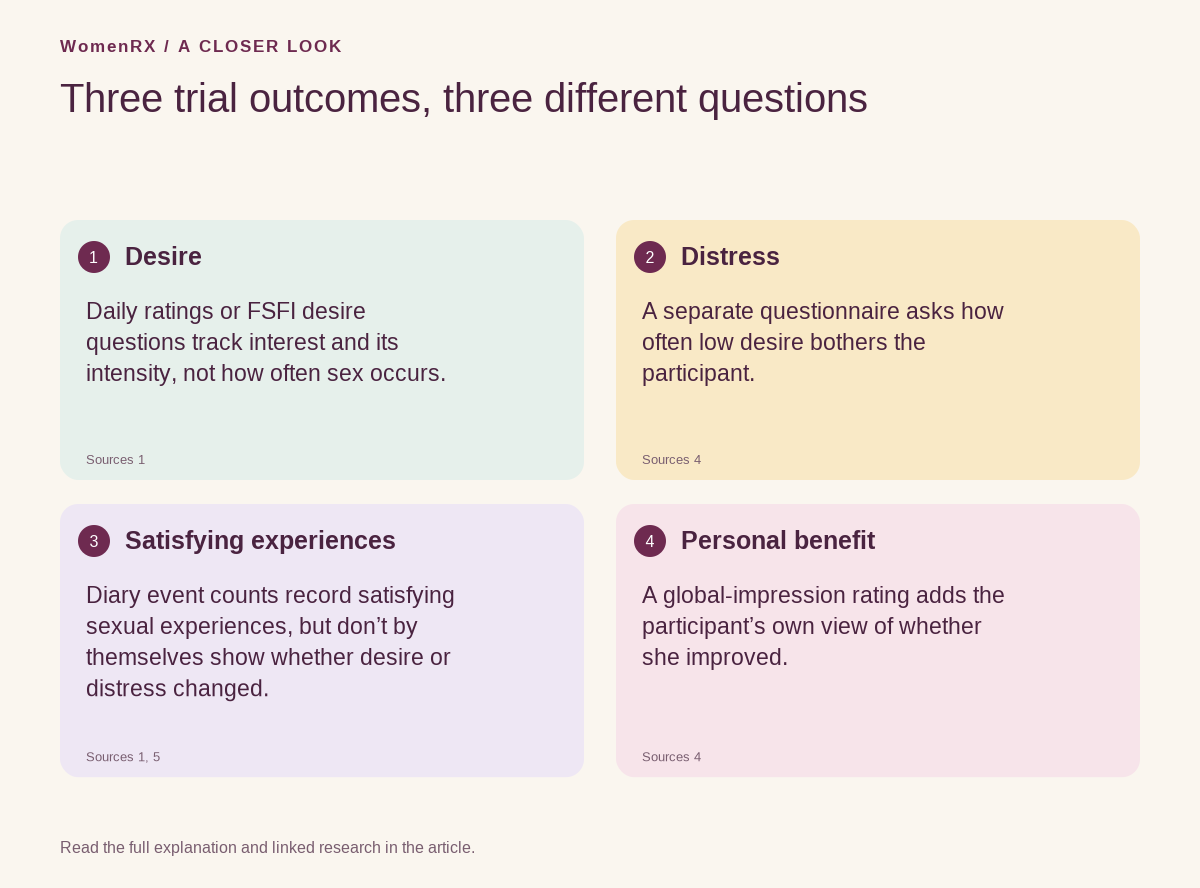
Three trial outcomes, three different questions
Desire: Daily ratings or FSFI desire questions track interest and its intensity, not how often sex occurs.1
Distress: A separate questionnaire asks how often low desire bothers the participant.4
Satisfying experiences: Diary event counts record satisfying sexual experiences, but don’t by themselves show whether desire or distress changed.15
Personal benefit: A global-impression rating adds the participant’s own view of whether she improved.4
Read the figure as text
A trial score or event count captures only one part of sexual experience. These measures are best read separately and then interpreted in light of what matters to the individual.- Desire: Daily ratings or FSFI desire questions track interest and its intensity, not how often sex occurs.1
- Distress: A separate questionnaire asks how often low desire bothers the participant.4
- Satisfying experiences: Diary event counts record satisfying sexual experiences, but don’t by themselves show whether desire or distress changed.15
- Personal benefit: A global-impression rating adds the participant’s own view of whether she improved.4
More questions, answered
Does having more satisfying sexual events mean treatment worked?
Not necessarily. Event counts are only one outcome, and trial reviews found that changes in event counts did not always align with changes in desire or distress. Your own sense of whether the change mattered is another useful part of judging benefit. 54
Do the premenopausal results apply after menopause?
Not directly. Postmenopausal women were studied separately, and one trial ended early, leaving less complete evidence than the premenopausal trial record. 12
Sources you can check
- ADDYI (FLIBANSERIN) TABLET, FILM COATED [SPROUT PHARMACEUTICALS, INC.] | US prescribing information and patient instructionsAccessed 2026-09-25Return to first citation
- Flibanserin in Postmenopausal Women With Hypoactive Sexual Desire Disorder: Results of the PLUMERIA Study.Portman DJ, Brown L, Yuan J, Kissling R, Kingsberg SA. · The journal of sexual medicine · 2017Return to first citation
- Efficacy and Safety of Flibanserin for the Treatment of Hypoactive Sexual Desire Disorder in Women: A Systematic Review and Meta-analysis.Jaspers L, Feys F, Bramer WM, Franco OH, Leusink P, Laan ET. · JAMA internal medicine · 2016Return to first citation
- Clinically Meaningful Benefit in Women with Hypoactive Sexual Desire Disorder Treated with Flibanserin.Simon JA, Clayton AH, Kim NN, Patel S. · Sexual medicine · 2022Return to first citation
- Satisfying sexual events as outcome measures in clinical trial of female sexual dysfunction.Kingsberg SA, Althof SE. · The journal of sexual medicine · 2011Return to first citation