How to Read Personal Reviews of Flibanserin
A review can describe one woman’s experience, but controlled studies are better for judging how often benefits and side effects occurred.
Treat a flibanserin review as a personal account, not a forecast. Ask what changed, how long the medicine was taken, what else was going on, and whether side effects were described. Then compare that story with trials, which measured desire, distress, and satisfying sexual events separately and compared flibanserin with placebo. Those group results help set expectations, but they can’t predict one person’s experience. 2 3
A review is a story, not a success rate
A woman may describe more interest in sex, less distress, no noticeable change, or an unpleasant side effect. Her account can help you picture what an experience might feel like. But a collection of online stories can’t establish how common an outcome is unless you know how the accounts were collected and which users they cover. Personal accounts also aren’t a controlled comparison group.
A review may leave out details that matter, such as the reason flibanserin was prescribed, the length of treatment, other medicines, or the person’s health and life circumstances. Treat a vivid account as a question to explore, not proof that the same thing will happen to you.
What the trials measured instead
In flibanserin trials, women reported on several different outcomes: satisfying sexual events, sexual desire, and distress related to low desire. These aren’t interchangeable. A change in the number of satisfying sexual events, for example, doesn’t automatically mean a woman felt more desire or less bothered by it. A review of HSDD trials found that these measures did not always move together; in the two flibanserin trials it examined, satisfying sexual events tracked with desire measured by one questionnaire but not with desire recorded in an electronic diary. 2
Researchers have also asked women to rate their overall improvement. In a pooled analysis of three trials in premenopausal women, 49.8% of those taking flibanserin and 33.6% of those taking placebo reported some improvement on the Patient Global Impression of Improvement scale, including being minimally improved. In a separate analysis of naturally postmenopausal women, the corresponding figures were 40.5% and 28.7%. These results describe groups in studies, not the chance that a particular reader will improve. The analysis combined trial data and used women’s own global ratings alongside other measures. 3
The placebo comparison matters. Some women in the placebo groups also reported improvement, so a positive review by itself can’t show whether flibanserin caused the change. Nor should a group average cancel out a person’s experience: it simply gives that experience a more useful context.
Read side effects with the same care
One person’s report can alert you to a possible side effect, but it can’t establish how common that effect is. In randomized trials of women younger than 65 with HSDD, dizziness was reported by 11.4% of premenopausal women taking flibanserin and 2.2% taking placebo; in the postmenopausal trials, the figures were 7.9% and 3.3%. These are trial results for particular groups and settings, not a guarantee about what you’ll experience. 1
The prescribing information also reports that somnolence, sedation, or fatigue occurred in 21% of premenopausal trial participants taking flibanserin and 8% taking placebo. The risk of central nervous system depression is higher with alcohol, other central nervous system depressants, or certain medicines that raise flibanserin levels. If a review mentions feeling unusually sleepy, dizzy, or faint, use it as a prompt to check the safety details and discuss your own medicines and health conditions with your prescriber. 1
Check whether the situation matches yours
A review is more informative when it includes context. Look for whether the person describes a diagnosis of hypoactive sexual desire disorder (HSDD), what outcome mattered to her, how long she took the medicine, and whether she mentions other medicines or health conditions. Missing details don’t make her account untrue; they make it harder to compare with your situation.
Age and life stage can be relevant context, but an anecdote can’t establish that flibanserin works differently because someone is cycling, perimenopausal, or postmenopausal. The prescribing information describes the postmenopausal trial participants as having HSDD, no significant comorbid medical conditions, and no concomitant medications; most were younger than 65. Those characteristics limit how confidently the results apply to people whose circumstances differ. They don’t prove how the medicine will affect any individual woman. 1
Questions that can make a prescribing visit useful
Bring the question the review raised, then make it specific to your own situation:
- What outcome should I use to judge whether treatment is helping: desire, distress, satisfying sexual experiences, or something else?
- How do my diagnosis, age, life stage, health conditions, and current medicines compare with the women studied?
- Which side effects or medicine interactions are most relevant to my current prescriptions or other substances I use?
- What would be a reasonable point to reassess whether the benefits are meaningful to me?
You don’t have to dismiss personal reviews or take them literally. Let them help you name what you’re wondering about, then use trial results and a conversation about your own circumstances to judge what they can, and can’t, tell you.
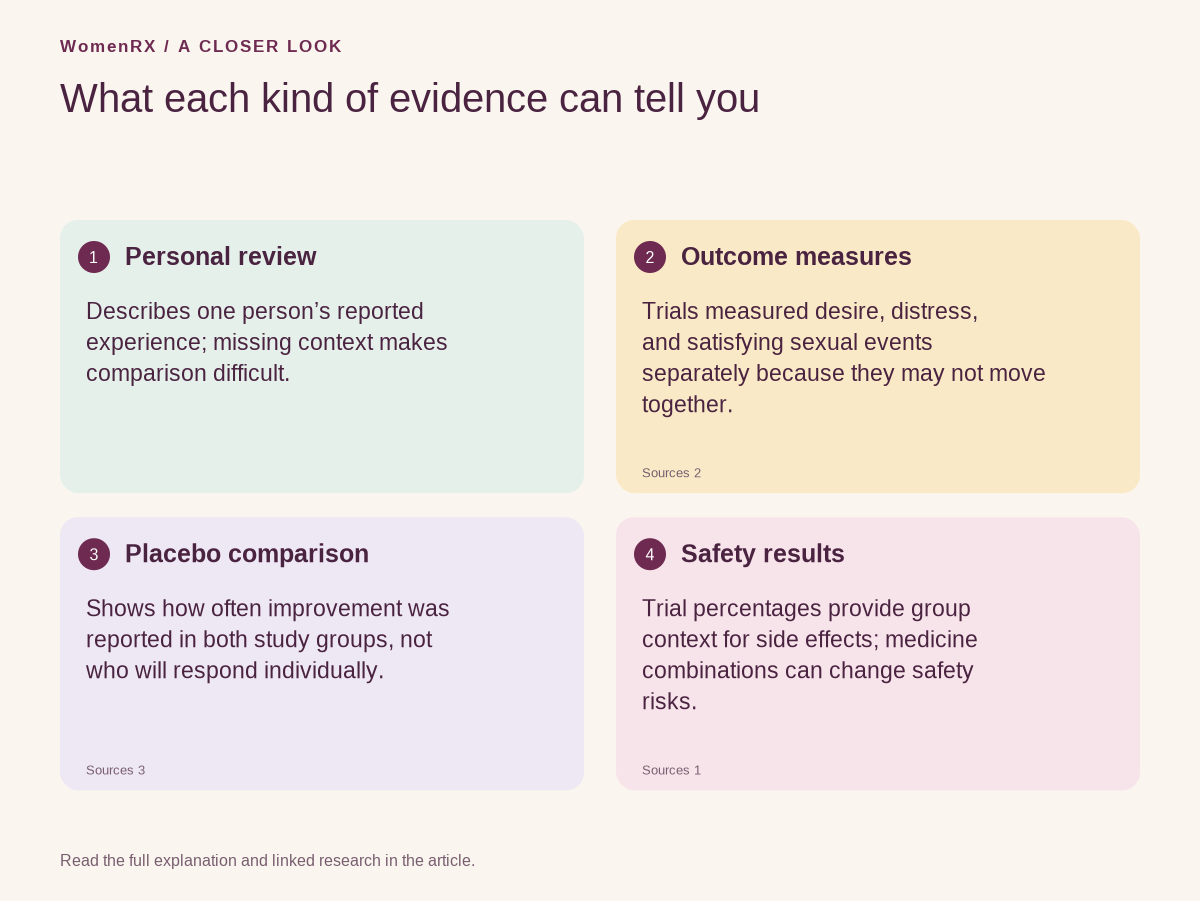
What each kind of evidence can tell you
Personal review: Describes one person’s reported experience; missing context makes comparison difficult.
Outcome measures: Trials measured desire, distress, and satisfying sexual events separately because they may not move together.2
Placebo comparison: Shows how often improvement was reported in both study groups, not who will respond individually.3
Safety results: Trial percentages provide group context for side effects; medicine combinations can change safety risks.1
Read the figure as text
A personal account can raise a useful question; controlled comparisons help put benefits and side effects in group context.- Personal review: Describes one person’s reported experience; missing context makes comparison difficult.
- Outcome measures: Trials measured desire, distress, and satisfying sexual events separately because they may not move together.2
- Placebo comparison: Shows how often improvement was reported in both study groups, not who will respond individually.3
- Safety results: Trial percentages provide group context for side effects; medicine combinations can change safety risks.1
More questions, answered
Can a positive review tell me whether flibanserin will work for me?
No. It tells you what one person reported, not how likely another person is to have the same result. In trials, some women taking placebo also reported improvement, which is one reason a personal account can’t establish what caused a change. 3
Why do trial results include more than one measure?
Desire, distress about low desire, and satisfying sexual events capture different parts of an experience. They don’t always change together, so one outcome alone may not describe how a woman feels overall. 2
Sources you can check
- ADDYI (FLIBANSERIN) TABLET, FILM COATED [SPROUT PHARMACEUTICALS, INC.] | US prescribing information and patient instructionsAccessed 2026-09-25Return to first citation
- Satisfying sexual events as outcome measures in clinical trial of female sexual dysfunction.Kingsberg SA, Althof SE. · The journal of sexual medicine · 2011Return to first citation
- Clinically Meaningful Benefit in Women with Hypoactive Sexual Desire Disorder Treated with Flibanserin.Simon JA, Clayton AH, Kim NN, Patel S. · Sexual medicine · 2022Return to first citation