Fezolinetant Reviews: How to Read Personal Stories
Personal accounts can show what someone noticed, while controlled trials offer a fairer comparison of average outcomes.
A personal account can describe one person’s hot flashes, sleep, side effects, and priorities, but it can’t show how common an outcome is or prove what caused it. In randomized trials, participants reported improvements in symptoms and some quality-of-life measures, including sleep, compared with placebo. Those group results can help set expectations, but they can’t predict exactly what you’ll experience. 24
What a personal account can tell you
A post saying “it worked for me” may be sincere and useful. It can help you picture what someone noticed, which symptoms mattered to them, or what they found difficult. But it describes one person’s experience, not the odds that the same thing will happen to you.
People who choose to post may differ from people who don’t. Accounts may also leave out useful context, such as how symptoms were measured, how long someone used the medicine, or what else changed during that time. A collection of posts can’t reliably establish how common a benefit or side effect is. Treat a vivid story as a prompt for questions, not a forecast.
What trials add to the picture
Clinical trials also ask people to report their own experiences. The difference is that participants in a trial answer the same questions on a planned schedule, and researchers can compare groups receiving fezolinetant or placebo. That comparison helps separate a treatment-group pattern from changes also seen in the placebo group. It still describes averages, not a guarantee for any one person.
In DAYLIGHT, a 24-week randomized, double-blind study, 452 women considered unsuitable for hormone therapy received fezolinetant or placebo. At week 24, the fezolinetant group had greater improvement than the placebo group in reported sleep disturbance and menopause-related quality of life. These findings describe group differences; they don’t mean every participant felt better. 2
A separate analysis of two phase 3 trials gives a concrete example of why the comparison matters. At week 12, 154 of 302 participants taking fezolinetant 45 mg (51.0%) said their sleep disturbance was much or moderately better, compared with 98 of 292 participants taking placebo (33.6%). Improvement was reported in both groups. The difference between groups is more informative than either percentage alone, but it still doesn’t tell you what caused a particular person’s improvement. 4
Follow-up length matters, too. VESTA followed postmenopausal women for 12 weeks and tested several fezolinetant doses. Some patient-reported measures improved from baseline in both placebo and fezolinetant groups, with larger improvements on several measures in the fezolinetant groups. Because VESTA was a dose-ranging study, its results aren’t a direct estimate of what any one person will experience on the currently indicated treatment. 3
Read reports about benefits and risks differently
For benefits, look for the symptom someone is describing: hot-flash frequency, severity, sleep, or interference with daily life. A general statement such as “I feel better” may matter to that person, but it is harder to compare with a trial measure or with your own priorities. Timing also changes the meaning of a report: a brief update and a measured outcome after several weeks of follow-up aren’t equivalent.
For a possible side effect, an account can alert you to a symptom someone noticed, but it can’t establish how often the symptom occurs or whether fezolinetant caused it. The US prescribing information is more useful for specific safety instructions. It calls for liver blood tests before treatment, monthly for the first three months, and at months six and nine. If you develop possible liver-problem symptoms such as unusual tiredness, nausea, itching, yellowing of the skin or eyes, pale stools, dark urine, or abdominal pain, stop taking fezolinetant and contact your prescriber right away. 1
A quick way to assess a story
Before letting an account shape your expectations, ask:
- What changed? Hot flashes, sleep, or another part of daily life?
- When was it assessed? How long had the person been followed?
- How was it measured? A general impression, a daily record, or a repeated questionnaire?
- What comparison is missing? A personal post doesn’t show what might have changed without the medicine.
- Does it match your priority? The outcome that matters most to someone else may not be the one you’re hoping to improve.
The useful middle ground is to learn from the details in personal accounts without treating them as representative. Trial comparisons give a steadier view of average outcomes; neither a trial average nor an online story can promise how fezolinetant will feel for you.
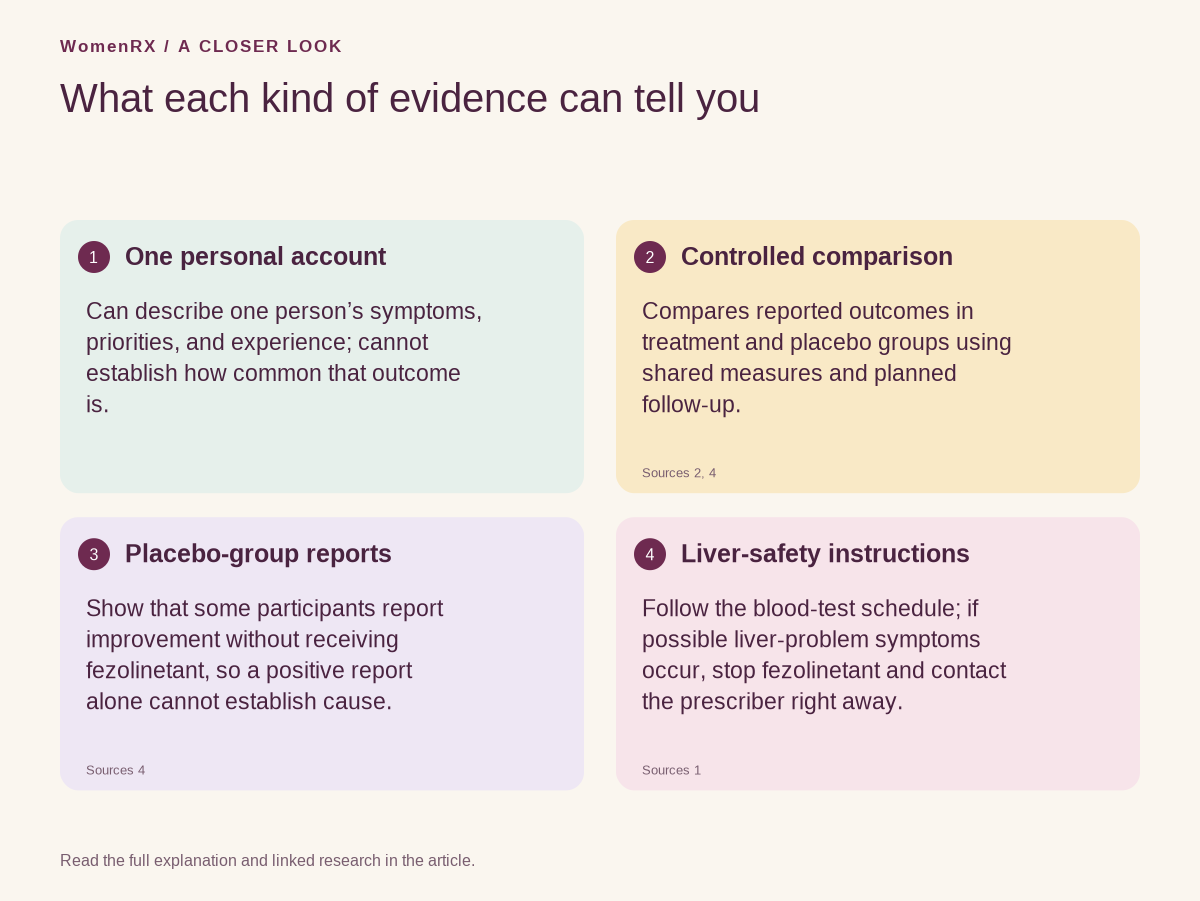
What each kind of evidence can tell you
One personal account: Can describe one person’s symptoms, priorities, and experience; cannot establish how common that outcome is.
Controlled comparison: Compares reported outcomes in treatment and placebo groups using shared measures and planned follow-up.24
Placebo-group reports: Show that some participants report improvement without receiving fezolinetant, so a positive report alone cannot establish cause.4
Liver-safety instructions: Follow the blood-test schedule; if possible liver-problem symptoms occur, stop fezolinetant and contact the prescriber right away.1
Read the figure as text
Personal accounts, controlled comparisons, and prescribing information answer different questions. Keep their roles distinct when weighing a story against study findings.- One personal account: Can describe one person’s symptoms, priorities, and experience; cannot establish how common that outcome is.
- Controlled comparison: Compares reported outcomes in treatment and placebo groups using shared measures and planned follow-up.24
- Placebo-group reports: Show that some participants report improvement without receiving fezolinetant, so a positive report alone cannot establish cause.4
- Liver-safety instructions: Follow the blood-test schedule; if possible liver-problem symptoms occur, stop fezolinetant and contact the prescriber right away.1
More questions, answered
Do patient reviews predict whether fezolinetant will work for me?
No. A review describes one person’s experience. Randomized studies offer a better comparison between treatment and placebo groups, but their average results still can’t predict an individual response. 24
What should I do if I read about a possible liver problem?
Use the prescribing information’s specific guidance: stop taking fezolinetant and contact your prescriber right away if symptoms such as yellowing of the skin or eyes, dark urine, pale stools, nausea, itching, unusual tiredness, or abdominal pain occur. The information also specifies liver blood-test monitoring during treatment. 1
Sources you can check
- VEOZAH (FEZOLINETANT) TABLET, FILM COATED [ASTELLAS PHARMA US, INC.] | US prescribing information and patient instructionsAccessed 2026-09-25Return to first citation
- Effect of fezolinetant on patient-reported quality-of-life outcomes: Data from a phase 3b study (DAYLIGHT) of the treatment of moderate to severe vasomotor symptoms associated with menopause in women considered unsuitable for hormone therapy.Shapiro C M M, Wu X, Wang X, Miyazaki K, Morga A, Nappi RE, Stute P, Martins K, Schaudig K. · Maturitas · 2025Return to first citation
- Effect of the neurokinin 3 receptor antagonist fezolinetant on patient-reported outcomes in postmenopausal women with vasomotor symptoms: results of a randomized, placebo-controlled, double-blind, dose-ranging study (VESTA).Santoro N, Waldbaum A, Lederman S, Kroll R, Fraser GL, Lademacher C, Skillern L, Young J, Ramael S. · Menopause (New York, N.Y.) · 2020Return to first citation
- Effect of fezolinetant on sleep disturbance and impairment during treatment of vasomotor symptoms due to menopause.Shapiro C M M, Cano A, Nappi RE, Santoro N, English ML, Mancuso S, Morga A, Siddiqui E, Valluri U, Ottery FD. · Maturitas · 2024Return to first citation