How Can You Weigh Personal Stories About Vaginal Estrogen?
Personal accounts can help you picture what someone experienced, but they can’t predict your response or show how often an outcome happens.
Treat online stories as prompts for questions, not forecasts. Vaginal estrogen is used for menopause-related vaginal dryness and irritation, and studies measure specific symptoms, patient-reported improvement, and other outcomes across groups. Those results can add context that one person’s account can’t provide, but they still can’t tell you exactly what you will experience. 2 4 5
A personal story can make a treatment feel less abstract. Someone might describe a symptom improving, staying the same, or becoming harder to tolerate. That account may help you name what you want to know. But it can’t establish that the treatment caused the change, how often the same experience happens, or whether you’ll have it too.
There’s another limit: the stories you happen to find online aren’t a representative sample of everyone using vaginal estrogen. A detailed account is still one person’s account, even when it feels familiar or appears alongside many similar posts.
Check which symptom the story is about
Vaginal estrogen is a local treatment for menopause-related vaginal symptoms such as dryness and irritation. It isn’t meant to treat other menopause symptoms such as hot flashes or sleep problems. A story about those symptoms improving or persisting may not answer whether vaginal estrogen helped the symptoms it’s used for. 2
Even accounts about vaginal or urinary symptoms can describe different things. A person might mean dryness, pain with sex, urinary urgency, or something else. A study that measures those outcomes separately can give a clearer picture than a broad review saying “it worked” or “it didn’t.” A systematic review of vaginal estrogen studies included patient-reported symptoms such as dryness, pain with sex, and urinary concerns. 5
When you read a review, ask: What symptom changed? How does the person define “better”? What didn’t change, or what side effect did they notice? If those details are missing, the account may still be meaningful to its author, but it may be hard to compare with your own situation.
Timing and treatment form matter
A story posted soon after starting treatment may describe a different stage than one written later. NHS guidance says vaginal estrogen can take up to three months to work fully. Its information also lists possible early effects including headache, abdominal or vaginal pain, and bleeding, which commonly improve in the first few months. This is general guidance, not a prediction of what will happen to you. 1 2
The form matters too. Vaginal estrogen is available in forms such as tablets, creams, gels, and rings. A story about one form doesn’t automatically describe another, and a person’s chosen outcome may depend on the symptom they were trying to address. 2
What group studies add
Studies can ask similar questions of many participants and compare outcomes. A systematic review included 44 eligible studies and searched research published through April 2013. Compared with placebo, vaginal estrogen improved several reported symptoms, including dryness and pain with sex. In comparisons with nonhormonal moisturizers, the review found a greater improvement with estrogen for people reporting two or more vulvovaginal symptoms; for people with one or minor complaints, symptom resolution was similar with either treatment. That comparison describes study findings, not a rule for any one person. 5
A randomized trial gives another example of what patient-reported measures can show. It compared vaginal estrogen cream with vaginal laser treatment in menopausal women with significant symptoms. The trial enrolled 69 women, and 62 completed the six-month protocol; 32 were assigned to estrogen cream. The abstract reports that 70% in the estrogen group rated their improvement as “better” or “much better,” and 73.3% reported being satisfied or very satisfied. It doesn’t report the number who contributed to each rating, so don’t read those percentages as necessarily representing all 32 assigned to estrogen. The comparison was with laser, not no treatment, and the reported satisfaction differences between groups were not statistically significant. 4
Even a group study can’t capture every detail that matters in someone’s life. A symptom score may not describe whether a change helped with a particular activity or relationship. A satisfaction rating may not show which symptom improved. Study results provide context, not an individual forecast.
Let a story sharpen your question
Try this quick filter when an account catches your attention:
- Name the outcome: Is the person describing dryness, pain with sex, urinary symptoms, or a side effect?
- Notice what’s missing: Do they say which form they used, what “better” means, or how long they used it?
- Match your question to a measure: If your concern is dryness, look for evidence that assessed dryness rather than a general claim about menopause.
Personal accounts can help you recognize questions worth asking, including whether a side effect is listed in treatment information. They can’t show how common an experience is. For bothersome genitourinary symptoms of menopause that aren’t relieved by over-the-counter options, the North American Menopause Society identifies low-dose vaginal estrogen as one treatment option for women without an indication for systemic hormone therapy. Whether it fits your situation depends on your symptoms and circumstances. 3
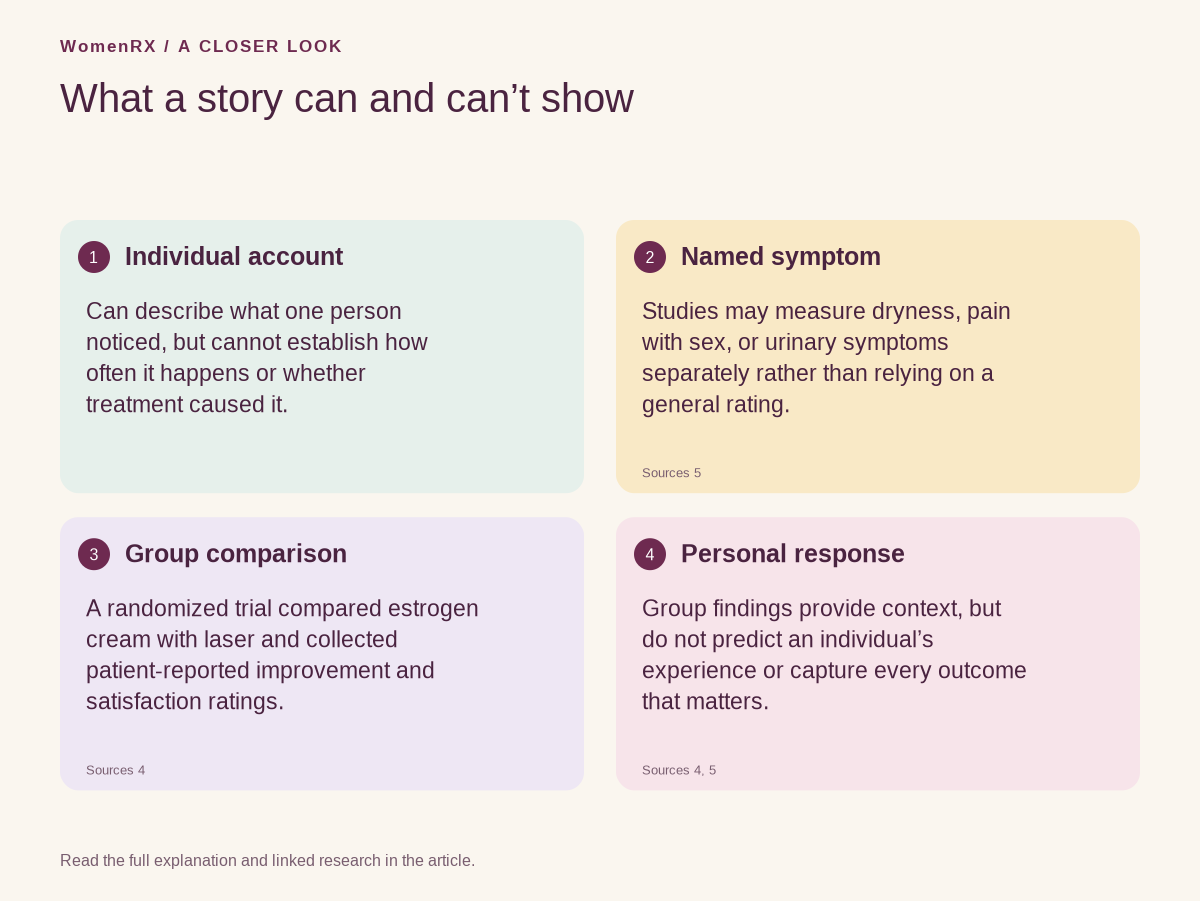
What a story can and can’t show
Individual account: Can describe what one person noticed, but cannot establish how often it happens or whether treatment caused it.
Named symptom: Studies may measure dryness, pain with sex, or urinary symptoms separately rather than relying on a general rating.5
Group comparison: A randomized trial compared estrogen cream with laser and collected patient-reported improvement and satisfaction ratings.4
Personal response: Group findings provide context, but do not predict an individual’s experience or capture every outcome that matters.45
Read the figure as text
Personal accounts describe individual experiences; studies can compare defined outcomes across groups, but neither provides a personal forecast.- Individual account: Can describe what one person noticed, but cannot establish how often it happens or whether treatment caused it.
- Named symptom: Studies may measure dryness, pain with sex, or urinary symptoms separately rather than relying on a general rating.5
- Group comparison: A randomized trial compared estrogen cream with laser and collected patient-reported improvement and satisfaction ratings.4
- Personal response: Group findings provide context, but do not predict an individual’s experience or capture every outcome that matters.45
More questions, answered
Can an online review tell me how long vaginal estrogen will take to help?
It can tell you when one person noticed a change, but not what timing to expect for yourself. NHS guidance says vaginal estrogen can take up to three months to work fully. 2
If someone reports a side effect, does that mean the treatment caused it?
Not by itself. A personal account can flag something to ask about, but it can’t establish cause or estimate how often it happens. NHS information lists possible early side effects, including headache, abdominal or vaginal pain, and bleeding. 1 2
Sources you can check
- Side effects of vaginal oestrogen - NHSAccessed 2026-09-25Return to first citation
- About vaginal oestrogen - NHSAccessed 2026-09-25Return to first citation
- The 2022 hormone therapy position statement of The North American Menopause Society.“The 2022 Hormone Therapy Position Statement of The North American Menopause Society” Advisory Panel. · Menopause (New York, N.Y.) · 2022Return to first citation
- A randomized clinical trial comparing vaginal laser therapy to vaginal estrogen therapy in women with genitourinary syndrome of menopause: The VeLVET Trial.Paraiso MFR, Ferrando CA, Sokol ER, Rardin CR, Matthews CA, Karram MM, Iglesia CB. · Menopause (New York, N.Y.) · 2020Return to first citation
- Vaginal estrogen for genitourinary syndrome of menopause: a systematic review.Rahn DD, Carberry C, Sanses TV, Mamik MM, Ward RM, Meriwether KV, Olivera CK, Abed H, Balk EM, Murphy M, Society of Gynecologic Surgeons Systematic Review Group. · Obstetrics and gynecology · 2014Return to first citation