Fezolinetant for Menopause Hot Flashes: What to Know
Fezolinetant is a nonhormonal prescription option for moderate to severe menopause-related hot flashes and night sweats, with medication review and scheduled liver blood tests built into the decision.
Fezolinetant (Veozah) is a nonhormonal prescription medicine for moderate to severe vasomotor symptoms due to menopause, including hot flashes and night sweats. It targets those symptoms, not menopause as a whole. Before considering it, review your medicines and liver and kidney history, and make sure the required liver blood tests and follow-up are workable for you. 1 2
A focused treatment for hot flashes and night sweats
Fezolinetant is intended to treat moderate to severe vasomotor symptoms (VMS) due to menopause. VMS include hot flashes and night sweats. The medicine isn’t a hormone: it blocks a neurokinin 3 receptor pathway involved in the brain’s regulation of body temperature, helping reduce signals that can trigger a hot flash. 1 2
That makes fezolinetant a focused option, not a general treatment for every menopause-related change. A reduction in hot flashes might matter to you because of how they affect your day or night, but the available trial evidence doesn’t establish fezolinetant as a treatment for mood changes, sexual concerns, or sleep problems on their own. The SKYLIGHT 1 researchers said those wider quality-of-life effects merited further study. 3
In SKYLIGHT 1, a randomized, placebo-controlled trial, women aged 40 to 65 had an average of at least seven moderate to severe hot flashes a day when they enrolled. At week 12, the group taking the studied 45 mg dose had a change of 2.55 fewer VMS per day than the placebo group. That’s a comparison between groups, not a forecast of how much your own symptoms will change. 3
Build liver testing into the decision
The US prescribing information calls for a liver blood test before treatment, then follow-up testing monthly for the first three months and at months six and nine. If a test is elevated, the prescriber may advise stopping treatment or order additional tests. Ask who will arrange the tests and how you’ll receive and act on the results. 1
In a pooled analysis of three phase 3 trials, liver enzyme elevations occurred in 1.5% to 2.3% of participants taking fezolinetant and were typically temporary and without symptoms. That trial finding doesn’t remove the need for monitoring: the US instructions warn that serious liver problems can occur. 1 2
The patient instructions say to stop taking fezolinetant and contact your prescriber right away if you develop possible liver symptoms. These include unusual tiredness, reduced appetite, nausea or vomiting, itching, yellowing of the eyes or skin, pale stools, dark urine, or abdominal pain. 1
Check medicines and health history
Bring a current list of prescription medicines, over-the-counter products, vitamins, and herbal supplements. Fezolinetant must not be used with certain medicines called CYP1A2 inhibitors. A prescriber or pharmacist can check your specific list rather than relying on a general list of possible interactions. 1
The US patient instructions also say not to use fezolinetant if you have cirrhosis, severe kidney problems, or kidney failure. Tell your prescriber about any liver or kidney problems, even if you’re unsure whether they meet those restrictions. 1
Common side effects listed in the patient information include abdominal pain, diarrhea, insomnia, back pain, and hot flashes. Ask which effects should prompt a call and how you’ll decide whether the benefit is worth continuing. 1
Weigh it against your treatment preferences
Menopausal hormone therapy is another treatment to discuss for moderate to severe VMS. A pooled-analysis introduction describes hormone therapy as the primary treatment, while also noting that some people can’t use it or don’t want it. Fezolinetant offers a nonhormonal option, but whether it fits depends on your health history, medication list, symptoms, and willingness to follow the blood-test schedule. 2 4
A practical conversation can start with three questions: Which symptoms do I most want to improve? Does my medication and health history fit the US restrictions? Can I complete the scheduled tests and follow up on results? Then agree on what improvement would matter to you and when you’ll reassess it.
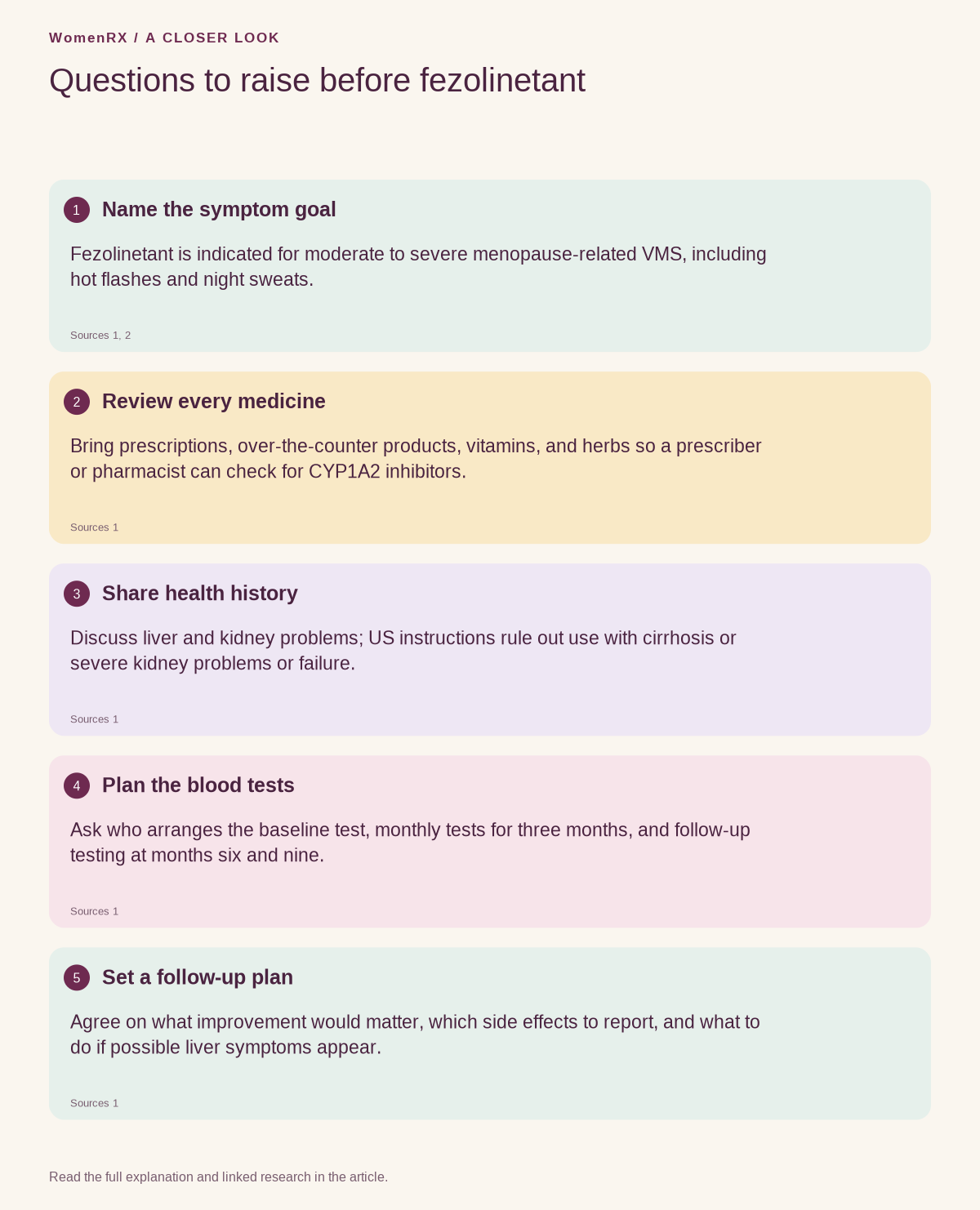
Questions to raise before fezolinetant
Name the symptom goal: Fezolinetant is indicated for moderate to severe menopause-related VMS, including hot flashes and night sweats.12
Review every medicine: Bring prescriptions, over-the-counter products, vitamins, and herbs so a prescriber or pharmacist can check for CYP1A2 inhibitors.1
Share health history: Discuss liver and kidney problems; US instructions rule out use with cirrhosis or severe kidney problems or failure.1
Plan the blood tests: Ask who arranges the baseline test, monthly tests for three months, and follow-up testing at months six and nine.1
Set a follow-up plan: Agree on what improvement would matter, which side effects to report, and what to do if possible liver symptoms appear.1
Read the figure as text
Use these prompts to connect the symptom you want treated with the medicine’s safety checks and follow-up.- Name the symptom goal: Fezolinetant is indicated for moderate to severe menopause-related VMS, including hot flashes and night sweats.12
- Review every medicine: Bring prescriptions, over-the-counter products, vitamins, and herbs so a prescriber or pharmacist can check for CYP1A2 inhibitors.1
- Share health history: Discuss liver and kidney problems; US instructions rule out use with cirrhosis or severe kidney problems or failure.1
- Plan the blood tests: Ask who arranges the baseline test, monthly tests for three months, and follow-up testing at months six and nine.1
- Set a follow-up plan: Agree on what improvement would matter, which side effects to report, and what to do if possible liver symptoms appear.1
More questions, answered
Is fezolinetant a hormone?
No. Fezolinetant is a nonhormonal medicine that acts on a neurokinin pathway involved in temperature regulation. 1 2
Is it a treatment for sleep problems by themselves?
It’s indicated for menopause-related vasomotor symptoms, not sleep problems on their own. The SKYLIGHT 1 researchers noted that effects on wider quality-of-life concerns, including mood and sexual wellbeing, needed further study. 1 3
Sources you can check
- VEOZAH (FEZOLINETANT) TABLET, FILM COATED [ASTELLAS PHARMA US, INC.] | US prescribing information and patient instructionsAccessed 2026-09-25Return to first citation
- Safety of Fezolinetant for Treatment of Moderate to Severe Vasomotor Symptoms Due to Menopause: Pooled Analysis of Three Randomized Phase 3 Studies.Kagan R, Cano A, Nappi RE, English ML, Mancuso S, Wu X, Ottery FD. · Advances in therapy · 2025Return to first citation
- Fezolinetant for treatment of moderate-to-severe vasomotor symptoms associated with menopause (SKYLIGHT 1): a phase 3 randomised controlled study.Lederman S, Ottery FD, Cano A, Santoro N, Shapiro M, Stute P, Thurston RC, English M, Franklin C, Lee M, Neal-Perry G. · Lancet (London, England) · 2023Return to first citation
- Fezolinetant: A New Nonhormonal Treatment for Vasomotor Symptoms.Onge ES, Phillips B, Miller L. · The Journal of pharmacy technology : jPT : official publication of the Association of Pharmacy Technicians · 2023Return to first citation