What Fezolinetant Treats, and How It Works
Fezolinetant targets moderate to severe menopause-related hot flashes and night sweats by blocking a brain signaling pathway involved in temperature regulation.
Fezolinetant (Veozah) is a nonhormonal medicine indicated in the US for moderate to severe vasomotor symptoms due to menopause, including hot flashes and night sweats. It blocks neurokinin B from binding to the NK3 receptor in a brain pathway that helps regulate temperature. Its evidence and intended target are specific to these symptoms, not menopause concerns as a whole. 1 3 4
A treatment for a specific symptom group
Fezolinetant, sold in the US as Veozah, is indicated for moderate to severe vasomotor symptoms (VMS) due to menopause. VMS means hot flashes and night sweats. Fezolinetant is nonhormonal, and its target is this symptom group, rather than menopause generally. 1 3 4
That distinction is useful when weighing what you want help with. If disruptive hot flashes or night sweats are the main concern, the medicine’s intended target matches that concern. If you’re also dealing with vaginal symptoms, mood changes, or another midlife concern, relief of VMS shouldn’t be taken as proof that fezolinetant will address those too. Its pivotal trials measured VMS frequency and severity, not every symptom associated with menopause. 1
How the temperature pathway fits
The brain’s thermoregulatory center helps manage body temperature. One part of the signaling network connected to it is made up of KNDy neurons, named for kisspeptin, neurokinin B, and dynorphin. Menopause-related estrogen changes can affect this network. Fezolinetant blocks neurokinin B from binding to the NK3 receptor on KNDy neurons, which modulates their activity in the thermoregulatory center. 1 3
In everyday terms, fezolinetant acts on a signal involved in the brain’s temperature regulation. It doesn’t cool the body directly, and knowing how it works doesn’t tell you in advance how much relief you’ll experience. The clinical question is whether it reduces how often moderate to severe flashes or sweats happen, or how severe they feel.
What the trials measured
Two phase 3 trials compared fezolinetant with placebo during their first 12 weeks. Participants had an average of at least seven moderate to severe VMS episodes a day at the start. At week 12, average daily frequency in the 45 mg study groups had fallen by 6.4 episodes in one trial and 7.5 in the other. The corresponding placebo-group reductions were 3.9 and 5.0 episodes. The placebo-adjusted differences were 2.6 and 2.5 fewer episodes per day, respectively. These are group averages, not a prediction of an individual’s response. The trials also found reductions in symptom severity compared with placebo. 1
The numbers help put the treatment’s scope in perspective: the primary outcomes were how often moderate to severe VMS occurred and how severe they were. They don’t establish that fezolinetant treats every physical or emotional change that may occur around menopause. 1
Where sleep fits
Night sweats can interrupt sleep, so fewer episodes could matter to someone whose sleep is disrupted by them. Reviews also describe some improvement in sleep measures in fezolinetant studies. But sleep was not the medicine’s labeled symptom target, and those findings don’t establish fezolinetant as a treatment for insomnia or for sleep problems with other causes. 1 2 3
A practical way to frame the question is to separate the symptom you want treated from its possible ripple effects: Are hot flashes or night sweats the main problem, or is sleep trouble itself the larger concern? That distinction keeps expectations tied to what fezolinetant has been shown and intended to treat.
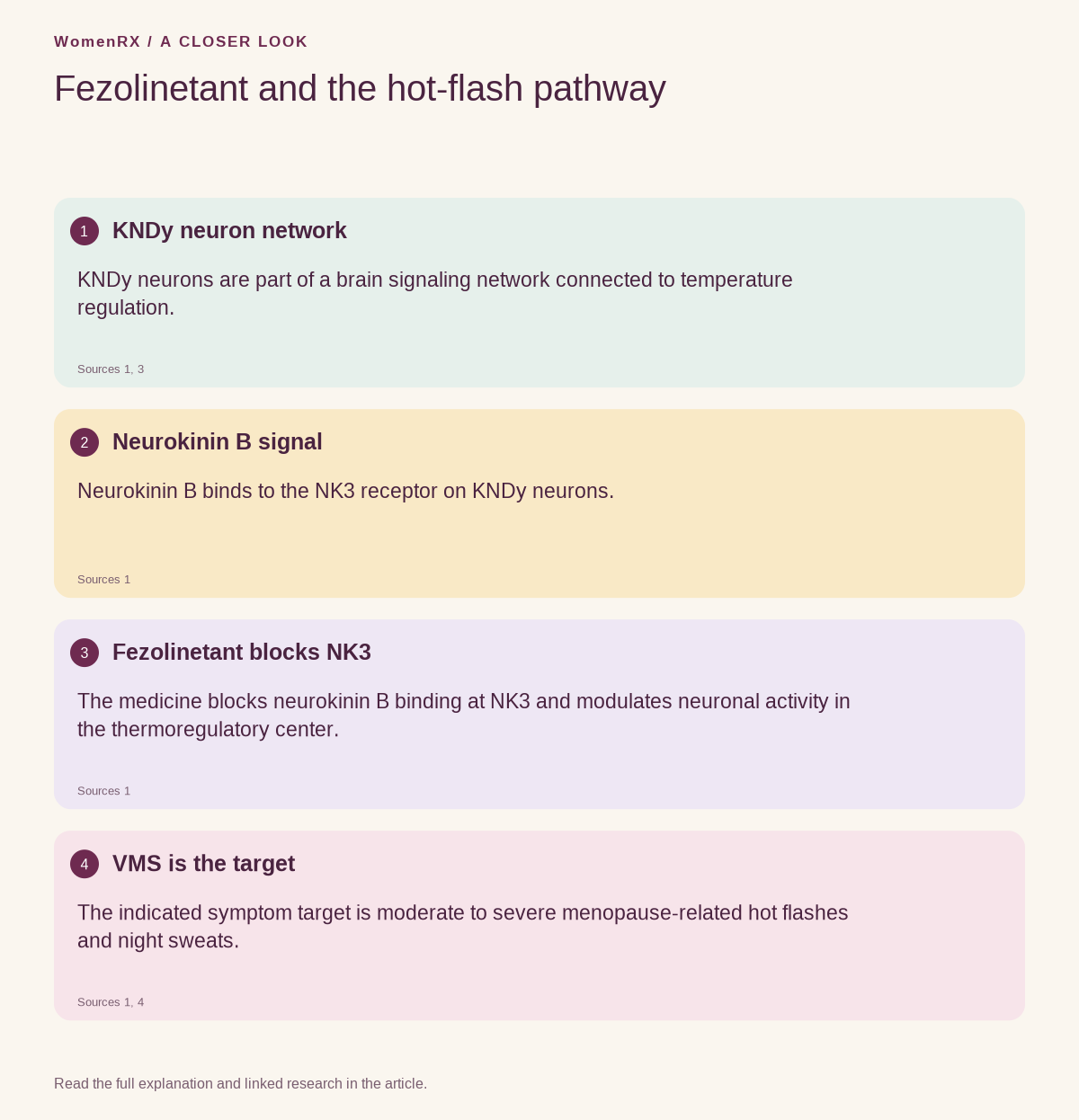
Fezolinetant and the hot-flash pathway
KNDy neuron network: KNDy neurons are part of a brain signaling network connected to temperature regulation.13
Neurokinin B signal: Neurokinin B binds to the NK3 receptor on KNDy neurons.1
Fezolinetant blocks NK3: The medicine blocks neurokinin B binding at NK3 and modulates neuronal activity in the thermoregulatory center.1
VMS is the target: The indicated symptom target is moderate to severe menopause-related hot flashes and night sweats.14
Read the figure as text
This pathway shows how fezolinetant acts on temperature-regulation signaling and identifies the menopause symptoms it is intended to treat.- KNDy neuron network: KNDy neurons are part of a brain signaling network connected to temperature regulation.13
- Neurokinin B signal: Neurokinin B binds to the NK3 receptor on KNDy neurons.1
- Fezolinetant blocks NK3: The medicine blocks neurokinin B binding at NK3 and modulates neuronal activity in the thermoregulatory center.1
- VMS is the target: The indicated symptom target is moderate to severe menopause-related hot flashes and night sweats.14
More questions, answered
Is fezolinetant a hormone treatment?
No. Fezolinetant is described as a nonhormonal, selective NK3 receptor antagonist. It acts on a brain signaling pathway involved in temperature regulation. 1 3
Does fezolinetant treat insomnia?
Its US indication is for moderate to severe menopause-related vasomotor symptoms, not insomnia. Some sleep improvement has been reported in reviews of fezolinetant studies, but that doesn’t establish it as a treatment for insomnia or sleep problems unrelated to hot flashes and night sweats. 1 2 3
Sources you can check
- VEOZAH (FEZOLINETANT) TABLET, FILM COATED [ASTELLAS PHARMA US, INC.] | US prescribing information and patient instructionsAccessed 2026-09-25Return to first citation
- Neurokinin Antagonists to Treat Vasomotor Symptoms-Possible Implications for Long-Term Health and Disease.Cagnacci A, Xholli A, Fiamberti M, Londero AP. · Journal of clinical medicine · 2025Return to first citation
- A profile of safety and efficacy of fezolinetant for the treatment of menopausal vasomotor symptoms.Cucinella L, Cassani C, Tedeschi S, Memoli S, Martini E, Nappi RE. · Expert review of clinical pharmacology · 2025Return to first citation
- Elinzanetant: Defining the Role of Dual Neurokinin-1 and Neurokinin-3 Receptor Antagonism for Management of Vasomotor Symptoms in Menopause.Teli V, Teli A. · Journal of menopausal medicine · 2026Return to first citation