How Wegovy Affects Eating and What It Treats
Wegovy can help reduce food intake, but its uses depend on whether it’s the injection or tablet and on the condition being treated.
Wegovy contains semaglutide, which activates GLP-1 receptors involved in appetite regulation and helps people eat less. Both Wegovy forms are prescribed for long-term weight management in eligible adults and to reduce certain cardiovascular events in eligible adults. The injection also has uses for adolescents with obesity and adults with a specific form of liver disease. Wegovy and Ozempic contain the same drug, but their approved uses differ.13

What the GLP-1 effect feels like in everyday terms
Semaglutide activates receptors for GLP-1, a hormone involved in regulating appetite and calorie intake. Wegovy’s prescribing information says semaglutide decreases calorie intake, likely through its effects on appetite. It also delays stomach emptying and affects the release of insulin and glucagon when blood glucose changes. Those are different actions of the same drug, not proof that every condition linked to weight or blood sugar is a Wegovy treatment target.1
A randomized trial offers a useful distinction between eating less and feeling less hungry. Researchers assigned 120 adults with overweight or obesity to injected semaglutide or placebo and measured what they ate at a laboratory lunch over 60 weeks. The semaglutide group had larger reductions in lunch intake at weeks 20, 40 and 60. They also reported greater improvements in several appetite measures at week 20, but the groups no longer differed significantly on those appetite measures at weeks 40 or 60. In other words, the effect on food intake persisted in this study even when the difference in reported hunger became less clear.2
Which uses belong to Wegovy?
The answer changes slightly by formulation. Both the injection and tablet are used alongside a reduced-calorie diet and increased physical activity to reduce excess body weight and maintain weight reduction long term in adults with obesity, or adults with overweight and at least one weight-related condition. Both are also indicated to reduce the risk of cardiovascular death, nonfatal heart attack or nonfatal stroke in adults who already have cardiovascular disease and have obesity or overweight.1
The injection has two additional uses listed in its prescribing information. Its weight-management indication includes young people ages 12 and older with obesity; the tablet’s weight-management indication is for adults. The injection is also indicated for adults with noncirrhotic metabolic dysfunction-associated steatohepatitis, or MASH, and moderate to advanced liver scarring consistent with fibrosis stages F2 to F3. That does not mean it’s a treatment for every kind of fatty liver disease. The MASH indication received accelerated approval based on improvement in liver inflammation and scarring seen on biopsies; continued approval may depend on confirmation of clinical benefit.1
That liver distinction is backed by more than an explanation of how GLP-1 works. In a randomized trial’s 72-week analysis of 800 adults with MASH and stage F2 or F3 fibrosis, the estimated rate of MASH resolution without worsening fibrosis was 63% with Wegovy injection versus 34% with placebo. The estimated rate of fibrosis improvement without worsening MASH was 37% versus 22%. These are biopsy findings in the studied population, not evidence that the tablet has the same MASH indication or that improvement in longer-term health outcomes has been confirmed.1
The cardiovascular use has its own trial evidence, too. Among adults with established cardiovascular disease and overweight or obesity but without diabetes, a first cardiovascular death, nonfatal heart attack or nonfatal stroke occurred in 569 of 8,803 assigned to Wegovy injection and 701 of 8,801 assigned to placebo over a median follow-up of 41.8 months. The exact way semaglutide lowers this combined risk has not been established. Appetite suppression alone shouldn’t be treated as its proven explanation.1
Same ingredient, different product
Ozempic also contains semaglutide, but its listed uses center on adults with type 2 diabetes: improving blood sugar control, reducing major cardiovascular events in those with established cardiovascular disease, and reducing certain kidney and cardiovascular risks in those with chronic kidney disease. A result from an Ozempic diabetes trial isn’t automatically a result for Wegovy’s weight-management population, and Wegovy’s MASH indication doesn’t become an Ozempic indication because the ingredient is shared. Wegovy’s prescribing information also does not recommend using it alongside another semaglutide-containing product or another GLP-1 receptor agonist.13
What the evidence says for women
Women were included in the appetite trial: 94 of its 120 participants were female. The reported appetite and lunch-intake results were for the groups as a whole, not separate estimates for women. In the Wegovy injection cardiovascular trial, 72% of participants were male; its prescribing information reports that the effect on the combined cardiovascular outcome was not affected by sex, without giving a women-only event rate in these sections. In the MASH trial’s 72-week analysis, 57% of participants were female, but the biopsy results presented here are not broken out by sex. None of those overall percentages predicts an individual woman’s result.21
Pregnancy and breastfeeding bring different questions. Human pregnancy data are insufficient to establish Wegovy’s risks. Its prescribing information says weight loss offers no benefit during pregnancy and directs discontinuation when pregnancy is recognized in someone using it for weight reduction. For someone being treated for MASH with advanced fibrosis, it calls for weighing potential maternal benefit against fetal risk rather than assuming the same decision applies.1
For breastfeeding, the formulation matters again. Breastfeeding is not recommended during treatment with Wegovy tablets because their absorption enhancer, SNAC, or its metabolites are present in human milk and the potential effects on infants are uncertain. For Wegovy injection, there are no human-milk data establishing whether injected semaglutide reaches milk or affects the infant or milk production. That uncertainty isn’t the same as proof of harm, or proof of safety.1
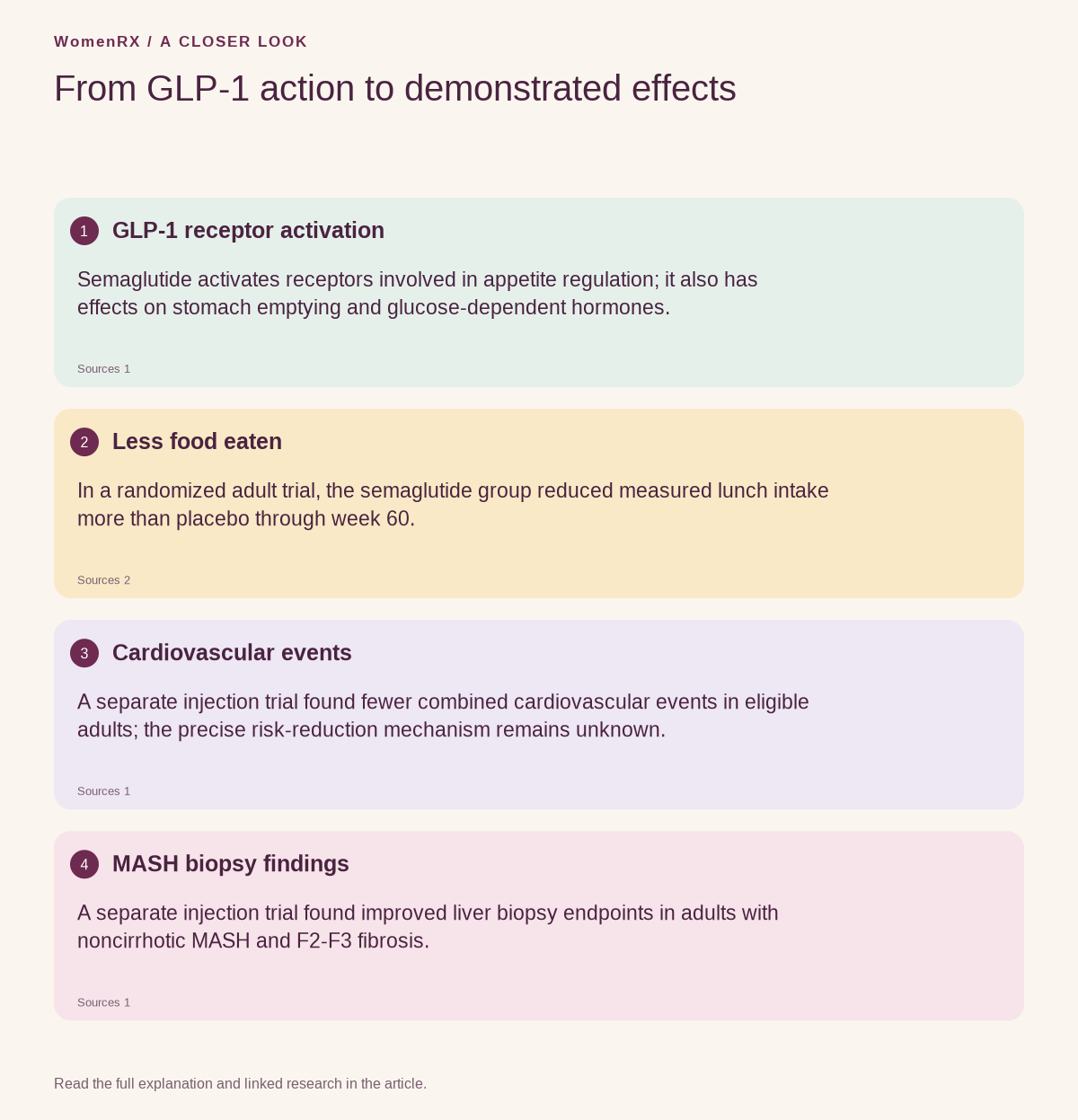
From GLP-1 action to demonstrated effects
GLP-1 receptor activation: Semaglutide activates receptors involved in appetite regulation; it also has effects on stomach emptying and glucose-dependent hormones.1
Less food eaten: In a randomized adult trial, the semaglutide group reduced measured lunch intake more than placebo through week 60.2
Cardiovascular events: A separate injection trial found fewer combined cardiovascular events in eligible adults; the precise risk-reduction mechanism remains unknown.1
MASH biopsy findings: A separate injection trial found improved liver biopsy endpoints in adults with noncirrhotic MASH and F2-F3 fibrosis.1
Read the figure as text
Follow the appetite pathway, then see why other Wegovy uses require their own clinical evidence.- GLP-1 receptor activation: Semaglutide activates receptors involved in appetite regulation; it also has effects on stomach emptying and glucose-dependent hormones.1
- Less food eaten: In a randomized adult trial, the semaglutide group reduced measured lunch intake more than placebo through week 60.2
- Cardiovascular events: A separate injection trial found fewer combined cardiovascular events in eligible adults; the precise risk-reduction mechanism remains unknown.1
- MASH biopsy findings: A separate injection trial found improved liver biopsy endpoints in adults with noncirrhotic MASH and F2-F3 fibrosis.1
Sources you can check
- WEGOVY (SEMAGLUTIDE) INJECTION, SOLUTION WEGOVY (SEMAGLUTIDE) TABLET [NOVO NORDISK PHARMACEUTICAL INDUSTRIES, LP] | US prescribing information and patient instructionsAccessed 2026-09-25Return to first citation
- Short- and long-term effects of semaglutide 2.4 mg on energy intake, appetite, and food reward: a 60-week, double-blind randomized controlled trial.Tronieri JS, Allison KC, DeRouen K, Amaro A, Collins KG, Roy A, Watts S, Ananna T, Wadden TA. · The American journal of clinical nutrition · 2026Return to first citation
- OZEMPIC (SEMAGLUTIDE) INJECTION, SOLUTION [NOVO NORDISK PHARMACEUTICAL INDUSTRIES, LP] | US prescribing information and patient instructionsAccessed 2026-09-25Return to first citation