Wegovy and an Eating Disorder History: What to Discuss
A past eating disorder doesn’t decide the question on its own; current recovery, treatment goals, and a plan for noticing changes all matter.
Having an eating disorder history doesn’t, by itself, tell you whether Wegovy is right for you. The discussion should include your current symptoms and recovery, the reason for considering treatment, and what support would help protect your relationship with food. Research is limited, and few studies specifically answer how semaglutide affects people with a diagnosed eating disorder history. 2
Start with your situation now
There isn’t a simple yes-or-no answer that applies to everyone with a past or current eating disorder. A useful discussion looks at what’s happening now, what you hope treatment will address, and whether the people supporting your recovery can stay involved.
It may help to describe your history in your own terms: what symptoms you’ve experienced, whether any are active, what recovery looks like for you, and which changes would feel concerning. You don’t need to prove that your history is serious enough to mention. If weight or food conversations have affected your body image, say that too. It helps your care team understand the whole context, not just a number or a diagnosis.
Semaglutide affects the brain and body systems involved in food intake and satiety. That makes it reasonable to discuss how appetite changes might fit with your recovery patterns, including whether they could make it harder to notice hunger, keep familiar eating routines, or feel at ease around food. Those are questions to plan for, not outcomes that happen to everyone. 1
What the research can and can’t tell you
A rapid review included 25 studies of GLP-1 medicines in adolescents and adults with obesity or type 2 diabetes. The studies measured eating behaviors and eating-disorder risk in different ways. Some reported improvements in binge-eating measures or cravings; other measures were unchanged. The review’s overall message was that evidence is limited, and it doesn’t establish what will happen for a particular person with a diagnosed eating disorder history. 2
One retrospective study followed adults with class 3 obesity in a multidisciplinary weight-management program. Among 203 participants with follow-up data who weren’t taking a GLP-1 medicine at the start, 31 began one. At 12 months, researchers found no statistically significant change in their eating-disorder-risk or psychological-distress questionnaire scores, and none stopped treatment because of eating-disorder symptoms or distress. This is reassuring context, but it wasn’t a trial designed to answer whether semaglutide is safe or suitable for every person with a past eating disorder. 3
A published case report described worsening restrictive symptoms in one adolescent taking semaglutide. A single case can’t show how often this happens or predict what an adult will experience. It does support taking changes in eating behavior seriously rather than assuming they’re automatically part of weight treatment. 4
Taken together, these findings don’t prove that Wegovy causes or treats an eating disorder. They also don’t settle the decision for someone whose symptoms are active, recently improved, or long in the past. The studies don’t provide a reliable rule for making that decision from history alone. 2 3 4
Make the conversation specific
You could bring these questions to the prescribing clinician and, if you have one, your eating-disorder therapist or dietitian:
- What is the treatment goal in my case? Ask what health concern the medicine is meant to address and how you’ll judge whether the plan is helping, beyond changes in weight.
- Which parts of my history matter right now? Describe current or returning patterns that concern you, and what has helped you stay grounded in recovery.
- Who will notice changes with me? Agree on which members of your care team will check in about eating behavior and emotional well-being, and how you can reach them if something shifts.
- What would prompt us to revisit the plan? You might name examples that matter to you, such as returning to restrictive rules, stronger fear around eating or weight changes, or renewed bingeing or compensatory urges. These are discussion prompts, not a diagnostic checklist.
A plan can include noticing whether appetite changes are disrupting routines or recovery supports, not just recording weight. If you’re already working with an eating-disorder clinician, ask whether they can coordinate with the prescriber. The aim is for the people involved to understand both the medical goal and what recovery requires for you.
Pregnancy, trying to conceive, postpartum recovery, or breastfeeding can also change the context of a treatment decision. Bring up any of these that apply, along with body-image pressures or changes in support. The point isn’t to assume what the medication means for that stage; it’s to make sure those circumstances are part of the individualized conversation.
Keep room to adjust
The best plan is one you can revisit. Before starting, you can agree on what you want to monitor, who will follow up, and what changes would lead you to pause and talk through the approach. If eating-disorder symptoms return or intensify, tell your care team rather than treating that change as a personal failure or something you have to manage alone.
An eating disorder history deserves attention, but it doesn’t erase your other health needs. A thoughtful decision makes space for both.
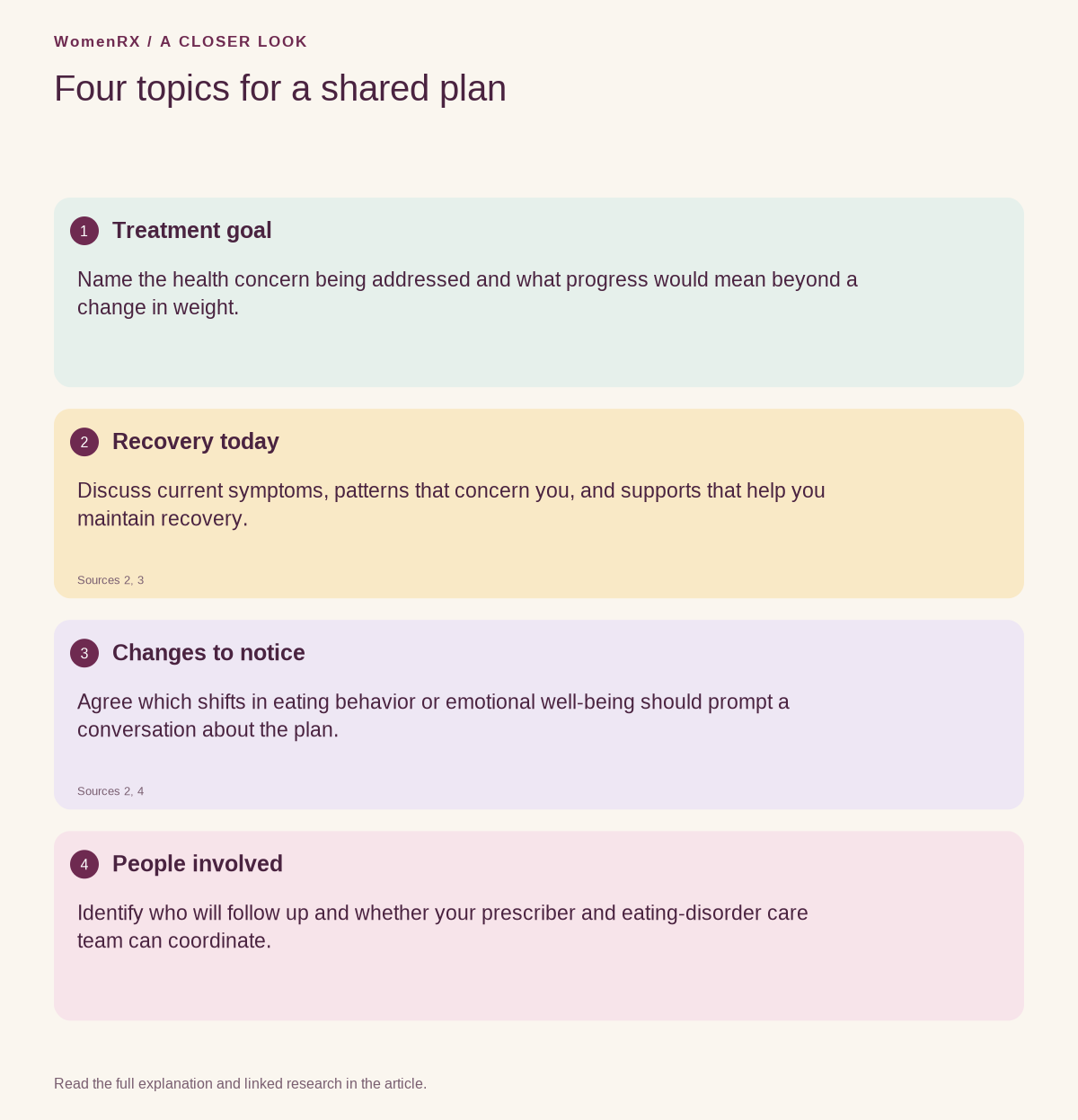
Four topics for a shared plan
Treatment goal: Name the health concern being addressed and what progress would mean beyond a change in weight.
Recovery today: Discuss current symptoms, patterns that concern you, and supports that help you maintain recovery.23
Changes to notice: Agree which shifts in eating behavior or emotional well-being should prompt a conversation about the plan.24
People involved: Identify who will follow up and whether your prescriber and eating-disorder care team can coordinate.
Read the figure as text
Use these prompts to connect the reason for treatment with recovery needs and a plan for noticing meaningful changes.- Treatment goal: Name the health concern being addressed and what progress would mean beyond a change in weight.
- Recovery today: Discuss current symptoms, patterns that concern you, and supports that help you maintain recovery.23
- Changes to notice: Agree which shifts in eating behavior or emotional well-being should prompt a conversation about the plan.24
- People involved: Identify who will follow up and whether your prescriber and eating-disorder care team can coordinate.
More questions, answered
Does Wegovy treat binge-eating disorder?
The available review describes some improvements in binge-eating measures in studies of GLP-1 medicines, but the evidence is limited and doesn’t establish Wegovy as an eating-disorder treatment. The findings aren’t enough to replace a separate discussion of eating-disorder care. 2
What if my eating disorder was years ago?
These studies don’t provide a cutoff based on how long ago symptoms occurred. Your current recovery, any returning patterns, and the supports you have are more useful points to discuss than relying on a particular number of symptom-free years. 2 3
Sources you can check
- Glucagon-like peptide-1 receptor agonist semaglutide through the lens of psychiatry: a systematic review of potential benefits and risks.Carminati M, Tondello M, Concina A, Olgiati P, Zanardi R. · International clinical psychopharmacology · 2026Return to first citation
- GLP-1 Receptor Agonist Medications for Obesity and Type 2 Diabetes Treatment: A Rapid Review of Changes in Eating Behaviors and Eating Disorder Risk.Jebeile H, Danielsen YS, Sumithran P, Lorien S, Jardine IR, Baur LA, Lister NB. · Obesity reviews : an official journal of the International Association for the Study of Obesity · 2026Return to first citation
- Effects of GLP-1 Receptor Agonist Therapy on Eating Disorder Risk and Psychological Distress in Adults With Class 3 Obesity.Maynard S, Hay P, Chimoriya R, Acosta Reyes P, Grudzinskas K, Kormas N, Piya MK. · The International journal of eating disorders · 2026Return to first citation
- Semaglutide-associated worsening of atypical anorexia nervosa in an adolescent girl: case report.Liekens L, Kaïret K, Elst EF. · BJPsych open · 2025Return to first citation