Tirzepatide and Eating Disorder History: What to Discuss
A past or current eating disorder doesn’t settle the decision; your present symptoms, treatment goals, and support deserve a place in the conversation.
There isn’t a reliable yes-or-no rule for tirzepatide when you have an eating disorder history. Research on these medications in people with current or past eating disorders is limited, and guidance specific to this situation is lacking. Discuss what’s happening with eating and weight-related thoughts now, what treatment is meant to help, and how your care teams would stay in touch. 13

An eating disorder history is relevant to a tirzepatide decision, but it doesn’t tell the whole story. Active symptoms and a past diagnosis with stable recovery are different situations. The useful question is how the medication’s effects on appetite and eating might fit with your current health goals, history, and support. Research has not established a simple rule for who with an eating disorder history should or shouldn’t use these medications. 13
That uncertainty doesn’t mean you need to decide alone or assume the answer is no. It does mean your prescriber should understand more than a diagnosis from the past, and your mental-health or eating-disorder team may have important context to add.
Describe what’s happening now
Tell the prescriber whether eating-disorder symptoms are active, have changed recently, or have been absent for some time. If it helps, describe specific patterns rather than relying only on a label: for example, restricting food, regularly missing meals, bingeing, purging, or feeling increasingly preoccupied with controlling weight. These are conversation prompts, not a diagnostic checklist.
The reason to discuss them is that appetite changes could matter differently for different people. Emerging literature raises concern that appetite suppression may reinforce restriction or avoidance of regular eating for some people, while early findings suggest possible improvement in binge-eating symptoms in some groups. Neither is an established effect of tirzepatide for an individual, and the research is limited. 12
If your eating disorder is in the past and you feel well now, say that too. Ask what changes in eating or weight-related thoughts the team would want to hear about, and who you should contact if something shifts. Researchers have called for screening before and during treatment and better multidisciplinary monitoring, but validated monitoring tools and specific clinical guidance for this group are lacking. 13
Make the treatment goal clear
Ask what health concern tirzepatide is meant to address in your case, and what meaningful benefit would look like beyond a change on the scale. You can also ask what the team would reconsider if appetite changes made regular eating, recovery, or another treatment goal harder.
It may help to talk about the kind of weight-focused care you’ve had before. For instance, did weighing or weight-loss conversations feel useful, stressful, or connected to old symptoms? If you’re in a life stage that affects your priorities or how you feel about weight-centered care, such as postpartum or menopause, you can name that too. These details help the team understand what goals and language feel supportive; they don’t by themselves determine whether the medication is suitable.
Agree on support and follow-up
Before treatment begins, ask who will check in about eating patterns and distress, and whether your prescriber can coordinate with your therapist, eating-disorder clinician, or dietitian if you have one. If you don’t have a mental-health or nutrition support person, ask what support is available through the care team.
Together, you might agree on personal signs to report, such as returning binge or purge behaviors, increased restriction, avoiding regular meals, or more intense weight and body-image concerns. These are examples drawn from emerging concerns in the literature, not a validated risk tool. 13
A 2026 scoping review found only nine empirical studies on weight-loss injections and eating disorders, covering different medications and diagnoses. It concluded that evidence about psychological effects is very limited and clinical guidance is lacking. That makes the findings hard to apply specifically to tirzepatide or to predict what will happen for one person. 1
Questions to bring to your care team
- How do my current eating patterns and past treatment affect this decision?
- What health goal are we aiming for, beyond weight change?
- What changes in eating or weight-related thoughts should I report?
- Who will follow up, and can my care teams coordinate?
- If treatment makes recovery or regular eating harder, what would we reconsider?
- What kind of weight-focused language or follow-up feels supportive to me?
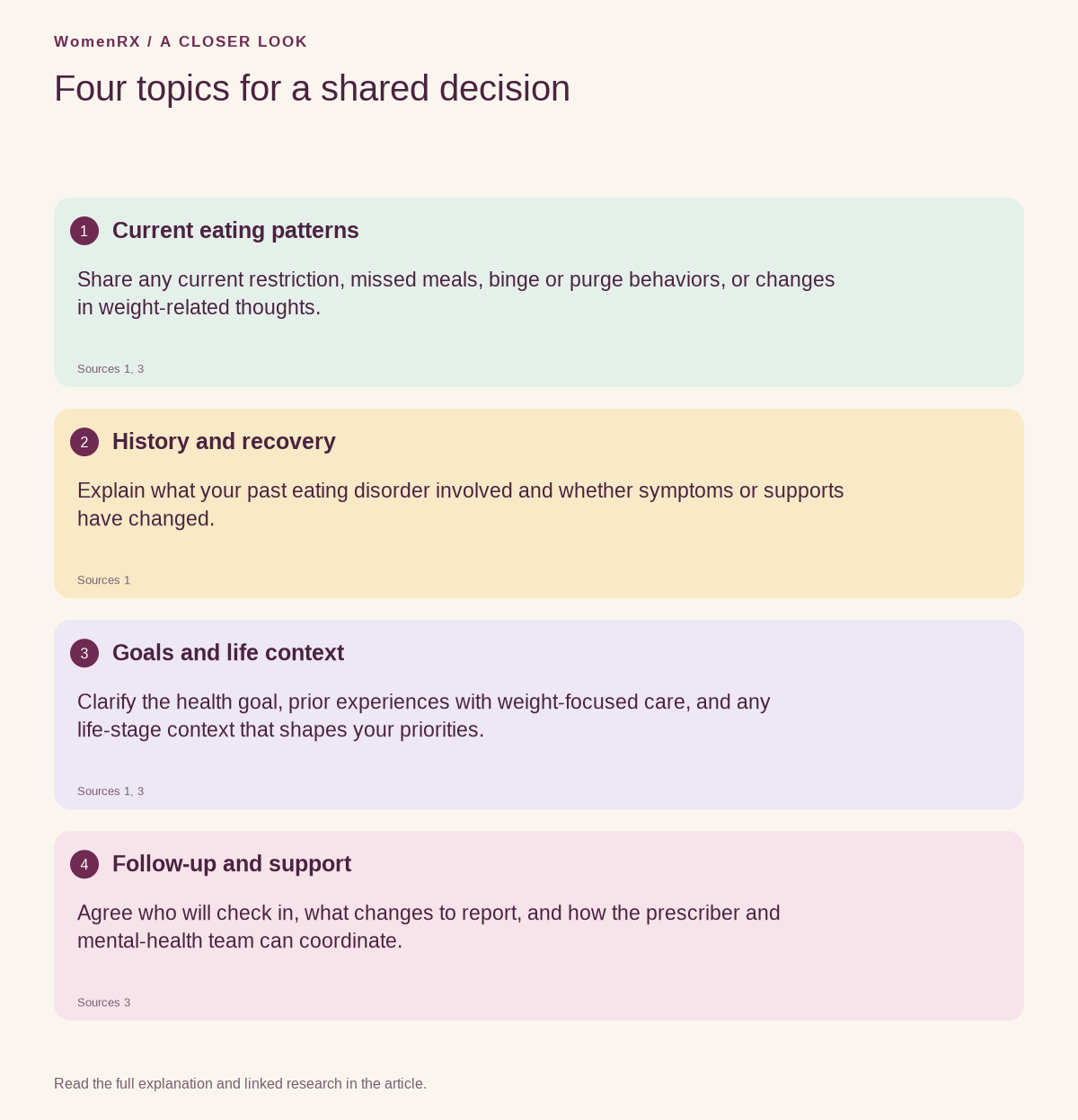
Four topics for a shared decision
Current eating patterns: Share any current restriction, missed meals, binge or purge behaviors, or changes in weight-related thoughts.13
History and recovery: Explain what your past eating disorder involved and whether symptoms or supports have changed.1
Goals and life context: Clarify the health goal, prior experiences with weight-focused care, and any life-stage context that shapes your priorities.13
Follow-up and support: Agree who will check in, what changes to report, and how the prescriber and mental-health team can coordinate.3
Read the figure as text
Use these prompts to make room for current symptoms, personal context, treatment goals, and follow-up. They are not a validated screening tool.- Current eating patterns: Share any current restriction, missed meals, binge or purge behaviors, or changes in weight-related thoughts.13
- History and recovery: Explain what your past eating disorder involved and whether symptoms or supports have changed.1
- Goals and life context: Clarify the health goal, prior experiences with weight-focused care, and any life-stage context that shapes your priorities.13
- Follow-up and support: Agree who will check in, what changes to report, and how the prescriber and mental-health team can coordinate.3
More questions, answered
Does a past eating disorder automatically rule out tirzepatide?
The available research doesn’t establish an automatic yes or no. The decision needs to account for your current symptoms, treatment goals, and support; evidence and clinical guidance specific to people with eating-disorder histories remain limited. 1
Is tirzepatide a treatment for binge eating?
The limited research on GLP-1-based medications includes preliminary reports of possible improvement in binge-eating symptoms in some groups, but it doesn’t establish tirzepatide as an eating-disorder treatment. The same appetite effects may raise different concerns for someone vulnerable to restrictive eating. 12
Sources you can check
- A scoping review on weight loss injections and eating disorders: therapeutic impact, risks of misuse, and emerging harms.Barrett P, Papastavrou Brooks C, McCluskey S, Brown A. · Journal of eating disorders · 2026Return to first citation
- The dual role of GLP-1 receptor agonists in weight management and eating disorders: Potential benefits and risks.Leziak A, Kochman K, Kocełak P. · Journal of psychiatric research · 2026Return to first citation
- Eating Disorders in the GLP-1 Era: A Spotlight on Emerging Clinical Risks, Research Gaps, and Practice Priorities.Škudar S. · The International journal of eating disorders · 2026Return to first citation