Ozempic and an Eating Disorder History: What to Discuss
A useful decision looks at your current recovery, the treatment goal, possible stomach symptoms, and the support you’d want in place.
An eating disorder history doesn’t settle whether Ozempic is right for you. Tell your prescriber what’s happening with eating and recovery now, why you’re considering treatment, and who supports you. Ask how you’ll respond if nausea, vomiting, or diarrhea makes eating or drinking difficult. Research has not established how semaglutide affects recovery from a specific eating disorder. 14

Start with the present, not just the diagnosis
A past eating disorder can remain relevant even when you feel well. Active symptoms call for a different conversation than a remote history with no current concerns. Neither your diagnosis nor your body size tells your care team everything about how treatment might fit your life.
Describe what recovery looks like lately. For example, are you eating in a way that feels manageable? Have old behaviors or urges returned? Do changes in appetite, weight, or attention to the scale feel difficult? You’re giving your clinicians a useful picture of the present, not trying to prove that your history does or doesn’t count.
The uncertainty is real but specific: studies of mental-health outcomes with GLP-1 medicines have not established what semaglutide does to recovery for people with particular eating disorder diagnoses. A review of obesity interventions also found that long-term mental-health data for GLP-1 medicines remain limited. 4
Make the health goal clear
Ask what concern Ozempic is meant to address for you and how you’ll know whether it’s helping. If weight is part of that conversation, it needn’t be the only measure that matters. Body weight alone cannot tell the whole story of someone’s health. 2
This is also a chance to say how you’d like progress discussed. For example, if frequent weigh-ins or detailed talk about appetite would be unsettling, ask whether follow-up can focus on the treatment goal and how you’re functioning. That preference doesn’t determine the medical plan on its own, but it helps your team make one you can participate in.
Talk through stomach symptoms before they happen
Ozempic’s prescribing information warns that nausea, vomiting, and diarrhea can cause dehydration and kidney problems. It also says to report stomach problems that are severe or do not go away. 1
If feeling sick could make eating or drinking difficult, say so before treatment begins. Ask who you would contact, how quickly you should report symptoms, and what would prompt a change in the plan. These questions matter for your physical health and for a recovery plan that may depend on eating consistently. They don’t assume that you’ll have side effects.
Decide who should be involved in follow-up
If a therapist, dietitian, or other recovery support knows what has helped you stay well, ask whether you want them involved. Clarify who will check in about stomach symptoms, eating patterns, and distress, and how you can raise a concern between visits. You might also agree in advance on what changes would lead you and your team to reconsider the treatment.
One observational study of people with pre-existing neuropsychiatric conditions reported outcomes in a combined category covering eating, sleep, and behavioral disorders. That category cannot show whether semaglutide prevents or triggers a relapse of any particular eating disorder. 3
A few questions can keep the conversation focused:
- What health goal are we treating, and what would count as a meaningful benefit for me?
- How do my current symptoms differ from my past history when we weigh this decision?
- What’s the plan if stomach symptoms interfere with eating or drinking?
- Who will check in on recovery as well as physical side effects?
- What would tell us this plan no longer fits?
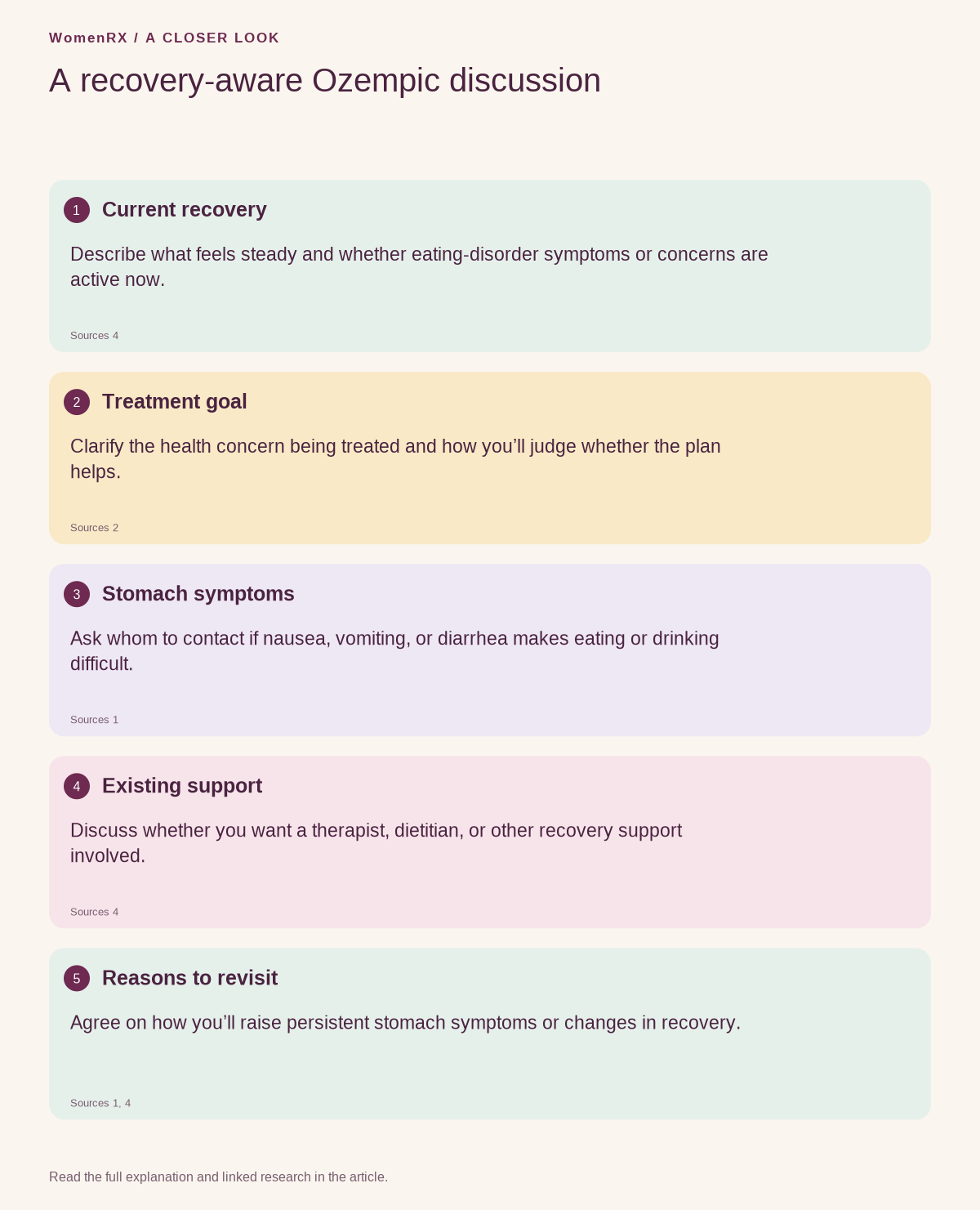
A recovery-aware Ozempic discussion
Current recovery: Describe what feels steady and whether eating-disorder symptoms or concerns are active now.4
Treatment goal: Clarify the health concern being treated and how you’ll judge whether the plan helps.2
Stomach symptoms: Ask whom to contact if nausea, vomiting, or diarrhea makes eating or drinking difficult.1
Existing support: Discuss whether you want a therapist, dietitian, or other recovery support involved.4
Reasons to revisit: Agree on how you’ll raise persistent stomach symptoms or changes in recovery.14
Read the figure as text
Use these prompts to make the decision about your present health and the support you would need.- Current recovery: Describe what feels steady and whether eating-disorder symptoms or concerns are active now.4
- Treatment goal: Clarify the health concern being treated and how you’ll judge whether the plan helps.2
- Stomach symptoms: Ask whom to contact if nausea, vomiting, or diarrhea makes eating or drinking difficult.1
- Existing support: Discuss whether you want a therapist, dietitian, or other recovery support involved.4
- Reasons to revisit: Agree on how you’ll raise persistent stomach symptoms or changes in recovery.14
More questions, answered
Does Ozempic treat an eating disorder?
Semaglutide has not been established as a treatment for eating disorders. If Ozempic is being considered for another health goal, ask how your eating-disorder care would continue alongside it. 4
Does a past eating disorder automatically rule out Ozempic?
Not necessarily. A past diagnosis alone cannot describe your current symptoms, treatment goals, or support needs. Those are the details to discuss before deciding whether the medication fits. Research does not provide a reliable diagnosis-specific answer about recovery outcomes. 4
Sources you can check
- OZEMPIC (SEMAGLUTIDE) INJECTION, SOLUTION [A-S MEDICATION SOLUTIONS] | US prescribing information and patient instructionsAccessed 2026-09-25Return to first citation
- Body Weight: MedlinePlusAccessed 2026-09-25Return to first citation
- Higher semaglutide dose is associated with lower neuropsychiatric event incidence independent of weight loss.Murugadoss K, Venkatakrishnan AJ, Soundararajan V. · npj metabolic health and disease · 2026Return to first citation
- Mental health outcomes in obesity interventions with GLP-1 receptor agonists: is it similar to other obesity interventions? A narrative review with systematic evidence synthesis.Osborne D, Abdelgadir E. · International journal of obesity (2005) · 2026Return to first citation