Zepbound and an Eating Disorder History: Making a Shared Plan
An eating disorder history deserves a place in the Zepbound conversation, but it doesn’t decide the answer by itself.
Research doesn’t yet tell us how Zepbound affects someone with a current or past eating disorder. Most studies in this area are small, focus on binge eating disorder, and examine medicines other than tirzepatide. A useful next step is to discuss your weight-related health goals alongside your recovery priorities, the support you have, and how you’d revisit the decision if things change. 134
Start with both health and recovery
An eating disorder history doesn’t, by itself, tell you whether Zepbound is a good fit. The more useful question is whether the treatment you’re considering serves your health goals while leaving room to protect your recovery. You shouldn’t have to treat those as separate conversations.
Tell the clinician discussing Zepbound what your eating disorder has looked like for you, whether it’s current or in the past, and what support you have now. If you work with an eating-disorder clinician, ask how they and the prescriber can stay aligned. You can also say what matters beyond weight, such as a steadier relationship with food or being able to participate in meals without distress. Those are examples of priorities you may want considered, not goals someone else should choose for you.
Why binge-eating research doesn’t settle the question
A 2026 scoping review found very limited research on the psychological effects of weight-loss injections in people with current or past eating disorders. The studies covered different medicines and eating-disorder situations, leaving little basis for predicting one person’s response to Zepbound. 1
There is some early evidence involving binge eating disorder (BED). A 2025 meta-analysis combined five studies with 182 participants and reported improved binge-eating scores among people receiving GLP-1 medicines. Those studies examined liraglutide, semaglutide, or dulaglutide, not tirzepatide. They also differed in design and population, so the finding doesn’t establish that Zepbound treats BED. 3
The distinction matters even more if your history involves anorexia, bulimia, or another eating disorder. Reviews describe the evidence as concentrated in BED, with limited evidence for other diagnoses; a review of BED treatments says it remains unclear whether tirzepatide helps BED. Possible improvements in binge-eating symptoms with other medicines can’t answer what treatment would mean for your recovery. 124
Agree on what you’ll pay attention to
Before deciding, try to make the plan specific enough that you’d know when to speak up and whom to contact. These prompts can help:
- Name the reason for treatment. What health concern are you hoping Zepbound will address? Which outcomes matter to you besides weight?
- Name what you want to protect. For example, would a change in eating patterns, more distress around meals, or renewed body-image concerns signal that you want to check in? You don’t need to predict whether any of these will happen to decide what deserves attention.
- Connect your support. If you have an eating-disorder care team, discuss how they and the prescriber will share concerns. If you don’t, ask what support could be part of the plan.
- Choose a point to reconsider. Agree on when you’ll review both your health goals and your experience of eating and recovery, and what would prompt an earlier conversation.
You could ask, “What are we hoping this treatment will improve?” and “If my eating or distress changes, who should I tell, and how would we reconsider the plan?” The point isn’t to pass a test of whether you’re doing treatment correctly. It’s to make the decision responsive to your whole health.
If pregnancy or postpartum life is part of the picture
If you’re planning a pregnancy, pregnant, or postpartum, bring that into the discussion of your goals and support. For example, pregnancy planning may change the questions you want answered before starting a weight-management treatment, while postpartum life may change what help you have around meals and recovery. Research on weight-loss injections and eating disorders doesn’t establish how tirzepatide affects recovery in these circumstances. 1
You don’t need to assume that your history predicts either harm or benefit. You do deserve a plan that takes it seriously, makes space for uncertainty, and can change if your experience changes.
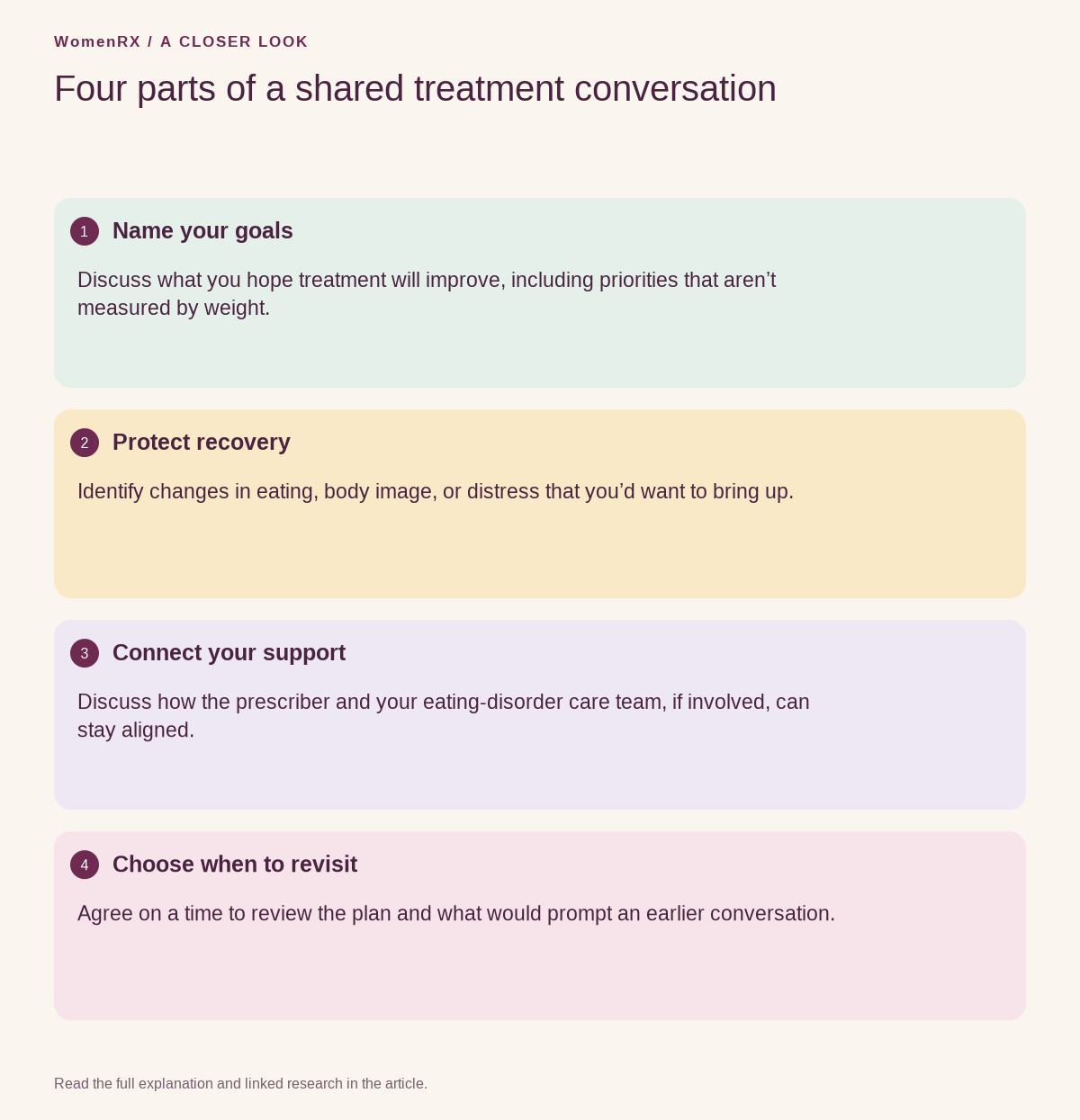
Four parts of a shared treatment conversation
Name your goals: Discuss what you hope treatment will improve, including priorities that aren’t measured by weight.
Protect recovery: Identify changes in eating, body image, or distress that you’d want to bring up.
Connect your support: Discuss how the prescriber and your eating-disorder care team, if involved, can stay aligned.
Choose when to revisit: Agree on a time to review the plan and what would prompt an earlier conversation.
Read the figure as text
Use these prompts to put health goals and recovery priorities in the same discussion.- Name your goals: Discuss what you hope treatment will improve, including priorities that aren’t measured by weight.
- Protect recovery: Identify changes in eating, body image, or distress that you’d want to bring up.
- Connect your support: Discuss how the prescriber and your eating-disorder care team, if involved, can stay aligned.
- Choose when to revisit: Agree on a time to review the plan and what would prompt an earlier conversation.
More questions, answered
Does research on binge eating disorder apply to anorexia or bulimia?
Not reliably. The limited research on GLP-1 medicines and eating disorders has focused largely on binge eating disorder. Findings about binge-eating symptoms shouldn’t be treated as evidence of benefit or safety for anorexia, bulimia, or another eating disorder. 123
Sources you can check
- A scoping review on weight loss injections and eating disorders: therapeutic impact, risks of misuse, and emerging harms.Barrett P, Papastavrou Brooks C, McCluskey S, Brown A. · Journal of eating disorders · 2026Return to first citation
- Psychiatric effects of GLP-1 receptor agonists: A systematic review of emerging evidence.Sa B, Maristany A, Subramaniam A, Guillen R, Buonocore B, Smith A, Oldak SE, Padilla V. · Diabetes, obesity & metabolism · 2026Return to first citation
- The impact of glucagon-like peptide-1 (GLP-1) agonists in the treatment of eating disorders: a systematic review and meta-analysis.Radkhah H, Rahimipour Anaraki S, Parhizkar Roudsari P, Arabzadeh Bahri R, Zooravar D, Asgarian S, Hosseini Dolama R, Alirezaei A, Khalooeifard R. · Eating and weight disorders : EWD · 2025Return to first citation
- Pharmacological Treatment of Binge Eating Disorder and Frequent Comorbid Diseases.Himmerich H, Bentley J, McElroy SL. · CNS drugs · 2024Return to first citation