Zepbound and Hypothyroidism: Which Thyroid History Matters?
Hypothyroidism is different from the histories named in Zepbound’s thyroid warning: a personal or family history of medullary thyroid carcinoma, or your own diagnosis of MEN2.
Having hypothyroidism alone is not one of the thyroid-related contraindications listed in Zepbound’s US prescribing information. The label says not to use Zepbound if you have a personal or family history of medullary thyroid carcinoma (MTC), or if you have multiple endocrine neoplasia syndrome type 2 (MEN2). Tell your prescriber about your thyroid diagnosis, thyroid medicine, and any personal or family history of MTC. 2

The key distinction
Hypothyroidism means your thyroid doesn’t make enough thyroid hormone. It’s often treated with levothyroxine. That diagnosis is not the same as the specific histories named in Zepbound’s thyroid warning: a personal or family history of medullary thyroid carcinoma (MTC), or your own diagnosis of multiple endocrine neoplasia syndrome type 2 (MEN2). Those are listed as reasons not to use Zepbound. Hypothyroidism by itself is not listed among those contraindications. 1 2
That distinction can make the prescriber conversation clearer. Mention hypothyroidism, but don’t assume it automatically rules Zepbound out. Also don’t treat a relevant cancer or MEN2 history as a minor detail.
What the warning says, and what it doesn’t
The warning is based on thyroid C-cell tumors seen in rats given tirzepatide. The label says it’s unknown whether Zepbound causes these tumors in people. It specifically names a personal or family history of MTC and a personal diagnosis of MEN2 in its contraindication; it does not say that ordinary hypothyroidism is equivalent to either one. 2
This doesn’t mean every other thyroid history is irrelevant. Tell your prescriber if you’ve had thyroid cancer, thyroid nodules, thyroid surgery, or another thyroid condition, and share what you know about it. The information here doesn’t establish how each of those histories affects an individual treatment decision. If you know the type of thyroid cancer, name it; if you don’t, say that too.
A useful family-history prompt
If thyroid cancer runs in your family, try to find out what type it was. You could ask: “Do you know whether the thyroid cancer was medullary thyroid carcinoma?” A family history of MTC is specifically named in Zepbound’s contraindication. MEN2 is a separate criterion: the label names your own diagnosis of MEN2, not a family history of MEN2. If the cancer type is unknown, report the family history without guessing. 2
The label also says routine calcitonin blood testing or thyroid ultrasound has uncertain value for early detection of MTC in people taking Zepbound. That’s a reason not to assume that screening tests can simply replace a careful review of your personal and family history. 2
If you take thyroid replacement
Include levothyroxine and any other thyroid medicines in your medication list. Levothyroxine treatment is managed using thyroid hormone levels and clinical response, with dose adjustments made based on individual assessment and laboratory results. 1 3
The information here doesn’t establish a specific interaction between Zepbound and levothyroxine or a standard thyroid-dose change when starting Zepbound. So don’t change your thyroid medicine based on this article. Ask your prescriber whether your current thyroid follow-up needs any adjustment, and keep thyroid treatment as a separate part of the plan.
Pregnancy planning is a separate conversation
If you’re pregnant, trying to conceive, or planning a pregnancy, bring that up separately from the thyroid question. A review of GLP-1 medicines and tirzepatide advises reproductive counseling and preconception discontinuation; an exact stop date isn’t established in the information summarized here. 4 The review also reports that tirzepatide prescribing information advises discontinuing it when pregnancy is recognized and says weight loss isn’t recommended during pregnancy. 5
Levothyroxine is a separate issue: it may be needed during pregnancy, and thyroid levels may need closer monitoring to keep treatment appropriately adjusted. Don’t stop thyroid replacement because you’re pregnant or planning pregnancy; discuss both medicines and your plans with your prescriber. 1 3
What to bring to the conversation
A concise starting point is: “I have hypothyroidism and take [your thyroid medicine]. I do/do not know of a personal or family history of MTC. I have/do not have a diagnosis of MEN2. I am/am not planning a pregnancy.” Add any other thyroid diagnosis or procedure you’ve had. This gives your prescriber the details relevant to the label warning, your thyroid replacement, and pregnancy planning without treating them as the same issue.
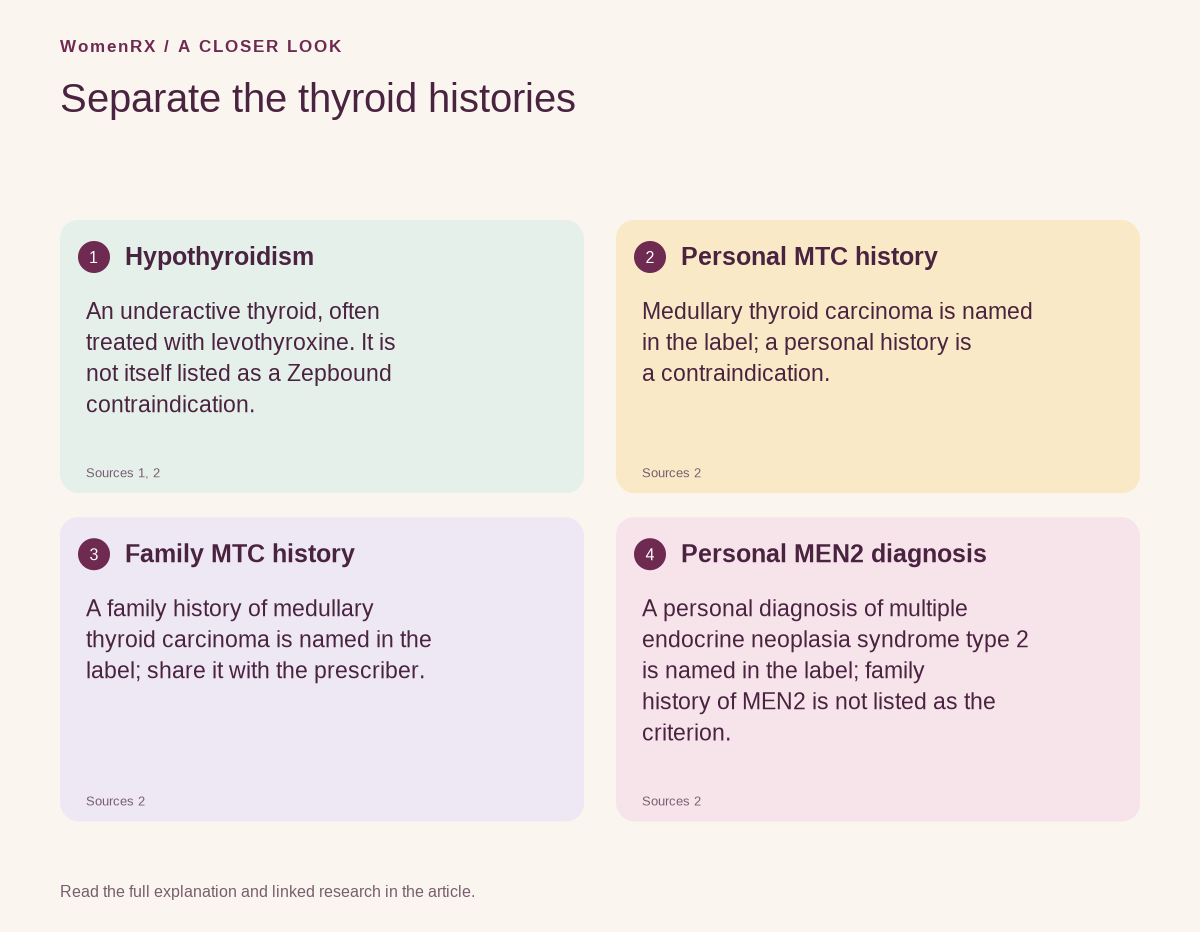
Separate the thyroid histories
Hypothyroidism: An underactive thyroid, often treated with levothyroxine. It is not itself listed as a Zepbound contraindication.12
Personal MTC history: Medullary thyroid carcinoma is named in the label; a personal history is a contraindication.2
Family MTC history: A family history of medullary thyroid carcinoma is named in the label; share it with the prescriber.2
Personal MEN2 diagnosis: A personal diagnosis of multiple endocrine neoplasia syndrome type 2 is named in the label; family history of MEN2 is not listed as the criterion.2
Read the figure as text
Compare hypothyroidism with the personal or family histories named in Zepbound’s contraindication.- Hypothyroidism: An underactive thyroid, often treated with levothyroxine. It is not itself listed as a Zepbound contraindication.12
- Personal MTC history: Medullary thyroid carcinoma is named in the label; a personal history is a contraindication.2
- Family MTC history: A family history of medullary thyroid carcinoma is named in the label; share it with the prescriber.2
- Personal MEN2 diagnosis: A personal diagnosis of multiple endocrine neoplasia syndrome type 2 is named in the label; family history of MEN2 is not listed as the criterion.2
More questions, answered
Does hypothyroidism automatically rule out Zepbound?
No. Hypothyroidism alone is not listed as a Zepbound contraindication. The label names a personal or family history of MTC and your own diagnosis of MEN2. Share your thyroid diagnosis and any relevant personal or family history with your prescriber. 2
Should I get a thyroid ultrasound or calcitonin test before starting?
The Zepbound label says routine calcitonin testing or thyroid ultrasound has uncertain value for early detection of MTC in people taking the medicine. Ask your prescriber what is appropriate for your own history rather than assuming either test is a substitute for reviewing it. 2
Sources you can check
- Levothyroxine: a medicine for an underactive thyroid (hypothyroidism) - NHSAccessed 2026-09-25Return to first citation
- ZEPBOUND (TIRZEPATIDE) INJECTION, SOLUTION ZEPBOUND (TIRZEPATIDE) INJECTION, SOLUTION ZEPBOUND KWIKPEN (TIRZEPATIDE) INJECTION, SOLUTION [ELI LILLY AND COMPANY] | US prescribing information and patient instructionsAccessed 2026-09-25Return to first citation
- LEVOTHYROXINE SODIUM TABLET [CARDINAL HEALTH 107, LLC] | US prescribing information and patient instructionsAccessed 2026-09-25Return to first citation
- What obgyns need to know about GLP-1 receptor agonists.Chauhan I. · Current opinion in obstetrics & gynecology · 2026Return to first citation
- From Weight Loss to Organ-Specific Disease Modification: A Narrative Review of Incretin-Based Therapies in Obesity-Related Cardiometabolic Disease, Chronic Kidney Disease, Metabolic Dysfunction-Associated Steatohepatitis, and Obstructive Sleep Apnoea.Joshi D. · Cureus · 2026Return to first citation