Zepbound and Thyroid Risk: What the Warning Means
Zepbound’s thyroid warning is about a specific tumor seen in rats, with a clear labeled restriction and important limits on what human studies have shown.
Zepbound’s boxed warning concerns thyroid C-cell tumors, including medullary thyroid carcinoma (MTC). The drug caused these tumors in rats, but whether it causes them in people is unknown. The labeled contraindication is specific: a personal or family history of MTC, or MEN 2. Other thyroid diagnoses or a history of nodules aren’t interchangeable with that restriction, though they’re worth describing accurately to your prescriber. 1
The warning is about one specific type of thyroid tumor
Zepbound (tirzepatide) caused thyroid C-cell tumors in rats. The prescribing information says it’s unknown whether the drug causes these tumors in people, including medullary thyroid carcinoma, or MTC. That uncertainty is the reason for the boxed warning; it is not proof that Zepbound causes thyroid cancer in humans. 1
MTC is one type of thyroid cancer. Other types include papillary and follicular thyroid cancer, and thyroid conditions can also include an enlarged thyroid, nodules, or problems with thyroid hormone levels. Those terms describe different things. A history of an ordinary thyroid condition is not the same as a history of MTC or MEN 2. 12
Which history is a labeled contraindication?
The Zepbound label says not to use the medicine if you have ever had MTC, if a family member has had MTC, or if you have multiple endocrine neoplasia syndrome type 2 (MEN 2). These are the specific histories to identify before treatment is considered. 1
A personal history of a thyroid nodule, goiter, Hashimoto’s disease, hypothyroidism, or another thyroid diagnosis is not listed as the same contraindication in the label. That doesn’t mean every thyroid finding is unimportant; it means your prescriber needs the actual diagnosis and context rather than a broad label like “thyroid problems.” If you’ve had a thyroid biopsy, surgery, cancer, or ongoing evaluation, share what you know and bring records if you have them.
Family history can be especially easy to describe imprecisely. If someone in your family had thyroid cancer, try to find out what type, if possible. “Thyroid cancer” alone doesn’t establish that it was MTC. If a relative had MEN 2, mention that specifically. When the type is unclear, say so rather than guessing. 12
What human research can and can’t tell us
A 2026 meta-analysis pooled 48 randomized trials of GLP-1 receptor agonist medicines, with 94,245 participants. It found that these medicines probably have little or no effect on thyroid cancer risk: the estimate was an odds ratio of 1.37, with a 95% confidence interval from 0.82 to 2.31. The authors estimated from the trials that this could mean 1 fewer to 9 more cases per 10,000 people treated. Results were consistent in analyses that included tirzepatide, but the trials weren’t designed to study cancer and had short follow-up. So this is useful reassurance, not a final answer about long-term risk or MTC specifically. 3
That distinction matters: the animal finding is real, and the human relevance remains unsettled. The current human evidence does not establish that tirzepatide causes thyroid cancer, but it also cannot settle every question about uncommon tumor types or longer-term use. 13
Should you get thyroid tests before or during treatment?
The label says the value of routine calcitonin blood testing or thyroid ultrasound for early detection of MTC in people taking Zepbound is uncertain. It does not establish that every patient needs these tests as routine screening. Your own thyroid history or a new finding may call for evaluation for its own reasons; that’s different from screening everyone because they take Zepbound. 1
Tell your prescriber about a new lump or swelling in your neck, persistent hoarseness, trouble swallowing, or trouble breathing. These are symptoms the label identifies for patients to report. They don’t by themselves mean you have thyroid cancer, but they shouldn’t be ignored. 1
A useful way to describe your history
Before a prescribing discussion, write down the exact thyroid diagnosis you’ve been given, any thyroid cancer type you or a relative had, and whether anyone in your family has MEN 2. If you’re unsure of a cancer type, say that. This helps separate the specific labeled restriction from other thyroid history that may need its own assessment.
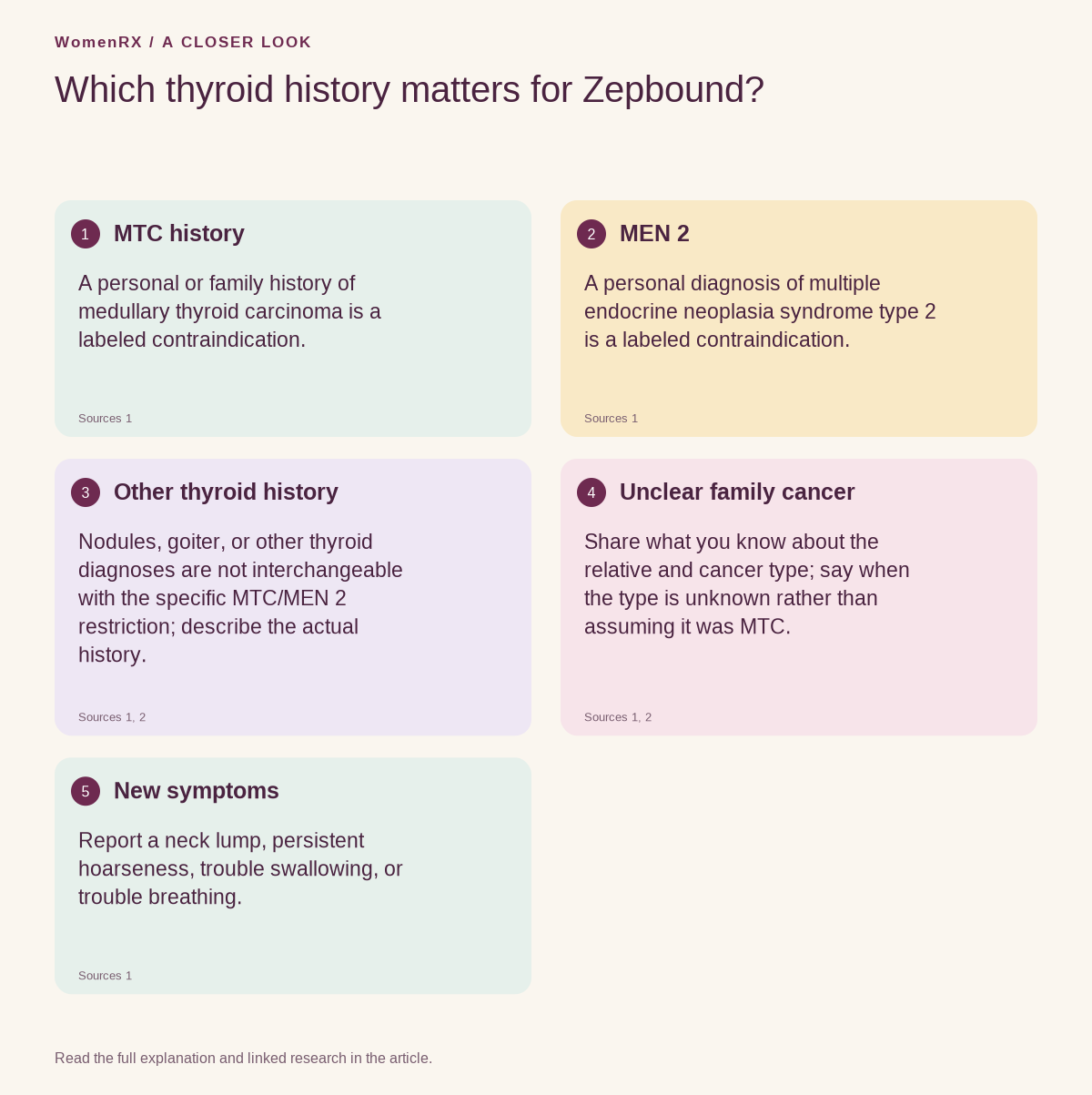
Which thyroid history matters for Zepbound?
MTC history: A personal or family history of medullary thyroid carcinoma is a labeled contraindication.1
MEN 2: A personal diagnosis of multiple endocrine neoplasia syndrome type 2 is a labeled contraindication.1
Other thyroid history: Nodules, goiter, or other thyroid diagnoses are not interchangeable with the specific MTC/MEN 2 restriction; describe the actual history.12
Unclear family cancer: Share what you know about the relative and cancer type; say when the type is unknown rather than assuming it was MTC.12
New symptoms: Report a neck lump, persistent hoarseness, trouble swallowing, or trouble breathing.1
Read the figure as text
Separate the label’s specific contraindication from other thyroid history, then identify what to tell a prescriber.- MTC history: A personal or family history of medullary thyroid carcinoma is a labeled contraindication.1
- MEN 2: A personal diagnosis of multiple endocrine neoplasia syndrome type 2 is a labeled contraindication.1
- Other thyroid history: Nodules, goiter, or other thyroid diagnoses are not interchangeable with the specific MTC/MEN 2 restriction; describe the actual history.12
- Unclear family cancer: Share what you know about the relative and cancer type; say when the type is unknown rather than assuming it was MTC.12
- New symptoms: Report a neck lump, persistent hoarseness, trouble swallowing, or trouble breathing.1
More questions, answered
Does a thyroid nodule automatically rule out Zepbound?
A thyroid nodule is not one of the specific contraindications named in the Zepbound label. Tell your prescriber about it and any evaluation or biopsy, but don’t assume a nodule means you have MTC or MEN 2. 1
Does a family history of any thyroid disease count as a family history of MTC?
No. The labeled family-history restriction is specifically for medullary thyroid carcinoma. If a relative had thyroid cancer but you don’t know the type, share that uncertainty so the history can be clarified if possible. 12
Sources you can check
- ZEPBOUND (TIRZEPATIDE) INJECTION, SOLUTION ZEPBOUND (TIRZEPATIDE) INJECTION, SOLUTION ZEPBOUND KWIKPEN (TIRZEPATIDE) INJECTION, SOLUTION [ELI LILLY AND COMPANY] | US prescribing information and patient instructionsAccessed 2026-09-25Return to first citation
- Thyroid Cancer | Thyroid Cancer Treatment | MedlinePlusAccessed 2026-09-25Return to first citation
- Risk for Cancer With Glucagon-Like Peptide-1 Receptor Agonists and Dual Agonists : A Systematic Review and Meta-analysis.Ko A, Chang YC, Bahar F, Wang TH, Xanthavanij N, Yu CC, Hsieh RJ, See XY, Lo SW, Song J, Hsia YP, Chiang CH, Xu X, Lin S, Chiang CH. · Annals of internal medicine · 2026Return to first citation