Can You Take Zepbound With Thyroid Medication?
Taking levothyroxine doesn’t automatically rule out Zepbound, but your thyroid history and treatment routine deserve a closer look.
If you take levothyroxine for an underactive thyroid, that alone is not a listed reason you cannot use Zepbound. Zepbound can affect how oral medicines are absorbed, but a specific Zepbound-levothyroxine interaction has not been established. Review your thyroid test results and medicine routine with your prescriber. Separately, Zepbound must not be used if you or a family member has had medullary thyroid carcinoma, or if you have MEN2.14
Two thyroid questions that shouldn’t be mixed up
If your thyroid makes too little hormone, levothyroxine replaces that hormone. Zepbound’s thyroid-cancer warning is about a different issue: thyroid C-cell tumors occurred in rats given tirzepatide. It isn’t known whether Zepbound causes these tumors in people. The prescribing information says not to use Zepbound if you have a personal or family history of medullary thyroid carcinoma (MTC) or if you have multiple endocrine neoplasia syndrome type 2 (MEN2). Having hypothyroidism or taking thyroid replacement is not, by itself, one of those listed contraindications.14
That distinction makes your diagnosis as useful to know as your medication name. If a relative had “thyroid cancer” but you don’t know which type, ask about the diagnosis before starting treatment rather than assuming the warning does or doesn’t apply. Tell your care team if you develop a lump or swelling in your neck, persistent hoarseness, trouble swallowing, or shortness of breath while taking Zepbound. Zepbound’s prescribing information says routine calcitonin testing or thyroid ultrasound has uncertain value for detecting MTC early in people taking it.1
What could change with a thyroid pill?
Zepbound slows stomach emptying, which may affect absorption of medicines taken by mouth. Levothyroxine tablets are absorbed through the digestive tract, and their absorption can also be affected by food and certain other medicines. Those facts give your prescriber a reason to look at your routine and thyroid test results. They do not show that Zepbound reliably lowers levothyroxine absorption or that everyone needs a thyroid dose change.124
The distinction matters because not every finding about a related weight-loss medicine applies to Zepbound. A 2025 review describes a change in levothyroxine exposure with oral semaglutide, while its notable tirzepatide finding concerns oral contraceptives. It does not establish the same levothyroxine effect for tirzepatide.3
If you use levothyroxine tablets, keep following the directions for your particular prescription unless your prescriber changes them. One US tablet label directs taking it on an empty stomach before breakfast and keeping it apart from medicines known to interfere with its absorption. Calcium and iron supplements are examples worth mentioning; acid-reducing medicines can matter too. Zepbound’s label does not set a special number of hours to separate its injection from levothyroxine, so don’t invent a new spacing rule or change your thyroid dose on your own.14
What monitoring is worth discussing?
For adults treated with levothyroxine for primary hypothyroidism, the tablet label calls for a TSH check 6 to 8 weeks after a levothyroxine dose change. On a stable replacement dose, it calls for periodic clinical and laboratory review, and another review when clinical status changes. That is not a rule requiring every person to change their dose or get a test immediately after starting Zepbound. Your recent results, symptoms, medicine routine, and any changes during treatment help your prescriber decide whether testing is needed.4
For example, if your levothyroxine routine has changed because you’ve started taking iron at breakfast, mention that alongside any new symptoms or thyroid results. Iron can interfere with levothyroxine tablet absorption, so it would be misleading to assume Zepbound caused a changed result without considering both changes.4
A short list to bring to the conversation
- Your thyroid medicine: Its name, formulation, current dose, and when you take it. The tablet instructions may not describe every other thyroid-medicine formulation.4
- What you take around it: Meals, calcium or iron supplements, antacids, and acid-reducing medicines can be relevant to levothyroxine tablet absorption.24
- Your thyroid history: Your diagnosis, recent thyroid test results, and any recent changes in dose or how you take it.4
- Your family and pregnancy history: Mention any personal or family history of MTC, whether you have MEN2, and whether you’re pregnant or planning pregnancy. These raise different questions about whether Zepbound is appropriate and how thyroid replacement is monitored.14
If pregnancy is possible, there’s one more medication detail to raise: Zepbound may reduce the effectiveness of oral hormonal contraceptives. Its label advises using a non-oral method or adding a barrier method for four weeks after starting Zepbound and for four weeks after each dose increase. Pregnancy planning also warrants a review of thyroid treatment: levothyroxine requirements and TSH monitoring can change during pregnancy. Zepbound’s label advises stopping it when pregnancy is recognized, while levothyroxine should not be stopped because of pregnancy.14
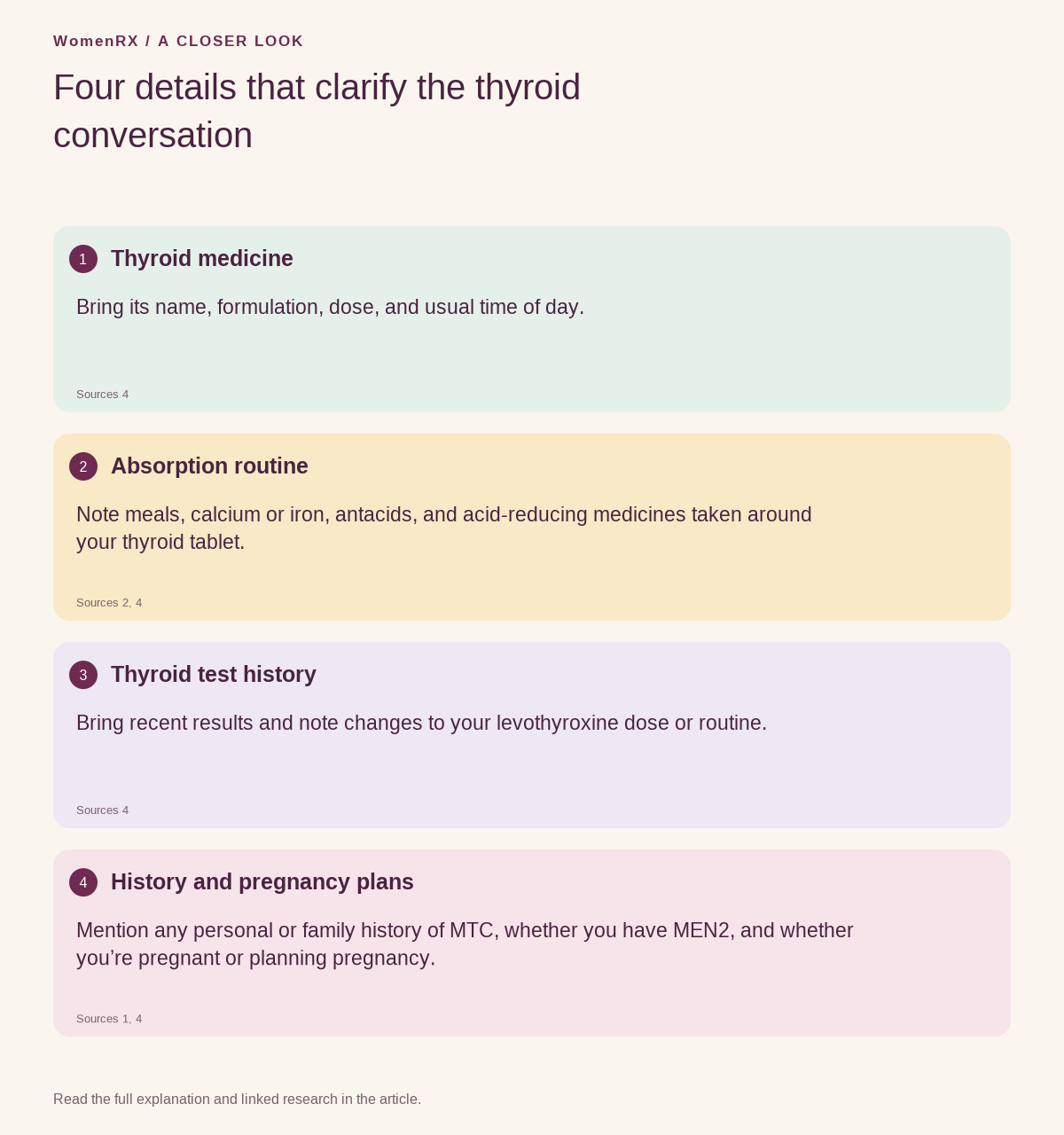
Four details that clarify the thyroid conversation
Thyroid medicine: Bring its name, formulation, dose, and usual time of day.4
Absorption routine: Note meals, calcium or iron, antacids, and acid-reducing medicines taken around your thyroid tablet.24
Thyroid test history: Bring recent results and note changes to your levothyroxine dose or routine.4
History and pregnancy plans: Mention any personal or family history of MTC, whether you have MEN2, and whether you’re pregnant or planning pregnancy.14
Read the figure as text
This is a prompt for a medication review, not a test for whether Zepbound is right for you.- Thyroid medicine: Bring its name, formulation, dose, and usual time of day.4
- Absorption routine: Note meals, calcium or iron, antacids, and acid-reducing medicines taken around your thyroid tablet.24
- Thyroid test history: Bring recent results and note changes to your levothyroxine dose or routine.4
- History and pregnancy plans: Mention any personal or family history of MTC, whether you have MEN2, and whether you’re pregnant or planning pregnancy.14
More questions, answered
Does Zepbound’s thyroid warning mean I need routine thyroid-cancer screening?
Not necessarily. The prescribing information says routine calcitonin testing or thyroid ultrasound has uncertain value for early MTC detection in people taking Zepbound. A thyroid nodule found on examination or imaging should be evaluated.1
Sources you can check
- ZEPBOUND (TIRZEPATIDE) INJECTION, SOLUTION ZEPBOUND (TIRZEPATIDE) INJECTION, SOLUTION ZEPBOUND KWIKPEN (TIRZEPATIDE) INJECTION, SOLUTION [ELI LILLY AND COMPANY] | US prescribing information and patient instructionsAccessed 2026-09-25Return to first citation
- LEVOTHYROXINE SODIUM TABLET [CARDINAL HEALTH 107, LLC] | US prescribing information and patient instructionsAccessed 2026-09-25Return to first citation
- A Comprehensive Review on the Pharmacokinetics and Drug-Drug Interactions of Approved GLP-1 Receptor Agonists and a Dual GLP-1/GIP Receptor Agonist.Min JS, Jo SJ, Lee S, Kim DY, Kim DH, Lee CB, Bae SK. · Drug design, development and therapy · 2025Return to first citation
- LEVOTHYROXINE SODIUM TABLET [A-S MEDICATION SOLUTIONS] | US prescribing information and patient instructionsAccessed 2026-09-25Return to first citation