Hashimoto’s and GLP-1 Medicines: Which Thyroid Warning Matters?
Hashimoto’s is distinct from the medullary thyroid cancer history named in Zepbound’s warning, but the exact medicine matters.
Hashimoto’s alone is not the thyroid condition named in Zepbound’s contraindication. Its label names a personal or family history of medullary thyroid carcinoma (MTC), or a diagnosis of MEN2. If you’re considering another medicine, such as semaglutide or liraglutide, ask about that product’s own warnings rather than relying on Zepbound’s label. Thyroid replacement and pregnancy plans are separate questions. 2 3 4 1
First, separate the thyroid questions
Hashimoto’s is an autoimmune thyroid disease. Autoimmune thyroid disease, including Hashimoto’s, is much more common in women than men. Levothyroxine is used to treat hypothyroidism. Medullary thyroid carcinoma (MTC), by contrast, is a cancer involving thyroid C cells. MEN2 is a separate diagnosis named alongside MTC in Zepbound’s contraindication. These are not interchangeable diagnoses. 4 1 2
That distinction matters because the Zepbound (tirzepatide) prescribing information names a personal or family history of MTC, or MEN2 in the person taking the medicine, as contraindications. It does not name Hashimoto’s or hypothyroidism in that contraindication. The label also warns that thyroid C-cell tumors occurred in rats, while saying it is unknown whether Zepbound causes these tumors in people. 2
So if you have Hashimoto’s, don’t assume that diagnosis alone answers whether you can use a weight-management medicine. Give the prescriber your exact thyroid diagnosis and the name of the product you’re considering. Semaglutide, tirzepatide, and liraglutide are among the medicines discussed in weight-management guidance, but Zepbound’s prescribing information establishes the wording for Zepbound, not for those other products. Ask the prescriber to check the warnings for your specific medicine. 3 2
If you take levothyroxine
Having a thyroid condition and taking thyroid replacement are two different parts of the conversation. Levothyroxine dosing is individualized and adjusted using clinical response and thyroid lab results; its prescribing information also describes pregnancy as a reason the dose and monitoring may need attention. 1
Significant weight loss may prompt a review of thyroid hormone treatment. A review of autoimmune thyroid care notes the possibility of needing to adjust thyroid hormone therapy with significant weight loss, while also emphasizing that dedicated trials of GLP-1 medicines for autoimmune thyroid disease are lacking. That’s a reason to ask about follow-up, not to change your levothyroxine dose on your own. 4
Whether you need a levothyroxine dose change or thyroid labs after starting a weight-management medicine depends on your individual treatment plan. A useful question is: “Given my thyroid history and current labs, when would you decide whether my levothyroxine dose needs review?”
Pregnancy needs its own plan
If you’re pregnant, trying to become pregnant, or could become pregnant, raise that before starting or continuing a weight-management medicine. The American College of Physicians makes its weight-management recommendations for nonpregnant adults; those recommendations do not address treatment during pregnancy. Ask the prescriber about the specific medicine and your plans. 3
Thyroid care also needs attention during pregnancy. Levothyroxine prescribing information says thyroid levels should be monitored and treatment adjusted as needed; it also says levothyroxine should not be discontinued during pregnancy. If you have Hashimoto’s and become pregnant, discuss thyroid monitoring and your treatment plan promptly with the clinician managing your pregnancy or thyroid care. 1
Questions that make the conversation specific
Bring the medicine name and your thyroid history, then ask:
- “Does this product’s label list my diagnosis as a contraindication? What exactly does its thyroid warning say?”
- “Do I have a personal or family history of MTC, or have I been diagnosed with MEN2?”
- “Should we review my thyroid labs or levothyroxine treatment if I lose significant weight?”
- “How would pregnancy plans affect whether I start or continue this medicine?”
For Zepbound, the label says routine calcitonin testing or thyroid ultrasound has uncertain value for early MTC detection. Ask whether any test is appropriate for your situation rather than assuming routine screening is required. The label identifies a neck mass, difficulty swallowing or breathing, and persistent hoarseness as symptoms of thyroid tumors to report. 2
Keep autoimmune hypothyroidism, thyroid replacement, and the MTC/MEN2 warning in separate boxes. Then confirm your personal and family history, your thyroid follow-up plan, and any pregnancy considerations for the product you’re considering.
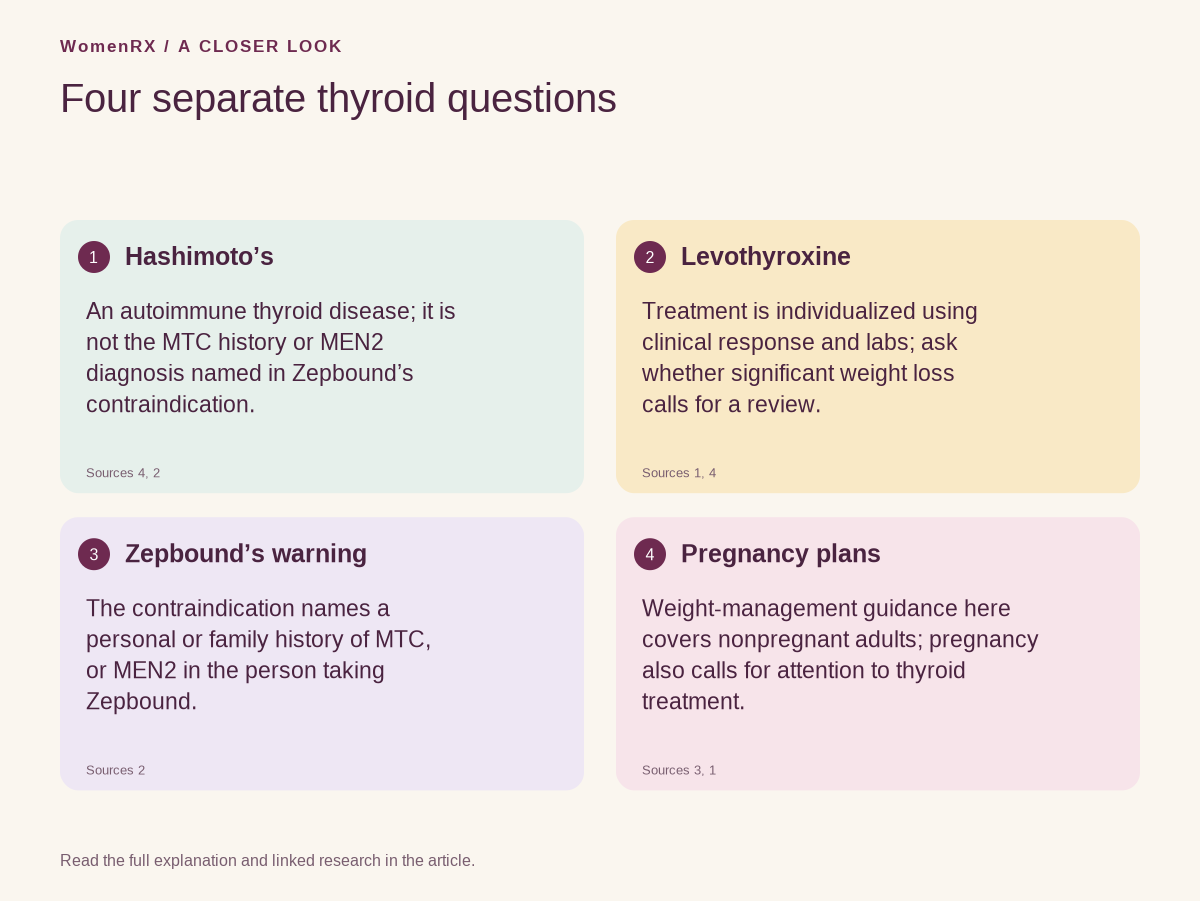
Four separate thyroid questions
Hashimoto’s: An autoimmune thyroid disease; it is not the MTC history or MEN2 diagnosis named in Zepbound’s contraindication.42
Levothyroxine: Treatment is individualized using clinical response and labs; ask whether significant weight loss calls for a review.14
Zepbound’s warning: The contraindication names a personal or family history of MTC, or MEN2 in the person taking Zepbound.2
Pregnancy plans: Weight-management guidance here covers nonpregnant adults; pregnancy also calls for attention to thyroid treatment.31
Read the figure as text
This comparison separates the diagnosis, thyroid treatment, a specific product warning, and pregnancy-related care.- Hashimoto’s: An autoimmune thyroid disease; it is not the MTC history or MEN2 diagnosis named in Zepbound’s contraindication.42
- Levothyroxine: Treatment is individualized using clinical response and labs; ask whether significant weight loss calls for a review.14
- Zepbound’s warning: The contraindication names a personal or family history of MTC, or MEN2 in the person taking Zepbound.2
- Pregnancy plans: Weight-management guidance here covers nonpregnant adults; pregnancy also calls for attention to thyroid treatment.31
More questions, answered
Does Hashimoto’s mean I have the MTC history named on Zepbound’s label?
No. Hashimoto’s is autoimmune thyroid disease; the Zepbound contraindication names a personal or family history of MTC, or MEN2 in the person taking it. Tell the prescriber about your full thyroid and family history so the warning can be checked. 4 2
Should I stop levothyroxine if I start a GLP-1 medicine?
Ask whether starting the medicine changes your levothyroxine follow-up plan. Levothyroxine dosing is individualized using thyroid labs and clinical response. Significant weight loss may call for a review of your treatment, but don’t alter the dose on your own. 1 4
Sources you can check
- LEVOTHYROXINE SODIUM TABLET [CARDINAL HEALTH 107, LLC] | US prescribing information and patient instructionsAccessed 2026-09-25Return to first citation
- ZEPBOUND (TIRZEPATIDE) INJECTION, SOLUTION ZEPBOUND (TIRZEPATIDE) INJECTION, SOLUTION ZEPBOUND KWIKPEN (TIRZEPATIDE) INJECTION, SOLUTION [ELI LILLY AND COMPANY] | US prescribing information and patient instructionsAccessed 2026-09-25Return to first citation
- Pharmacologic Treatments With Lifestyle Modifications in Nonpregnant Adults With Overweight or Obesity in Outpatient Settings: A Living Clinical Guideline From the American College of Physicians (April 2026).Qaseem A, Cross JT, Harrod CS, Owens DK, Balk EM, Crandall CJ, Clinical Guidelines Committee of the American College of Physicians, Fitterman N, Gibson M, Lewis J, Mackey K, Miller... · Annals of internal medicine · 2026Return to first citation
- The Thyroid Twist: How GLP-1 Agonists Are Influencing Autoimmune Thyroid Care.Mazza AD. · Cureus · 2025Return to first citation