Hashimoto’s and Weight: What Thyroid Treatment Can Change
Low thyroid hormone can contribute to weight gain, but bringing thyroid levels back to normal usually doesn’t produce major or predictable weight loss.
The weight connection depends more on whether thyroid hormone is currently low than on the diagnosis name alone. TSH and T4 tests help assess thyroid function; antibody tests can help identify autoimmune thyroid disease. In a 2026 review of 23 studies and 763 adults, levothyroxine treatment was linked to an average weight reduction of about 1.4 kg, not a return to a guaranteed prior weight. 2 5

Start with thyroid function, not the scale
Hashimoto’s can be part of the picture, but weight gain by itself can’t show whether your thyroid is underactive. Thyroid hormones affect how the body uses energy, and thyroid tests assess different things: TSH is usually the first blood test, T3 and T4 measure thyroid hormone levels, and antibody tests can help identify autoimmune thyroid disorders. 2
That distinction matters. If thyroid hormone is low, it may contribute to weight change. If you’re concerned about weight, current thyroid test results are more useful than trying to infer thyroid function from the scale or from a diagnosis label alone. Levothyroxine is used to treat an underactive thyroid, and treatment is adjusted using clinical response and blood-test results. 1 3
What treatment may realistically change
A 2026 systematic review and meta-analysis combined 23 studies of 763 adults with hypothyroidism who achieved normal thyroid function on levothyroxine. On average, weight decreased by 1.39 kg after treatment, alongside small average decreases in BMI and fat mass. The review found weight and BMI reductions in the subgroup with overt hypothyroidism, but not in the subgroup with subclinical hypothyroidism. These are group averages, not a promise about what will happen to one person. 5
The review also found a small decrease in lean body mass. That’s one reason a lower scale number doesn’t tell the whole story: body weight includes muscle, bone, fat, and water. 4 5
So, treatment may ease weight changes related to an underactive thyroid, particularly when hypothyroidism is overt, but the expected change is modest on average. It may not explain all the weight you’ve gained or lead to the loss you hoped for. A review of thyroid disease and weight likewise describes the increases associated with hypothyroidism as generally mild to modest, with partial reversal during treatment. 6
Why antibodies and thyroid levels answer different questions
An antibody test and a thyroid-function test aren’t interchangeable. Antibodies can help identify autoimmune thyroid disease; TSH and T3/T4 tests assess thyroid function and hormone levels. 2 The presence of antibodies alone doesn’t tell you how much of a current weight change is related to low thyroid hormone. The practical question is whether thyroid function is currently abnormal, considered alongside the rest of your health picture.
If your weight changes while thyroid tests are normal
A normal thyroid result doesn’t make a weight change unreal; it means weight alone doesn’t establish that thyroid hormone is the cause. Body weight is made up of more than fat, and everyday factors can affect it. If weight is changing unexpectedly, it’s reasonable to look beyond the thyroid rather than assuming more thyroid medicine will solve it. 2 4
Levothyroxine isn’t a weight-management treatment for people whose thyroid function is normal. Using thyroid hormone to create an overactive-thyroid state has not proved an effective weight-loss strategy. 7 Don’t increase or change your dose to pursue weight loss; treatment aims to restore and maintain appropriate thyroid levels. 3 7
A life-stage note
Pregnancy changes the monitoring needs of thyroid treatment: thyroid levels may need more frequent blood tests, and a levothyroxine dose may need adjustment to maintain normal thyroid function. That guidance is about thyroid care, not a promise about pregnancy-related weight change. 3
At older ages, the number on the scale can be less informative on its own because it doesn’t distinguish muscle, bone, fat, and water. MedlinePlus also emphasizes muscle and strength for older adults and says unexpected weight loss should be checked. 4
A useful next step is to review your recent thyroid-function results and whether they indicate underactive thyroid, rather than judging treatment by weight alone. If your thyroid levels are in range and weight remains a concern, the scale cannot identify the cause; other factors need consideration.
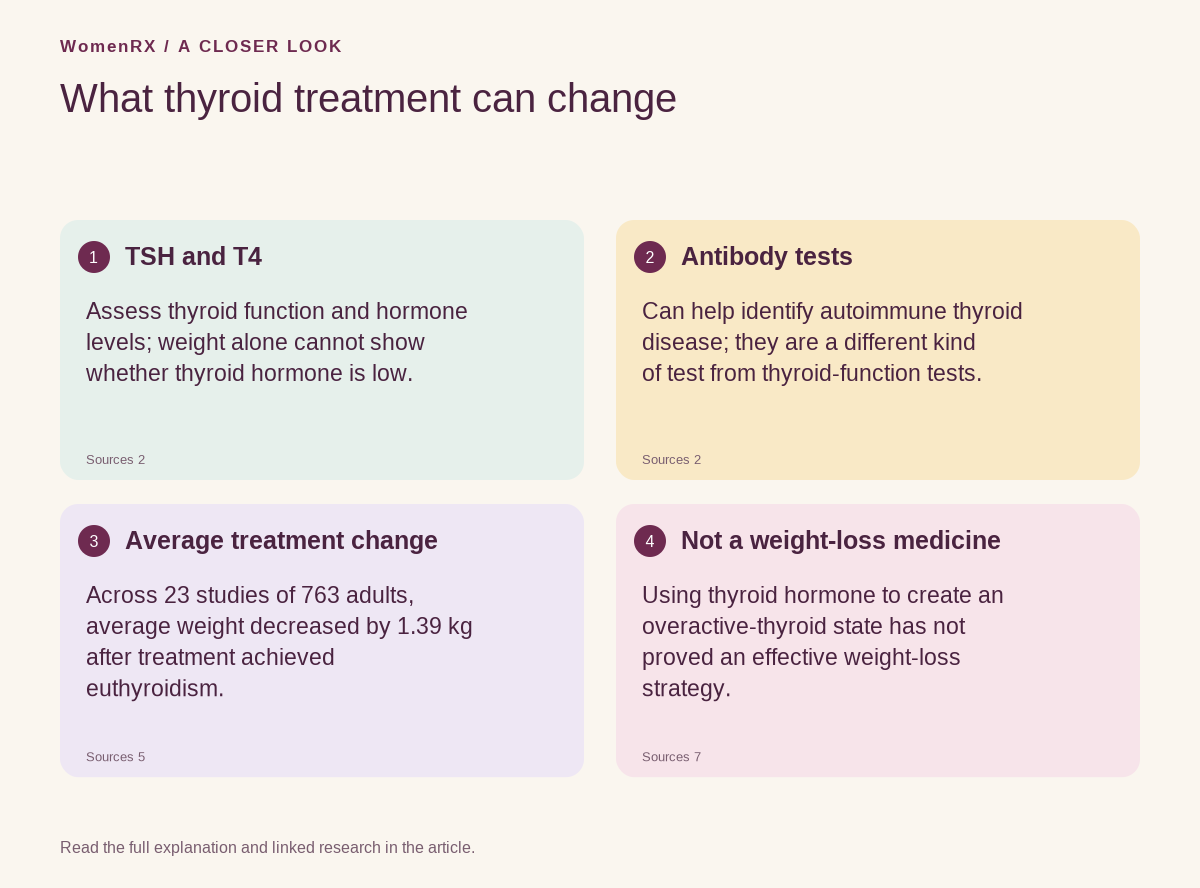
What thyroid treatment can change
TSH and T4: Assess thyroid function and hormone levels; weight alone cannot show whether thyroid hormone is low.2
Antibody tests: Can help identify autoimmune thyroid disease; they are a different kind of test from thyroid-function tests.2
Average treatment change: Across 23 studies of 763 adults, average weight decreased by 1.39 kg after treatment achieved euthyroidism.5
Not a weight-loss medicine: Using thyroid hormone to create an overactive-thyroid state has not proved an effective weight-loss strategy.7
Read the figure as text
Separate what thyroid tests show from what treatment may do to weight, and keep average study results distinct from personal expectations.- TSH and T4: Assess thyroid function and hormone levels; weight alone cannot show whether thyroid hormone is low.2
- Antibody tests: Can help identify autoimmune thyroid disease; they are a different kind of test from thyroid-function tests.2
- Average treatment change: Across 23 studies of 763 adults, average weight decreased by 1.39 kg after treatment achieved euthyroidism.5
- Not a weight-loss medicine: Using thyroid hormone to create an overactive-thyroid state has not proved an effective weight-loss strategy.7
More questions, answered
Can levothyroxine be used to lose weight if thyroid tests are normal?
No. Levothyroxine treats an underactive thyroid, and using thyroid hormone to create an overactive-thyroid state has not proved an effective weight-loss strategy. 1 7
Which thyroid test is most relevant to checking thyroid function?
TSH is usually the first test ordered. T3 and T4 measure thyroid hormone levels, while antibody tests can help identify autoimmune thyroid disorders. 2
Sources you can check
- Levothyroxine: a medicine for an underactive thyroid (hypothyroidism) - NHSAccessed 2026-09-25Return to first citation
- Thyroid Tests: MedlinePlusAccessed 2026-09-25Return to first citation
- LEVOTHYROXINE SODIUM TABLET [CARDINAL HEALTH 107, LLC] | US prescribing information and patient instructionsAccessed 2026-09-25Return to first citation
- Body Weight: MedlinePlusAccessed 2026-09-25Return to first citation
- Levothyroxine therapy for euthyroidism restoration results in clinically insignificant weight and anthropometric changes: a systematic review and meta-analysis.Wolde Sellasie S, Ossola N, Piticchio T, Uccioli L, Trimboli P. · International journal of obesity (2005) · 2026Return to first citation
- The Influence of Thyroid Dysfunction on Body Composition and Weight Trajectory.Jonklaas J. · Endocrine practice : official journal of the American College of Endocrinology and the American Association of Clinical Endocrinologists · 2026Return to first citation
- The complexity of the relationship between thyroid disease and body weight.Jonklaas J. · Nature reviews. Endocrinology · 2026Return to first citation