Hashimoto’s, Thyroid Hormones, and Your Menstrual Cycle
A positive thyroid antibody test points to autoimmunity, but your thyroid function tests show whether your gland is making enough hormone.
Hashimoto’s is an autoimmune condition; it doesn’t automatically mean your thyroid hormone levels are low. Antibody tests can help identify the cause, while TSH and T4 tests show how the thyroid is functioning. Menstrual changes are more clearly linked to thyroid dysfunction than to antibodies alone, though research on periods in women with normal thyroid function is limited. Pregnancy evidence about antibodies is still unsettled. 3 5 6
Two different questions in your test results
Hashimoto’s describes an immune response directed at the thyroid. Thyroid antibodies, such as thyroid peroxidase or thyroglobulin antibodies, can help identify that autoimmune cause. They don’t tell you on their own whether your thyroid is currently making enough hormone. 3 4
TSH and T4 answer a different question: how the thyroid is functioning. A pattern of higher TSH and lower free T4 is used to identify primary hypothyroidism; higher TSH with normal free T4 is called subclinical hypothyroidism. A person can also have thyroid autoimmunity while thyroid function is normal. 4 5
That distinction can make a positive antibody result feel less like a complete explanation. It identifies an immune marker, not a measurement of estrogen, progesterone, or every hormone involved in the menstrual cycle. Thyroid hormones affect many parts of the body, but an antibody result alone doesn’t show that your reproductive hormones are out of balance. 3
What the menstrual research can and can’t tell you
Low thyroid function can be associated with menstrual changes, including heavy or irregular periods, and hypothyroidism can contribute to fertility problems. 1 In one study of 485 women with thyroid conditions and 108 healthy controls, heavy menstrual bleeding was more common in women with overt hypothyroidism than in controls: 33% compared with 6%. The study did not find significant differences in menstrual disorder patterns between its euthyroid group, which included women with Hashimoto’s or nodular goiter, and controls. 5
That finding helps separate two ideas: menstrual changes may accompany thyroid dysfunction, but having antibodies with normal thyroid function doesn’t necessarily mean your periods will change. The study was conducted at one hospital and grouped euthyroid Hashimoto’s together with nodular goiter, so it can’t settle whether antibodies themselves affect periods. It also doesn’t rule out other causes of cycle changes.
If you have a Hashimoto’s diagnosis and a new menstrual change, the useful question is not only “Are my antibodies positive?” It’s also “What do my TSH and free T4 show?” Thyroid testing can help identify thyroid dysfunction, while the antibody test helps explain its cause. 3
Pregnancy is a separate evidence question
In pregnancy, thyroid hormone needs change, and hypothyroidism can be associated with complications for the pregnant person and baby. 1 A recent narrative review also describes associations between thyroid antibodies and outcomes such as miscarriage and preterm delivery in some euthyroid women. These are associations, not proof that antibodies directly cause those outcomes. The review says treatment decisions for antibody-positive women with normal thyroid function remain debated; it does not support assuming that a positive antibody test by itself means levothyroxine is needed. 6
If you’re pregnant, planning a pregnancy, or taking levothyroxine during pregnancy, thyroid function deserves attention as a separate issue from antibody status. 6 People taking levothyroxine may need additional blood tests during pregnancy to check thyroid hormone levels. 2 The practical distinction remains the same: antibodies help identify autoimmunity, while thyroid function tests show hormone levels.
A simple way to read the results
Think of the tests as answering two different questions. An antibody result helps explain why the thyroid may be affected. TSH and T4 show whether its hormone production is currently keeping up. For menstrual or pregnancy concerns, that second question matters; the antibody number alone can’t tell you whether thyroid function is low or whether thyroid treatment is appropriate. 3 4 6
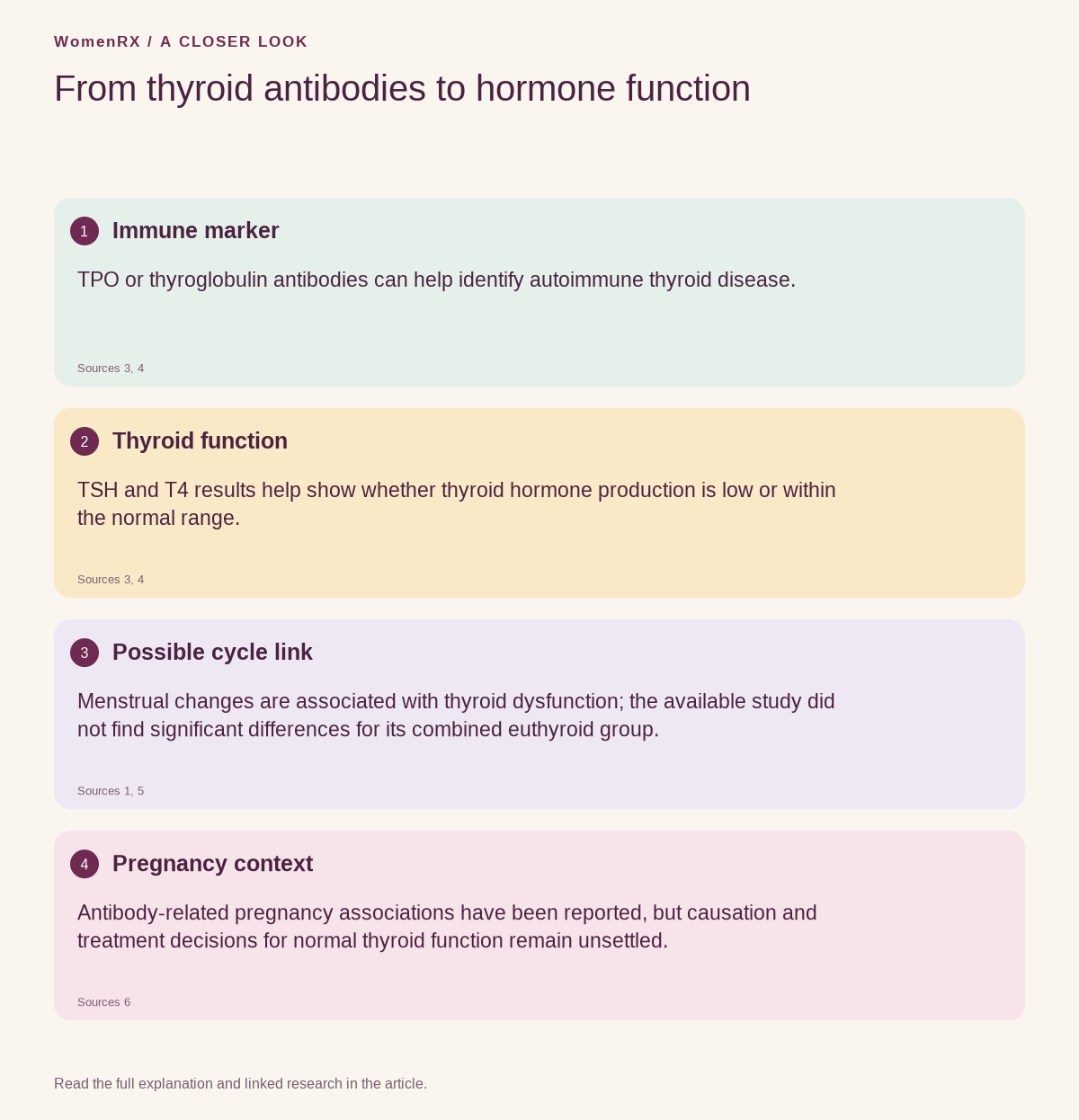
From thyroid antibodies to hormone function
Immune marker: TPO or thyroglobulin antibodies can help identify autoimmune thyroid disease.34
Thyroid function: TSH and T4 results help show whether thyroid hormone production is low or within the normal range.34
Possible cycle link: Menstrual changes are associated with thyroid dysfunction; the available study did not find significant differences for its combined euthyroid group.15
Pregnancy context: Antibody-related pregnancy associations have been reported, but causation and treatment decisions for normal thyroid function remain unsettled.6
Read the figure as text
These tests answer different questions: one points to autoimmunity, while the others show thyroid function and its possible downstream effects.- Immune marker: TPO or thyroglobulin antibodies can help identify autoimmune thyroid disease.34
- Thyroid function: TSH and T4 results help show whether thyroid hormone production is low or within the normal range.34
- Possible cycle link: Menstrual changes are associated with thyroid dysfunction; the available study did not find significant differences for its combined euthyroid group.15
- Pregnancy context: Antibody-related pregnancy associations have been reported, but causation and treatment decisions for normal thyroid function remain unsettled.6
More questions, answered
Can you have Hashimoto’s with normal thyroid hormone levels?
Yes. Thyroid autoimmunity can be present when thyroid function is normal; antibody tests and thyroid function tests measure different things. 5 3
Does a positive thyroid antibody test mean you need levothyroxine?
Not by itself. Levothyroxine replaces thyroid hormone when the thyroid is underactive. A positive antibody test identifies autoimmunity, but TSH and T4 tests assess thyroid function. Pregnancy decisions for antibody-positive people with normal thyroid function remain debated. 1 3 6
Sources you can check
- Hypothyroidism | Hashimoto's Disease | MedlinePlusAccessed 2026-09-25Return to first citation
- Levothyroxine: a medicine for an underactive thyroid (hypothyroidism) - NHSAccessed 2026-09-25Return to first citation
- Thyroid Tests: MedlinePlusAccessed 2026-09-25Return to first citation
- Current status of hypothyroidism control in Guangzhou area, China: a cross-sectional survey.Chen B, Wang S, Huang Y, Liu D, Chen R, Zhang H, Wang W, Zhou Q, Lie L, Ran J, Xu G. · BMC endocrine disorders · 2026Return to first citation
- Menstrual Cycle Characteristics in Women With and Without Thyroid Disease.Güngör Semiz G, Hekimsoy Z. · Cureus · 2024Return to first citation
- Autoimmune thyroiditis in pregnancy: epidemiology, clinical impact, and contemporary management challenges.Potorac A, Munteanu O, Baros A, Stoica EE, Cirstoiu MM. · Journal of medicine and life · 2026Return to first citation