Hashimoto’s and Fertility: What Thyroid Tests Can Tell You
For pregnancy planning, thyroid function and thyroid antibodies answer different questions, and neither result alone explains every fertility concern.
Hashimoto’s can lead to hypothyroidism, which may affect menstrual cycles and conception, but an antibody-positive result is not the same as low thyroid function or a diagnosis of infertility. TSH is usually the first thyroid test; T4 and thyroid antibodies can help clarify the picture. Treatment decisions depend on thyroid function, pregnancy plans, and your clinical situation, not antibodies alone. 1 3 5
Two results, two different questions
Hashimoto’s is an autoimmune thyroid condition. Thyroid antibodies can support an autoimmune diagnosis, while low thyroid function can indicate hypothyroidism. Both findings can occur together, but low thyroid function alone does not identify Hashimoto’s. 1 3
A TSH test is usually the first blood test used to assess how the thyroid is working. T4 measures thyroid hormone in the blood. Thyroid antibody tests can help identify an autoimmune thyroid disorder, but they are markers of the immune process, not a direct measurement of how much thyroid hormone your body is making. 1
That distinction matters when you’re trying to conceive. Hypothyroidism can be associated with menstrual changes and difficulty conceiving, but Hashimoto’s by itself doesn’t establish that it is the reason pregnancy hasn’t happened. 5
What the results may clarify
High antibodies, thyroid function in range: This can indicate thyroid autoimmunity without showing that you currently have hypothyroidism. The result may be relevant to follow-up, since thyroid antibodies are associated with a greater chance of developing hypothyroidism. But antibody positivity alone does not establish infertility or mean that thyroid hormone treatment is needed. 3
Elevated TSH, with T4 helping to clarify: An elevated TSH may point to thyroid underactivity, but TSH and T4 need to be interpreted together. A clinician can assess the pattern alongside your history and plans for pregnancy. One study protocol’s background discussion distinguishes overt hypothyroidism, for which levothyroxine is the usual treatment, from antibody detection alone, which does not automatically call for thyroid hormone. 1 3 5
Already taking levothyroxine: Don’t stop it on your own if you become pregnant. The U.S. prescribing information says levothyroxine should not be discontinued during pregnancy and that TSH should be monitored, with treatment adjusted as needed. 2
These are broad patterns, not a self-diagnosis. Pregnancy can change thyroid hormone needs, and your clinician can interpret results using the lab’s reference range and your particular circumstances. 2
What treatment can, and can’t, promise
When hypothyroidism is present, treating it is a different decision from trying to lower antibody levels. Levothyroxine is used to replace thyroid hormone, and pregnancy information in its prescribing label emphasizes maintaining a euthyroid state and monitoring TSH. 2 3
For people whose thyroid function is normal but who have thyroid antibodies, the fertility benefit of treatment is less clear. A review of autoimmune thyroid disease in pregnancy reports that randomized trials of thyroid hormone supplementation did not prevent adverse pregnancy outcomes in women with autoimmune thyroid disease. That finding does not prove that treatment can never help an individual, nor does it answer every question about conception; it does mean antibodies alone shouldn’t be treated as a guarantee that levothyroxine will improve fertility. 4
The practical question is not simply, “Are my antibodies positive?” It’s, “What do my thyroid function tests show, and how do those results affect my plan for pregnancy?”
A useful preconception conversation
If you have Hashimoto’s and are planning pregnancy, ask how your TSH and T4 results fit together, whether antibody testing helps clarify the diagnosis, and whether your current thyroid treatment needs review before or during pregnancy. If you take levothyroxine, ask what monitoring plan to follow if you become pregnant. The prescribing information notes that biotin can interfere with some TSH and T4 tests, so mention biotin-containing supplements when arranging or reviewing bloodwork. 2
If you’ve had difficulty conceiving, it’s reasonable to review thyroid results as one part of the picture, not assume they explain everything. A positive antibody result doesn’t identify all possible causes of infertility, and one thyroid test or antibody level should not be treated as a complete explanation for whether you’ll conceive. If thyroid function is normal, ask whether thyroid treatment is being proposed for a demonstrated hormone problem or because of antibodies alone.
Keep the focus on function and the whole picture
Hashimoto’s can be part of a fertility conversation, especially when thyroid hormone levels are abnormal. The most useful next step is usually to understand thyroid function separately from antibody status, then make a treatment and monitoring plan that accounts for your pregnancy plans. Treatment can address hypothyroidism; it cannot promise conception or replace evaluation of other possible fertility factors.
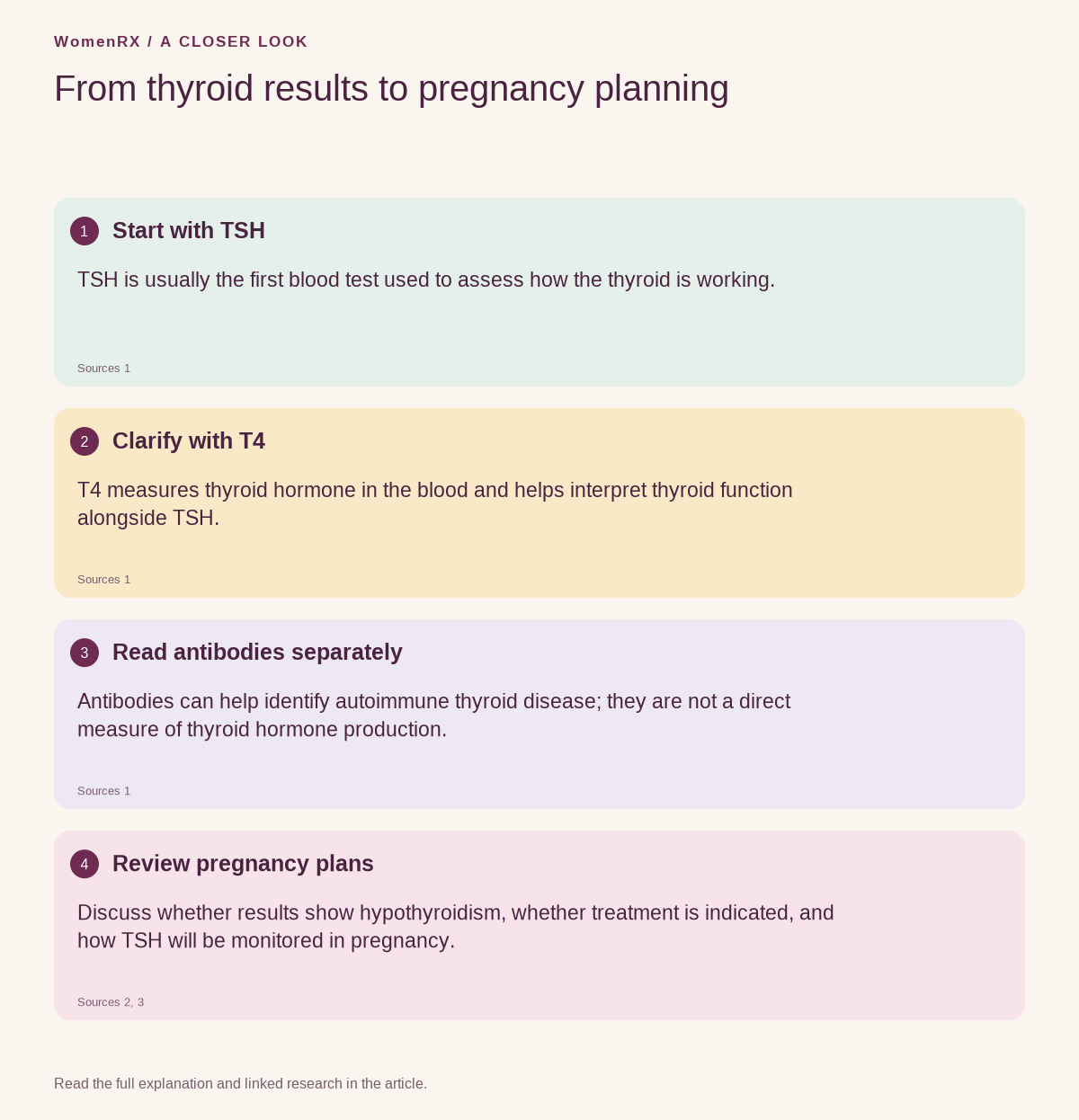
From thyroid results to pregnancy planning
Start with TSH: TSH is usually the first blood test used to assess how the thyroid is working.1
Clarify with T4: T4 measures thyroid hormone in the blood and helps interpret thyroid function alongside TSH.1
Read antibodies separately: Antibodies can help identify autoimmune thyroid disease; they are not a direct measure of thyroid hormone production.1
Review pregnancy plans: Discuss whether results show hypothyroidism, whether treatment is indicated, and how TSH will be monitored in pregnancy.23
Read the figure as text
The flow separates tests of thyroid function from antibody results, then connects each to a discussion about treatment and monitoring.- Start with TSH: TSH is usually the first blood test used to assess how the thyroid is working.1
- Clarify with T4: T4 measures thyroid hormone in the blood and helps interpret thyroid function alongside TSH.1
- Read antibodies separately: Antibodies can help identify autoimmune thyroid disease; they are not a direct measure of thyroid hormone production.1
- Review pregnancy plans: Discuss whether results show hypothyroidism, whether treatment is indicated, and how TSH will be monitored in pregnancy.23
More questions, answered
Do thyroid antibodies mean I’m infertile?
No. Antibodies can help identify autoimmune thyroid disease, but they don’t by themselves diagnose infertility or show that thyroid hormone levels are low. TSH and T4 assess thyroid function. 1 3
Should I stop levothyroxine if I become pregnant?
No. The U.S. prescribing information says not to discontinue levothyroxine during pregnancy and recommends TSH monitoring, with treatment adjusted as needed. 2
Sources you can check
- Thyroid Tests: MedlinePlusAccessed 2026-09-25Return to first citation
- LEVOTHYROXINE SODIUM TABLET [CARDINAL HEALTH 107, LLC] | US prescribing information and patient instructionsAccessed 2026-09-25Return to first citation
- The efficacy of acupuncture for the treatment and the fertility improvement in child-bearing period female with Hashimoto Disease: A randomized controlled study.Li F, Qi Z, Hua L, Wang X, Ling M, Juan D. · Medicine · 2020Return to first citation
- Innate Immunity in Autoimmune Thyroid Disease during Pregnancy.Bogović Crnčić T, Girotto N, Ilić Tomaš M, Krištofić I, Klobučar S, Batičić L, Ćurko-Cofek B, Sotošek V. · International journal of molecular sciences · 2023Return to first citation
- Overt and 'subclinical' hypothyroidism in women.Wartofsky L, Van Nostrand D, Burman KD. · Obstetrical & gynecological survey · 2006Return to first citation