Thyroid Tests and Treatment: What They Really Tell You
TSH is usually the first clue, but thyroid hormone tests, pregnancy plans, and your treatment history help put the result in context.
A TSH test measures thyroid-stimulating hormone; T4 and T3 tests measure thyroid hormones in the blood. TSH is usually the first test, but it doesn’t explain the whole picture by itself. Treatment decisions depend on the test pattern and individual circumstances, and levothyroxine doses are checked with blood tests. Pregnancy and recurrent pregnancy loss can call for more specific discussion. 1 2 4 6
A thyroid result can feel like a verdict, especially when it’s called “borderline.” In reality, the tests answer different questions: TSH measures thyroid-stimulating hormone, while T4 and T3 measure thyroid hormones in the blood. Together, they help describe thyroid function; they don’t make every question about symptoms or treatment disappear. 2
What each test can tell you
TSH is usually the first blood test ordered. T3 and T4 measure thyroid hormones directly, and thyroid antibody tests can help identify autoimmune thyroid disorders. These tests provide different kinds of information, so it’s useful to know which ones were measured and what pattern they show. 2
A raised TSH with thyroid hormone levels in the normal range is one pattern described as subclinical hypothyroidism. That description is about test results, not proof that a particular symptom is caused by the thyroid. 6 7
Common claims, checked against the tests
“One borderline TSH settles the diagnosis.”
A TSH result is one part of the picture. T4 and T3 tests measure thyroid hormones, and antibody testing may help identify an autoimmune cause. Ask which pattern your results show and whether the clinician thinks more information is needed before deciding what the result means. The test descriptions alone don’t establish that every borderline result requires treatment. 2
“My symptoms confirm hypothyroidism.”
Thyroid hormones affect many body functions, including heart rate, digestion, breathing, weight, and mood. But symptoms don’t measure TSH or thyroid hormone levels. Blood tests are used to assess thyroid function and help diagnose thyroid disease, so symptoms and lab results answer different questions. 2
“Levothyroxine is a supplement I can try.”
Levothyroxine is a medicine used to replace thyroid hormone in hypothyroidism, not a general wellness supplement. Its dose is individualized, and blood tests are used to check whether the dose is right. Taking too much or too little can matter; the NHS medicine information lists possible side effects when the dose is wrong. 1 4
There’s also a difference between a supplement affecting a test or medicine and treating hypothyroidism. Biotin, also called vitamin B7, can affect thyroid test results. A very small pilot trial of vitamin C involved people already taking high-dose levothyroxine; its authors said the results could not establish efficacy. It doesn’t show that vitamin C can replace thyroid hormone treatment. 1 5
“If I take levothyroxine, how I take it can’t matter.”
Food and other medicines can affect levothyroxine absorption. US prescribing information identifies calcium and iron products among medicines that can bind to it and reduce absorption, and lists other potential interactions, including some antacids and proton pump inhibitors. If your results remain off target, ask whether timing, other medicines, or absorption could be relevant before assuming the dose alone is the issue. 4
Pregnancy and preconception deserve their own context
If you’re already taking levothyroxine and become pregnant, tell the clinician managing your thyroid care. Levothyroxine can be used during pregnancy when needed, and blood testing may be more frequent to check thyroid hormone levels and dose. 1
Preconception care is a chance to discuss health issues before pregnancy. 3 If you have recurrent pregnancy loss, a thyroid result may be part of that discussion. One retrospective cohort studied 896 women with recurrent pregnancy loss and TSH between 2.5 and 4.0 mIU/L. In that group, levothyroxine treatment was associated with lower odds of miscarriage, but an observational association cannot establish that treatment caused the difference. The finding applies to that specific group; it doesn’t settle treatment for everyone planning a pregnancy. 6
Useful questions before a treatment decision
Bring the actual results, including TSH and any T4 or T3 measurements. Then ask: What pattern do these results show? Were thyroid antibodies checked, and would they help explain the cause? If treatment is proposed, what result or clinical concern is it meant to address, and when will blood tests be used to review the dose? If you’re pregnant or planning pregnancy, ask how that changes the interpretation and follow-up. 1 2 4
The most useful next step isn’t to treat a single word like “borderline” as a diagnosis. It’s to understand what was measured, what the combined results show, and what the proposed treatment is intended to do.
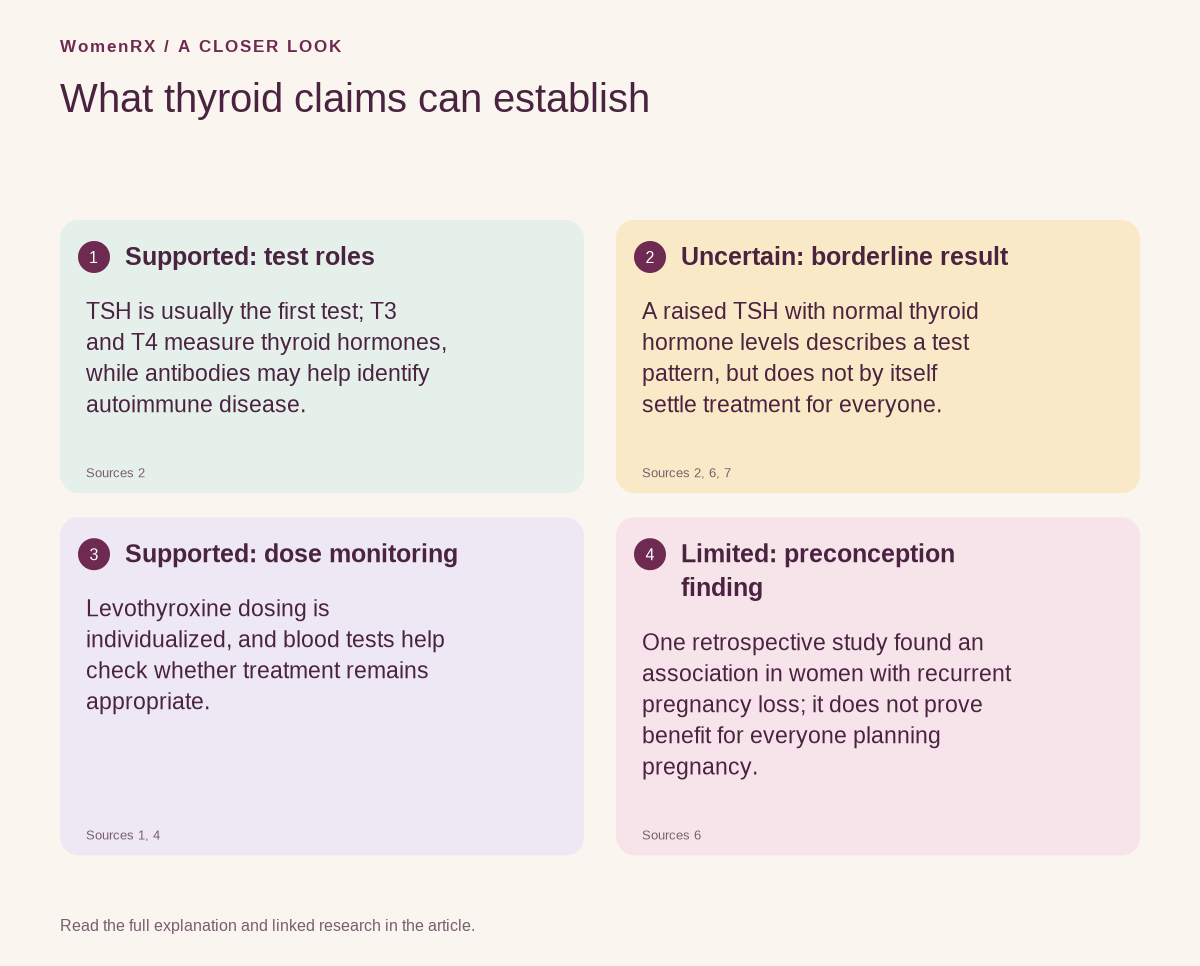
What thyroid claims can establish
Supported: test roles: TSH is usually the first test; T3 and T4 measure thyroid hormones, while antibodies may help identify autoimmune disease.2
Uncertain: borderline result: A raised TSH with normal thyroid hormone levels describes a test pattern, but does not by itself settle treatment for everyone.267
Supported: dose monitoring: Levothyroxine dosing is individualized, and blood tests help check whether treatment remains appropriate.14
Limited: preconception finding: One retrospective study found an association in women with recurrent pregnancy loss; it does not prove benefit for everyone planning pregnancy.6
Read the figure as text
Separate what a test or study directly shows from what still needs individual interpretation.- Supported: test roles: TSH is usually the first test; T3 and T4 measure thyroid hormones, while antibodies may help identify autoimmune disease.2
- Uncertain: borderline result: A raised TSH with normal thyroid hormone levels describes a test pattern, but does not by itself settle treatment for everyone.267
- Supported: dose monitoring: Levothyroxine dosing is individualized, and blood tests help check whether treatment remains appropriate.14
- Limited: preconception finding: One retrospective study found an association in women with recurrent pregnancy loss; it does not prove benefit for everyone planning pregnancy.6
More questions, answered
Can a supplement interfere with thyroid tests?
Yes. Biotin, also called vitamin B7, can affect thyroid test results. Mention it when discussing your lab results and any planned testing. 1
Do levothyroxine doses stay the same during pregnancy?
Not always. Blood tests may be needed more often during pregnancy to check thyroid hormone levels and whether the dose remains appropriate. 1
Sources you can check
- Levothyroxine: a medicine for an underactive thyroid (hypothyroidism) - NHSAccessed 2026-09-25Return to first citation
- Thyroid Tests: MedlinePlusAccessed 2026-09-25Return to first citation
- Preconception Care: MedlinePlusAccessed 2026-09-25Return to first citation
- LEVOTHYROXINE SODIUM TABLET [CARDINAL HEALTH 107, LLC] | US prescribing information and patient instructionsAccessed 2026-09-25Return to first citation
- Vitamin C supplementation in patients with hypothyroidism requiring high-dose levothyroxine: a proof-of-concept pilot study.Agha A, Afandi B, Yasin J, Sharma C, Alshaer MH, Alshamsi MAS, Yaaqeib DE, Alblooshi BKE, AlKaabi J. · Frontiers in endocrinology · 2025Return to first citation
- Preconception thyroid function optimization and pregnancy outcomes in women with recurrent pregnancy loss: a real-world cohort study.Xu H, Wang Z, Liu Y, Xing S, Zhen H, Li J, Qiao C. · Endocrine connections · 2026Return to first citation
- Association Between Thyroid Hormone Parameters and Renal Biochemical Markers in Patients With Subclinical Hypothyroidism: A Cross-Sectional Study From a Tertiary Care Hospital in Himachal Pradesh.Bansal A, Singh J, Pahal N, Singh H, Verma A, Dahmiwal S, Simranpal P. · Cureus · 2026Return to first citation