Fasting Insulin Tests: What Can They Tell You?
Fasting insulin can help estimate insulin resistance, but glucose tests answer the question of whether you have diabetes.
A fasting insulin test measures how much insulin is in your blood after a fast. It can help estimate insulin resistance, but a single result cannot diagnose diabetes. Glucose blood tests answer that question. Fasting glucose captures one point in time, A1C reflects roughly three months, and an oral glucose tolerance test includes a two-hour glucose measurement. 4153
Insulin and glucose answer different questions
Insulin is the hormone that helps move glucose from your blood into your cells. Your body may make insulin but have cells that respond poorly to it, as can happen in type 2 diabetes. A fasting insulin test looks at the hormone; diabetes testing looks at whether glucose in your blood is too high. Those are related questions, not interchangeable ones. 1
For example, someone may want an estimate of insulin resistance. Fasting insulin might add context to that discussion. If the question is Do I have prediabetes or diabetes?, a glucose blood test is the more direct next step. Diabetes is diagnosed using glucose blood tests, including A1C, rather than a fasting insulin result. 1
Why an insulin-resistance estimate isn’t a diagnosis
Insulin resistance is difficult to measure directly in an ordinary clinical setting. Fasting insulin is one estimate. HOMA-IR is another: it calculates an insulin-resistance estimate from fasting insulin and fasting glucose. In a study of 758 apparently healthy people without diabetes, both estimates had similar relationships with a direct measure of insulin-mediated glucose disposal. Each accounted for about 40% of the variation in that direct measure. Calculating HOMA-IR did not provide a better estimate of insulin action than fasting insulin alone in this study. 4
That distinction matters when you see a flagged number on a lab report or an online HOMA-IR calculator. An estimate can describe one aspect of metabolism without establishing whether you have diabetes or telling you, by itself, what treatment you need. 41
Which glucose test fits the question?
Fasting glucose measures the glucose in your blood at a fasting draw. It gives a snapshot, not a measurement of how much insulin your body made to reach that level. A1C reflects average blood glucose over roughly the past three months rather than glucose at a single draw. Both address blood glucose, not fasting insulin. 45
An oral glucose tolerance test (OGTT) includes a two-hour glucose measurement during the test, rather than only a fasting measurement. Glucose measurements, including A1C, are used to assess diabetes; an OGTT’s two-hour glucose result also appears in research on glucose metabolism. These distinctions don’t mean everyone needs every test. 13
The practical choice is driven by what you need to find out. If diabetes is the concern, glucose testing, rather than fasting insulin, is used to answer it. If fasting insulin is offered as an extra test, a useful question is: What decision would this result change that my glucose results would not? Fasting insulin and HOMA-IR can estimate insulin-related physiology, but neither substitutes for a glucose test. 14
PCOS and pregnancy change the context, not the basic distinction
PCOS is associated with insulin resistance and higher metabolic risk, so it makes sense to discuss glucose health if you have PCOS. But fasting insulin is not among the PCOS features described as diagnostic criteria in a study applying the 2023 international guideline. A PCOS diagnosis and an assessment for diabetes answer different questions; an insulin number alone settles neither. 21
Pregnancy brings a separate question: screening for gestational diabetes. It can occur without noticeable symptoms, and screening usually happens between 24 and 28 weeks of pregnancy. PCOS and a previous pregnancy with gestational diabetes are among the factors associated with higher gestational-diabetes risk. Pregnancy screening is about blood glucose, not a requirement to obtain fasting insulin. 1
Fasting insulin may be useful when a clinician has a specific reason to estimate insulin resistance and can explain how the result will add to the rest of your assessment. If your goal is to learn whether your glucose is too high, start with the tests that answer that question. 41
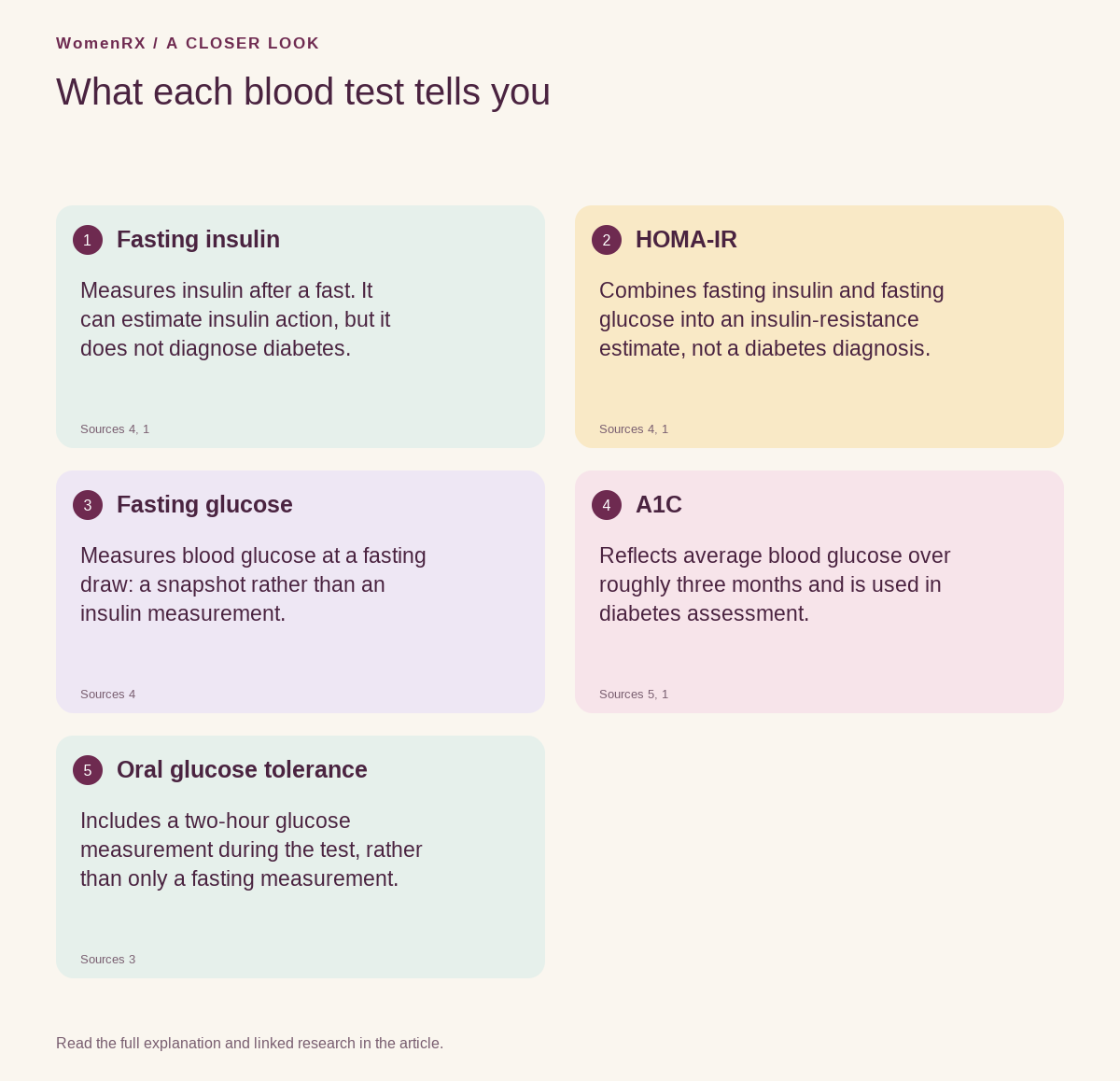
What each blood test tells you
Fasting insulin: Measures insulin after a fast. It can estimate insulin action, but it does not diagnose diabetes.41
HOMA-IR: Combines fasting insulin and fasting glucose into an insulin-resistance estimate, not a diabetes diagnosis.41
Fasting glucose: Measures blood glucose at a fasting draw: a snapshot rather than an insulin measurement.4
A1C: Reflects average blood glucose over roughly three months and is used in diabetes assessment.51
Oral glucose tolerance: Includes a two-hour glucose measurement during the test, rather than only a fasting measurement.3
Read the figure as text
Two measurements estimate insulin-related physiology; three look at blood glucose over different time windows or conditions.- Fasting insulin: Measures insulin after a fast. It can estimate insulin action, but it does not diagnose diabetes.41
- HOMA-IR: Combines fasting insulin and fasting glucose into an insulin-resistance estimate, not a diabetes diagnosis.41
- Fasting glucose: Measures blood glucose at a fasting draw: a snapshot rather than an insulin measurement.4
- A1C: Reflects average blood glucose over roughly three months and is used in diabetes assessment.51
- Oral glucose tolerance: Includes a two-hour glucose measurement during the test, rather than only a fasting measurement.3
Sources you can check
- Diabetes | Type 1 Diabetes | Type 2 Diabetes | MedlinePlusAccessed 2026-09-25Return to first citation
- 24-hour movement behaviours and cardiometabolic markers in women with polycystic ovary syndrome (PCOS): a compositional data analysis.Pesonen E, Farrahi V, Brakenridge CJ, Ollila MM, Morin-Papunen LC, Nurkkala M, Jämsä T, Korpelainen R, Moran LJ, Piltonen TT, Niemelä M. · Human reproduction (Oxford, England) · 2024Return to first citation
- Effects of exercise, metformin and their combination on glucose metabolism in individuals with abnormal glycaemic control: a systematic review and network meta-analysis.Zhao T, Yang Q, Feuerbacher JF, Yu B, Brinkmann C, Cheng S, Bloch W, Schumann M. · British journal of sports medicine · 2024Return to first citation
- Evaluation of fasting plasma insulin concentration as an estimate of insulin action in nondiabetic individuals: comparison with the homeostasis model assessment of insulin resistance (HOMA-IR).Abbasi F, Okeke Q, Reaven GM. · Acta diabetologica · 2014Return to first citation
- Blood Glucose | Blood Sugar | Diabetes | MedlinePlusAccessed 2026-09-25Return to first citation