Berberine Doses in Studies: What Safety Can They Tell You?
Research doses vary by study and product, so a number used in one trial isn’t a personal safety guide.
One recent trial used 1 gram of oral berberine daily for six months, while older diabetes studies summarized in a review used 300 or 500 milligrams three times daily alongside prescription medicines. Those are examples, not a recommended range: the studies involved different people and regimens, and they don’t establish that products or doses are interchangeable. 1 5
Study doses are clues, not instructions
There isn’t one dose that these studies establish as right for everyone. The amount, schedule, reason for taking berberine, and whether it was used alone or with other treatments all matter when comparing research.
For example, a randomized trial in China assigned 337 adults with obesity and fatty liver disease, but no diabetes, to berberine at 1 gram daily or placebo for six months. About 66% of participants were men. The trial found no significant difference between groups in visceral fat or liver fat; adverse events were similar between groups. That’s useful information about one dose, product, population, and time period. It doesn’t establish safety for longer use or for people with different health conditions. 1
An older review of type 2 diabetes studies describes two different combination regimens: 500 milligrams three times daily with glipizide and metformin for three months in one 60-person study, and 300 milligrams three times daily with metformin for 24 weeks in another 60-person study. These examples involved berberine alongside prescription drugs, not a comparison of berberine doses taken alone. The review is older, and the regimens don’t establish a general dose or show that one is safer than the other. 5
Taken together, these studies are not a dose-finding comparison. A dose used in a trial is not automatically a safe or appropriate dose for you.
Why the label matters as much as the number
A milligram amount only helps you compare products if you know what form the study used and what the label means. A review of natural-product research explains that a tea, a decoction, a standardized extract, and a purified compound should be treated as different products, even if they come from the same plant. It also describes variation in botanical identity and alkaloid content in berberine products. 2 4
So if a product lists a number that resembles a study dose, that alone doesn’t tell you that the product matches the study formulation or delivers the same exposure. Useful details to check include the specific form of berberine, the amount per serving, and whether the label identifies a standardized ingredient. If those details are unclear, the dose comparison is unclear too.
Medication interactions deserve a real review
Berberine can affect how some medicines are handled by the body, and it may also add to some medicines’ effects. A 2026 review identifies a human interaction with cyclosporine: in renal-transplant recipients, berberine was associated with a 34.5% increase in cyclosporine exposure (measured by AUC) and a 29.3% higher trough level than control. The same review says evidence for most other proposed interactions is mechanistic rather than confirmed in people. 2
The review also raises potential additive effects with medicines that lower blood sugar or blood pressure. That’s a reason to ask a pharmacist or prescriber to review your full medication list before considering berberine, especially if you take cyclosporine or a medicine that needs close monitoring. Don’t use a supplement dose as a substitute for changing a prescribed medicine. 2
Pregnancy and breastfeeding need extra caution
The clinical examples above don’t establish safety during pregnancy or breastfeeding. A toxicology review of Berberis plants and their alkaloids lists embryonic development among potential toxicity concerns, but its summary doesn’t establish the level of human risk or a safe dose. That uncertainty means a dose used by adults in a metabolic-health study shouldn’t be treated as pregnancy or breastfeeding guidance. 3
If you’re pregnant, trying to conceive, or breastfeeding, discuss berberine with your clinician or pharmacist before using it. The question is not just how many milligrams are on the label, but whether the product and its possible effects on medicines are appropriate for your circumstances.
A practical way to compare a study and a product
Before treating a study dose as relevant to a product you’re considering, check whether the study and label match on the form of berberine, amount and schedule, health condition being studied, and use with other medicines. Then review your medications and reproductive circumstances with a pharmacist or prescriber. If you can’t tell what form or amount the product contains, you can’t make a dependable comparison from the dose alone.
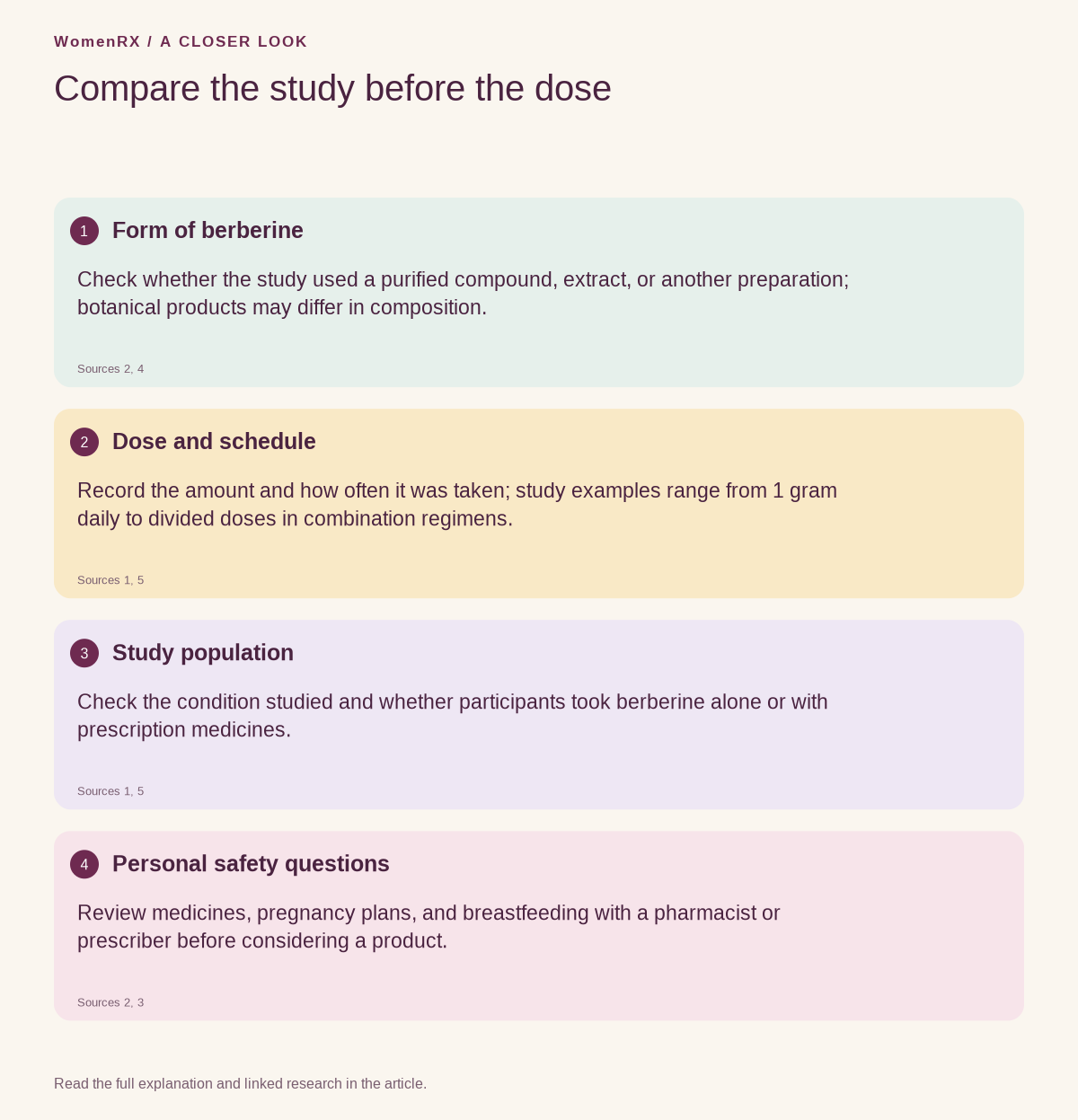
Compare the study before the dose
Form of berberine: Check whether the study used a purified compound, extract, or another preparation; botanical products may differ in composition.24
Dose and schedule: Record the amount and how often it was taken; study examples range from 1 gram daily to divided doses in combination regimens.15
Study population: Check the condition studied and whether participants took berberine alone or with prescription medicines.15
Personal safety questions: Review medicines, pregnancy plans, and breastfeeding with a pharmacist or prescriber before considering a product.23
Read the figure as text
A dose number is useful only when the study product and context are clear. Check these details before drawing a comparison.- Form of berberine: Check whether the study used a purified compound, extract, or another preparation; botanical products may differ in composition.24
- Dose and schedule: Record the amount and how often it was taken; study examples range from 1 gram daily to divided doses in combination regimens.15
- Study population: Check the condition studied and whether participants took berberine alone or with prescription medicines.15
- Personal safety questions: Review medicines, pregnancy plans, and breastfeeding with a pharmacist or prescriber before considering a product.23
More questions, answered
Does a study dose mean the product is proven safe?
No. A study’s safety findings apply to the people, product, dose, and follow-up period it examined. For example, one six-month trial found similar adverse-event rates with 1 gram daily and placebo in adults with obesity and fatty liver disease who did not have diabetes; it doesn’t establish safety for every person or product. 1
Which medication interaction is supported by human evidence?
A review reports increased cyclosporine exposure in renal-transplant recipients taking berberine. Many other proposed interactions discussed in the review are based on mechanisms rather than confirmed clinical effects in people. 2
Sources you can check
- Berberine and Adiposity in Diabetes-Free Individuals With Obesity and MASLD: A Randomized Clinical Trial.Lei L, Wang B, Zhao L, Li J, Yan X, Jiang J, Wang L, Ren G, Li Y, Cheng X, Yan X, Zhu Y, Guo Y, Zhong H, Zhang H, Li J, BRAVO Collaborative Group. · JAMA network open · 2026Return to first citation
- Berberine-Drug Interactions: Mechanisms, Clinical Relevance and Risk Stratification-A Narrative Review.Dumitru CN, Marcu T, Dumitru AO, Tudor SS, Ferțu ID, Elisei AM, Goroftei L. · Pharmaceuticals (Basel, Switzerland) · 2026Return to first citation
- Balancing efficacy and risk: A toxicological review and safety transformation of Berberis plants and their alkaloids.Ma J, Lan X, Luo X, Jing Y, Yin Y, Du H, Li Q, Fan G. · Phytomedicine : international journal of phytotherapy and phytopharmacology · 2026Return to first citation
- Defined Natural Products as Adjunctive Therapies: Evidence-Gated Polypharmacology Across Molecular Targets, Human Exposure, Clinical Signals, and Safety Boundaries.Seo Y, Woo J. · International journal of molecular sciences · 2026Return to first citation
- Application of berberine on treating type 2 diabetes mellitus.Pang B, Zhao LH, Zhou Q, Zhao TY, Wang H, Gu CJ, Tong XL. · International journal of endocrinology · 2015Return to first citation