Berberine Study Timelines: What Changes Can Tell You
Most trials measured blood sugar markers after about 12 weeks, but results depend on the product and don’t show that berberine prevents diabetes complications or heart events.
Trials generally measured blood sugar changes over 12 weeks. One small prediabetes study checked markers at weeks 4, 8, and 12; other studies tested a combination product or a distinct berberine-based medicine. These findings concern lab markers over limited periods, not proof of lasting benefit or fewer health complications. 3 4 5
The short answer: think in weeks, not days
Several studies assessed blood sugar over 12 weeks, and one small trial took measurements at weeks 4, 8, and 12. That gives a sense of when researchers looked for changes, not a promise that you’ll respond on that schedule. The results also came from specific products and study groups, so they can’t automatically predict what an over-the-counter berberine supplement will do for you. 3 4 5
A 12-week placebo-controlled pilot trial enrolled 34 people with prediabetes. It reported changes in several blood sugar markers, including fasting glucose and A1c, during the study. The small number of participants and the use of one named berberine product limit how confidently you can apply the findings beyond that trial. 3
A similar timeline doesn’t mean the same treatment
Some studies didn’t test berberine alone. One 12-week trial added a formulation containing berberine, hesperidin, and chromium to metformin for people with type 2 diabetes. The researchers reported improvements in fasting glucose and A1c compared with metformin alone. Because it was a combination product, the study can’t tell you how much of the result came from berberine itself. It also studied berberine as an add-on, not as a replacement for diabetes treatment. 4
Another 12-week trial tested berberine ursodeoxycholate, a distinct compound made from berberine and ursodeoxycholic acid, in people with type 2 diabetes. It found lower A1c compared with placebo. That product isn’t interchangeable with standard berberine supplements, so its results shouldn’t be used to predict the effect of a different formulation. 5
The duration and the outcome both matter. A study lasting a few months can show whether a lab marker changed during that period. It doesn’t, by itself, establish that a person will avoid diabetes complications, have fewer heart attacks, or maintain the change long term. These trials focused on metabolic or liver-related markers over limited follow-up. 3 4 5 6
Blood sugar and cholesterol are different questions
For blood sugar, trials report outcomes such as fasting glucose and A1c. A blood test called a lipid panel measures cholesterol and triglycerides; what levels mean for you depends on your health and risk factors. 1 2
There’s less basis for estimating when standard berberine alone might change cholesterol. In the 12-week metformin add-on study, the combination product did not show a lipid-profile effect. The authors discussed possible reasons, including the formulation’s berberine amount and participants’ use of statins, but those explanations don’t establish that another berberine product would work differently. 4
So if your main goal is a cholesterol change, don’t treat the blood-sugar timelines as a guide to when your lipid panel should change. A change in a lab value is also not the same as evidence that a supplement prevents heart disease. Cholesterol numbers need to be interpreted in the context of your overall risk and treatment plan. 1 2
What to take from a trial timeline
A study’s timeline is most useful when you read it alongside the product, participants, comparison group, and outcomes. Ask: Was the product berberine alone or a combination? Was it a standard supplement or a distinct compound? Did participants take other treatment? Were researchers measuring a lab marker, symptoms, or longer-term health outcomes?
Those distinctions matter for women, too. The studies don’t provide enough reported sex-specific results to show whether effects differ for women. They also don’t establish safety during pregnancy or breastfeeding. If you’re considering berberine while taking medication for blood sugar or cholesterol, the fact that some studies tested a product alongside another treatment is not a reason to add it or change your treatment on your own. The limited timelines and specific formulations make that a separate decision to discuss with the clinician managing your care. 3 4 5
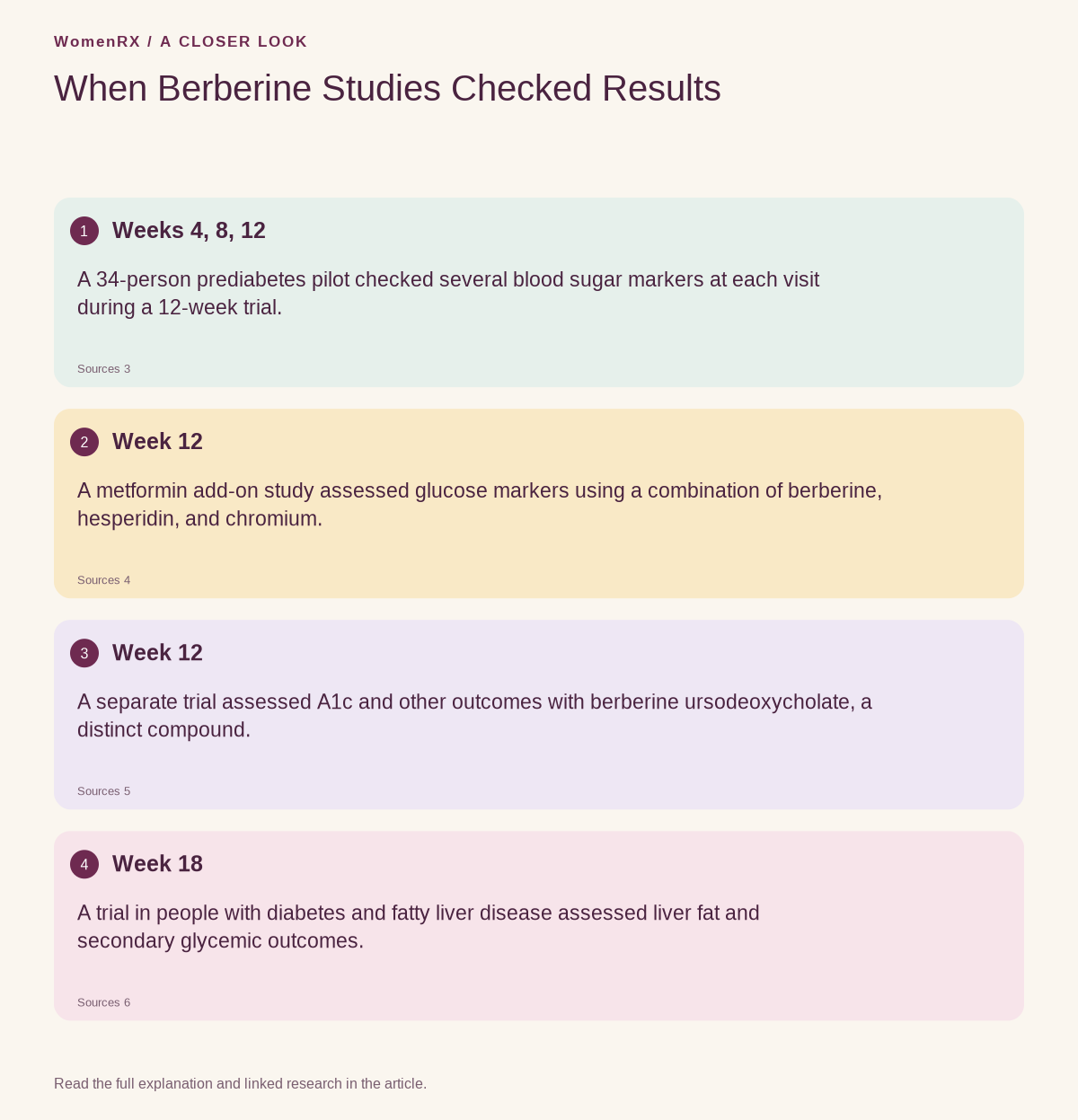
When Berberine Studies Checked Results
Weeks 4, 8, 12: A 34-person prediabetes pilot checked several blood sugar markers at each visit during a 12-week trial.3
Week 12: A metformin add-on study assessed glucose markers using a combination of berberine, hesperidin, and chromium.4
Week 12: A separate trial assessed A1c and other outcomes with berberine ursodeoxycholate, a distinct compound.5
Week 18: A trial in people with diabetes and fatty liver disease assessed liver fat and secondary glycemic outcomes.6
Read the figure as text
These study time points show when researchers assessed markers, not when every person should expect a response.- Weeks 4, 8, 12: A 34-person prediabetes pilot checked several blood sugar markers at each visit during a 12-week trial.3
- Week 12: A metformin add-on study assessed glucose markers using a combination of berberine, hesperidin, and chromium.4
- Week 12: A separate trial assessed A1c and other outcomes with berberine ursodeoxycholate, a distinct compound.5
- Week 18: A trial in people with diabetes and fatty liver disease assessed liver fat and secondary glycemic outcomes.6
More questions, answered
Does a 12-week result mean I should wait 12 weeks to check my levels?
Not necessarily. Twelve weeks describes the assessment period used in several studies, not a personal monitoring schedule. When to repeat a test depends on your situation and care plan; cholesterol testing frequency, for example, depends on factors such as age, risk, and family history. 1 2
Do these study results apply to berberine during pregnancy or breastfeeding?
These trials don’t establish safety during pregnancy or breastfeeding. They also don’t report enough women-specific results to show whether effects differ by sex. 3 4 5
Sources you can check
- Cholesterol Levels: What You Need to Know: MedlinePlusAccessed 2026-09-25Return to first citation
- Cholesterol | MedlinePlusAccessed 2026-09-25Return to first citation
- Efficacy and safety of HIMABERB® Berberine on glycemic control in patients with prediabetes: double-blind, placebo-controlled, and randomized pilot trial.Panigrahi A, Mohanty S. · BMC endocrine disorders · 2023Return to first citation
- Effect of a New Formulation of Nutraceuticals as an Add-On to Metformin Monotherapy for Patients with Type 2 Diabetes and Suboptimal Glycemic Control: A Randomized Controlled Trial.Sartore G, Ragazzi E, Antonello G, Cosma C, Lapolla A. · Nutrients · 2021Return to first citation
- Berberine Ursodeoxycholate for the Treatment of Type 2 Diabetes: A Randomized Clinical Trial.Ji L, Ma J, Ma Y, Cheng Z, Gan S, Yuan G, Liu D, Li S, Liu Y, Xue X, Bai J, Wang K, Cai H, Li S, Liu K, Yu M, Liu L. · JAMA network open · 2025Return to first citation
- A phase 2, proof of concept, randomised controlled trial of berberine ursodeoxycholate in patients with presumed non-alcoholic steatohepatitis and type 2 diabetes.Harrison SA, Gunn N, Neff GW, Kohli A, Liu L, Flyer A, Goldkind L, Di Bisceglie AM. · Nature communications · 2021Return to first citation