Berberine Dose Depends on What Was Studied
Human studies don’t establish one daily dose for berberine, and the best-known glucose trial tested it as part of a combination alongside metformin.
There isn’t a universal berberine dose supported for every goal. One 12-week trial studied 250 mg a day of berberine in a combination product added to metformin for type 2 diabetes; it can’t show berberine alone caused the changes. Cholesterol research includes varied formulations, and interaction risks matter: have a pharmacist or prescriber check your medicines before considering it. 2 3 4
What the glucose study actually tested
A dose from one study isn’t automatically a dose for you. In a 12-week randomized trial, people with type 2 diabetes whose blood sugar was not adequately controlled on metformin took metformin plus a combination product containing berberine, hesperidin, and chromium picolinate. The combination supplied 250 mg of berberine per day. The researchers reported better fasting glucose and HbA1c results than with metformin alone, but because the product had three ingredients, the study can’t show how much of the effect came from berberine itself. It also tested add-on use, not replacement of diabetes treatment. 2
The trial excluded people who were pregnant or breastfeeding, and its reported results don’t establish a women-specific dose or effect. That’s one reason not to treat its 250 mg figure as a general recommendation. 2
Cholesterol studies don’t give one clean protocol
A meta-analysis included 19 studies of berberine alone and combinations, including products with silymarin. It reported reductions in total and LDL cholesterol across the formulations; triglyceride reductions were smaller, and the HDL increase wasn’t statistically significant. The studies included both controlled and cross-sectional designs, and the authors said more clinical research is needed to clarify which treatments and patients benefit. 3
The diabetes trial authors described 1-1.5 grams per day as doses reported in earlier cholesterol research. That figure is not a proven dose for you, or a single protocol established by the meta-analysis. In the trial itself, the combination supplied 250 mg per day, and the researchers did not find a lipid-profile benefit. Different doses, formulations, and study designs make a simple dose-to-result comparison unreliable. 2 3
Check medicines before choosing a product
Berberine can affect how some medicines are handled in the body, and it may add to effects such as lowering blood sugar. A 2026 review describes interaction evidence as mixed: some concerns are based on mechanisms, while others have been observed in people. In one human interaction study summarized by the review, cyclosporine exposure increased; the review reported an area-under-the-curve increase of 34.5% and a trough level 29.3% above control. That finding matters especially if you take medicines where changes in drug levels could have serious consequences. 4
Bring the exact product label and your full prescription and supplement list to a pharmacist or prescriber for a check before using it. Products can differ in their actual botanical content, which adds uncertainty about what a given label delivers. 4
If you use berberine for blood sugar, don’t stop or reduce prescribed treatment based on a supplement study. Diabetes care uses blood-glucose measures and individualized targets; a supplement trial doesn’t establish that berberine can replace the treatment plan that helps keep your glucose in range. 1 2
Pregnancy and breastfeeding: what this study can’t tell you
The diabetes trial excluded pregnant and breastfeeding participants, so its results don’t answer whether berberine is safe in either situation. Don’t take this trial as evidence of safety or harm during pregnancy or breastfeeding. 2
A useful way to read a dose claim
Before treating a number on a bottle or online as a tested dose, ask: Was berberine studied alone or in a combination? For what condition and how long? Was it added to prescribed treatment? And were safety and results reported for women separately? In the available diabetes trial, the answer was a combination product, 12 weeks, add-on to metformin, and no reported women-specific dose result. That’s a much narrower finding than a universal daily recommendation. 2
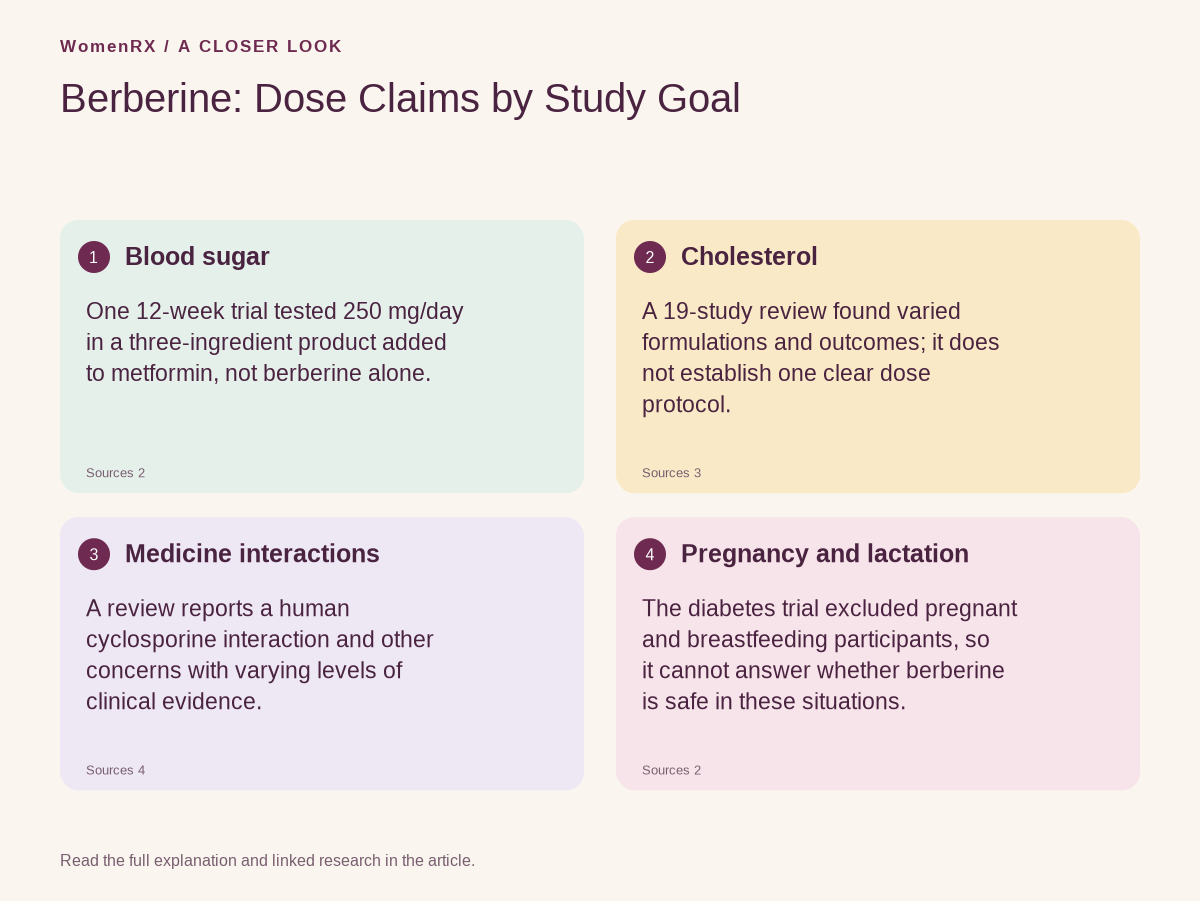
Berberine: Dose Claims by Study Goal
Blood sugar: One 12-week trial tested 250 mg/day in a three-ingredient product added to metformin, not berberine alone.2
Cholesterol: A 19-study review found varied formulations and outcomes; it does not establish one clear dose protocol.3
Medicine interactions: A review reports a human cyclosporine interaction and other concerns with varying levels of clinical evidence.4
Pregnancy and lactation: The diabetes trial excluded pregnant and breastfeeding participants, so it cannot answer whether berberine is safe in these situations.2
Read the figure as text
Compare what the human research actually tested with what remains uncertain, then check medicine and pregnancy considerations before making a decision.- Blood sugar: One 12-week trial tested 250 mg/day in a three-ingredient product added to metformin, not berberine alone.2
- Cholesterol: A 19-study review found varied formulations and outcomes; it does not establish one clear dose protocol.3
- Medicine interactions: A review reports a human cyclosporine interaction and other concerns with varying levels of clinical evidence.4
- Pregnancy and lactation: The diabetes trial excluded pregnant and breastfeeding participants, so it cannot answer whether berberine is safe in these situations.2
Sources you can check
- Blood Glucose | Blood Sugar | Diabetes | MedlinePlusAccessed 2026-09-25Return to first citation
- Effect of a New Formulation of Nutraceuticals as an Add-On to Metformin Monotherapy for Patients with Type 2 Diabetes and Suboptimal Glycemic Control: A Randomized Controlled Trial.Sartore G, Ragazzi E, Antonello G, Cosma C, Lapolla A. · Nutrients · 2021Return to first citation
- Berberine and Dyslipidemia: Different Applications and Biopharmaceutical Formulations Without Statin-Like Molecules-A Meta-Analysis.Bertuccioli A, Moricoli S, Amatori S, Rocchi MBL, Vici G, Sisti D. · Journal of medicinal food · 2020Return to first citation
- Berberine-Drug Interactions: Mechanisms, Clinical Relevance and Risk Stratification-A Narrative Review.Dumitru CN, Marcu T, Dumitru AO, Tudor SS, Ferțu ID, Elisei AM, Goroftei L. · Pharmaceuticals (Basel, Switzerland) · 2026Return to first citation