Inositol or Metformin for PCOS: What Was Studied?
The comparison looks different for cycle regularity, metabolic markers, and fertility, and one small trial of a specific inositol blend can’t settle them all.
A small 12-week trial in 60 women with PCOS compared metformin with one 40:1 blend of myo-inositol and D-chiro-inositol. Both groups improved on several measured outcomes, including menstrual regularity; metformin did somewhat better on some insulin-sensitivity and hormone measures, though the groups differed in PCOS phenotype. Broader reviews report possible inositol benefits, but the evidence varies in quality and doesn’t establish one best option or formulation. 1 2
Start with the outcome you care about
“Which is better?” depends on what you want to change. More regular periods, metabolic markers such as insulin resistance, ovulation, pregnancy, and live birth are separate outcomes. A change in a lab result or cycle pattern doesn’t automatically show that fertility or long-term health has improved.
The clearest direct comparison in this evidence base is a randomized 12-week trial of 60 women with PCOS. One group received metformin; the other received a 40:1 combination of myo-inositol and D-chiro-inositol. Both groups improved on several measured outcomes, including menstrual regularity and insulin sensitivity. Metformin had slightly better results on some insulin-sensitivity and endocrine measures. The researchers noted that the metformin group had more participants with phenotype A PCOS, which may have influenced the comparison. With a small sample and short follow-up, this trial can’t establish which treatment works better over time. 1
Cycle changes aren’t the same as confirmed ovulation
The trial reported improved menstrual regularity, but that result shouldn’t be treated as proof that every participant ovulated or that the change lasted. The study tested one particular blend, not inositol as a single, uniform treatment. Its findings don’t show that another ratio or a product with different ingredients will have the same effect. 1
An umbrella review of 13 meta-analyses found that inositol was associated with improvements across several PCOS outcomes. But its quality assessment found no high-quality evidence among the 85 outcome assessments it graded; 40% were rated low quality and 41.1% very low quality. The findings may be useful when weighing options, but their certainty and applicability vary. 2
Metabolic markers offer clues, not a full health outcome
The inositol review reported improvements in measures including HOMA-IR, an estimate of insulin resistance, as well as hormone and blood-fat measures. These are markers measured in studies, not proof that inositol prevents diabetes or heart disease. In comparisons with metformin, the review found no significant difference for most assessed outcomes, with exceptions including triglycerides and pregnancy rates. A finding of no significant difference does not establish that the treatments are equivalent. 2
The small head-to-head trial also found improvement in insulin sensitivity in both groups, with some measures favoring metformin. The researchers’ explanation that differences in PCOS phenotype may have contributed is a qualification, not proof that one treatment is better for a particular phenotype. 1
If fertility is the goal, name which step matters
Ovulation, pregnancy, and live birth are related, but they are not interchangeable. The umbrella review reported pooled inositol findings for ovulation and live birth compared with placebo or folic acid. Those results do not establish that inositol is better than metformin for live birth, or predict an individual person’s chance of conceiving. The review’s summary of comparisons with metformin found differences for pregnancy rates but not most other assessed outcomes; that still doesn’t show which approach is best for a particular fertility goal. 2
Metformin fertility findings can also vary across the populations studied. A review of reproductive evidence describes differences in some pregnancy and ovulation results by body mass index, while noting low overall evidence quality for the comparisons it summarizes. That makes it especially useful to ask what outcome a study measured and which group it studied, rather than treating one finding as a universal guide. 3
If you’re trying to conceive, useful questions include: Are we focusing on supporting ovulation, achieving pregnancy, or improving the chance of live birth? What other parts of my care address that goal? What result would show whether this approach is helping?
The inositol formulation matters
The direct comparison tested a 40:1 myo-inositol and D-chiro-inositol blend. The umbrella review included different inositol approaches and found that combinations did not consistently outperform single forms; it also advised caution with D-chiro-inositol alone. These findings don’t identify one best formulation. 1 2
The studies summarized here assessed particular study interventions, not whether commercial products consistently match those formulations or how product quality varies. If you’re considering inositol, ask whether the product’s ingredients and formulation match the approach being discussed, and how it fits with any prescribed care you already use. The evidence doesn’t support treating a supplement as a proven substitute for prescribed care.
A more useful comparison question
Before weighing the two, name your main goal: cycle regularity, a metabolic measure, or fertility. Then ask which outcome has actually been studied, whether the inositol formulation matches the one in that research, and what result would lead you to continue or reconsider the plan. The current evidence offers clues, not a universal ranking.
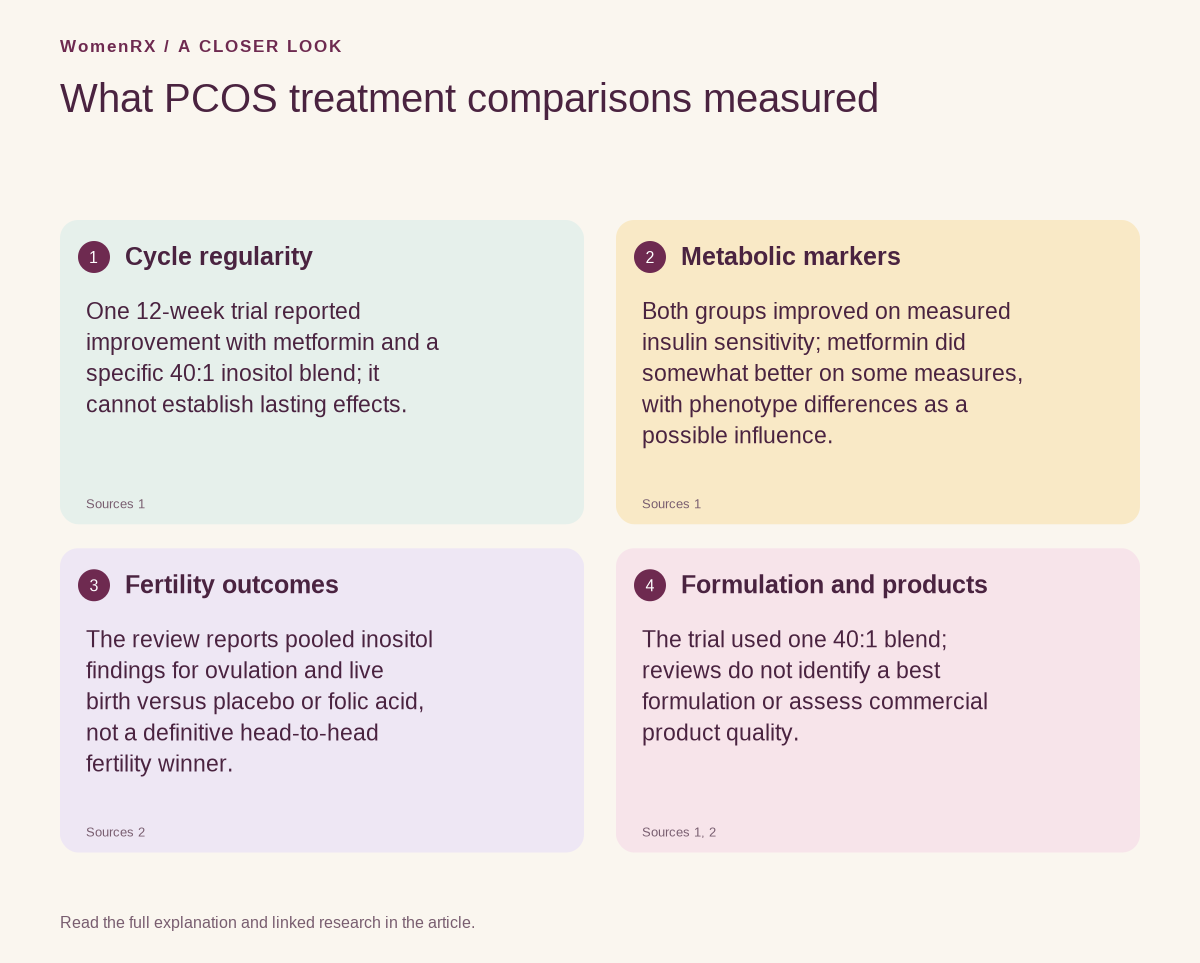
What PCOS treatment comparisons measured
Cycle regularity: One 12-week trial reported improvement with metformin and a specific 40:1 inositol blend; it cannot establish lasting effects.1
Metabolic markers: Both groups improved on measured insulin sensitivity; metformin did somewhat better on some measures, with phenotype differences as a possible influence.1
Fertility outcomes: The review reports pooled inositol findings for ovulation and live birth versus placebo or folic acid, not a definitive head-to-head fertility winner.2
Formulation and products: The trial used one 40:1 blend; reviews do not identify a best formulation or assess commercial product quality.12
Read the figure as text
Findings depend on the outcome and the inositol formulation tested. A result in one category doesn’t establish a winner in another.- Cycle regularity: One 12-week trial reported improvement with metformin and a specific 40:1 inositol blend; it cannot establish lasting effects.1
- Metabolic markers: Both groups improved on measured insulin sensitivity; metformin did somewhat better on some measures, with phenotype differences as a possible influence.1
- Fertility outcomes: The review reports pooled inositol findings for ovulation and live birth versus placebo or folic acid, not a definitive head-to-head fertility winner.2
- Formulation and products: The trial used one 40:1 blend; reviews do not identify a best formulation or assess commercial product quality.12
More questions, answered
Does a study of one inositol blend apply to every inositol product?
No. The direct comparison tested a 40:1 myo-inositol and D-chiro-inositol blend. The broader review included different approaches but did not identify one best formulation or assess whether commercial products match the studied interventions. 1 2
Does evidence about ovulation tell me about live birth?
Not by itself. Ovulation, pregnancy, and live birth are separate outcomes. The inositol review reported pooled findings for ovulation and live birth, but those findings don’t predict an individual outcome or settle which treatment is better in a direct comparison with metformin. 2
Sources you can check
- Comparative efficacy of combined myo-inositol and D-chiro inositol versus metformin across PCOS Phenotypes: enhancing ovarian function, ovulation, and stress response in a prospective clinical trial.Gul M, Khan H, Rauf B, Bukhari SMS, Ehtesham E, Malik MO, Shah FA, Alanazi FE, Shah M. · Naunyn-Schmiedeberg's archives of pharmacology · 2025Return to first citation
- Effects of inositol in women with polycystic ovary syndrome: an umbrella review of meta-analyses from randomized controlled trials.Duan M, Yang M, Li C, Wu X, Yin X, Zhu H. · Frontiers in endocrinology · 2026Return to first citation
- Revisiting Metformin in the Management of Polycystic Ovary Syndrome (PCOS).Telagarapu VML, Nallamothu PD, Telagarapu VN, Nalluri SRC, Nathani S, Kopani CP, Yarraguntla V, Vyasalapu S. · Cureus · 2025Return to first citation