What Glucose Tests Say About Insulin Resistance
Glucose tests can identify blood sugar problems that need attention, but they don’t show why those problems developed.
A clinician may use an A1c test, fasting blood glucose test, or oral glucose tolerance test to check for diabetes or other glucose problems. These tests assess glucose, not insulin resistance itself. An oral glucose tolerance test can be especially informative with PCOS, while pregnancy calls for its own screening approach.1257
The distinction that makes results easier to read
Insulin helps move glucose from your blood into your cells. Insulin resistance means your body isn’t using insulin properly; over time, blood glucose can rise. Prediabetes and diabetes describe glucose problems, not a test-proven explanation for what caused them. PCOS is one condition linked with insulin resistance and a higher risk of prediabetes and type 2 diabetes, but having PCOS doesn’t mean you have any one of those conditions.1
That distinction matters if, for example, you have irregular periods and are wondering whether PCOS explains them, or you’ve been told your blood sugar is high. Glucose testing can help answer what is happening with your blood sugar. It cannot, by itself, settle why.
What the common tests actually measure
A1c reflects longer-term average blood glucose. It doesn’t require a glucose drink, but conditions affecting red blood cells or hemoglobin can affect its measurement.5
Fasting plasma glucose measures blood glucose after a fast. It gives a useful snapshot, but a fasting result can miss a problem that becomes apparent after glucose enters the bloodstream.57
An oral glucose tolerance test (OGTT) measures how blood glucose responds to a glucose drink, including a later blood sample. It takes more time than a fasting test. Its value is that it can show a glucose problem that a fasting measurement alone doesn’t reveal.257
None of these glucose tests tells you, on its own, how resistant your cells are to insulin. They answer a different, practical question: whether your blood glucose needs follow-up.15
How a result changes the next conversation
For adults outside pregnancy, commonly used diabetes-range thresholds include an A1c of 6.5% or higher, fasting plasma glucose of 126 mg/dL or higher, or a two-hour OGTT plasma glucose of 200 mg/dL or higher. These are thresholds for diabetes, not measurements of insulin resistance.5
A result below one of those thresholds should not automatically be read as “everything is normal.” These diabetes cutoffs alone cannot tell you whether a result falls in the prediabetes range. The tests measure glucose in different ways, and a fasting or A1c result may not identify the same people as an OGTT. Ask whether another glucose test would change the picture.57
If a result is in the diabetes range, the useful next move is a timely discussion of what the finding means and what care is needed. If a result is below that range but a concern remains, the question is more specific: Would a different glucose test find something this one could miss? That question is particularly relevant with PCOS.7
Why PCOS can change the choice of test
PCOS can involve irregular or absent periods and is linked with insulin resistance, prediabetes, and type 2 diabetes. Those links are reasons to pay attention to glucose health, not proof that a symptom or a PCOS diagnosis establishes insulin resistance.1
In a systematic review of nine studies involving 2,628 women with PCOS, an A1c at the diabetes threshold identified about half of those who had diabetes by the OGTT comparison standard. Fasting glucose at its diabetes threshold also missed some OGTT-defined cases. This is why an OGTT may be worth discussing even when a simpler test has not shown diabetes. It does not mean everyone with PCOS has a glucose problem.7
What about menopause?
If your concern arises around menopause, these tests still assess glucose rather than directly establishing insulin resistance. The PCOS accuracy findings and pregnancy screening approach do not establish a menopause-specific test choice or cutoff. Outside pregnancy, the adult diabetes thresholds above describe glucose results, not what caused them.257
Pregnancy and the months after birth are different
Gestational diabetes is high blood glucose that develops during pregnancy. Screening may involve an OGTT, but pregnancy uses its own screening and diagnostic approach; don’t apply the adult diabetes thresholds above to a pregnancy result.26
If you’ve had gestational diabetes, a normal-looking result after delivery isn’t the end of the story. Gestational diabetes is linked with a higher future risk of type 2 diabetes, so make a plan for glucose testing after birth and ongoing follow-up. Home finger-prick readings can help monitor blood sugar during treatment. Point-of-care meters have also been studied for gestational-diabetes diagnosis in some settings, but their accuracy varied widely and depended on validated procedures and thresholds.234
The most useful interpretation is therefore not a single label of “insulin resistant” or “not insulin resistant.” It’s an answer to three questions: Which glucose test was done? Does the result meet a diabetes threshold? Would another test or later follow-up change what you do next?257
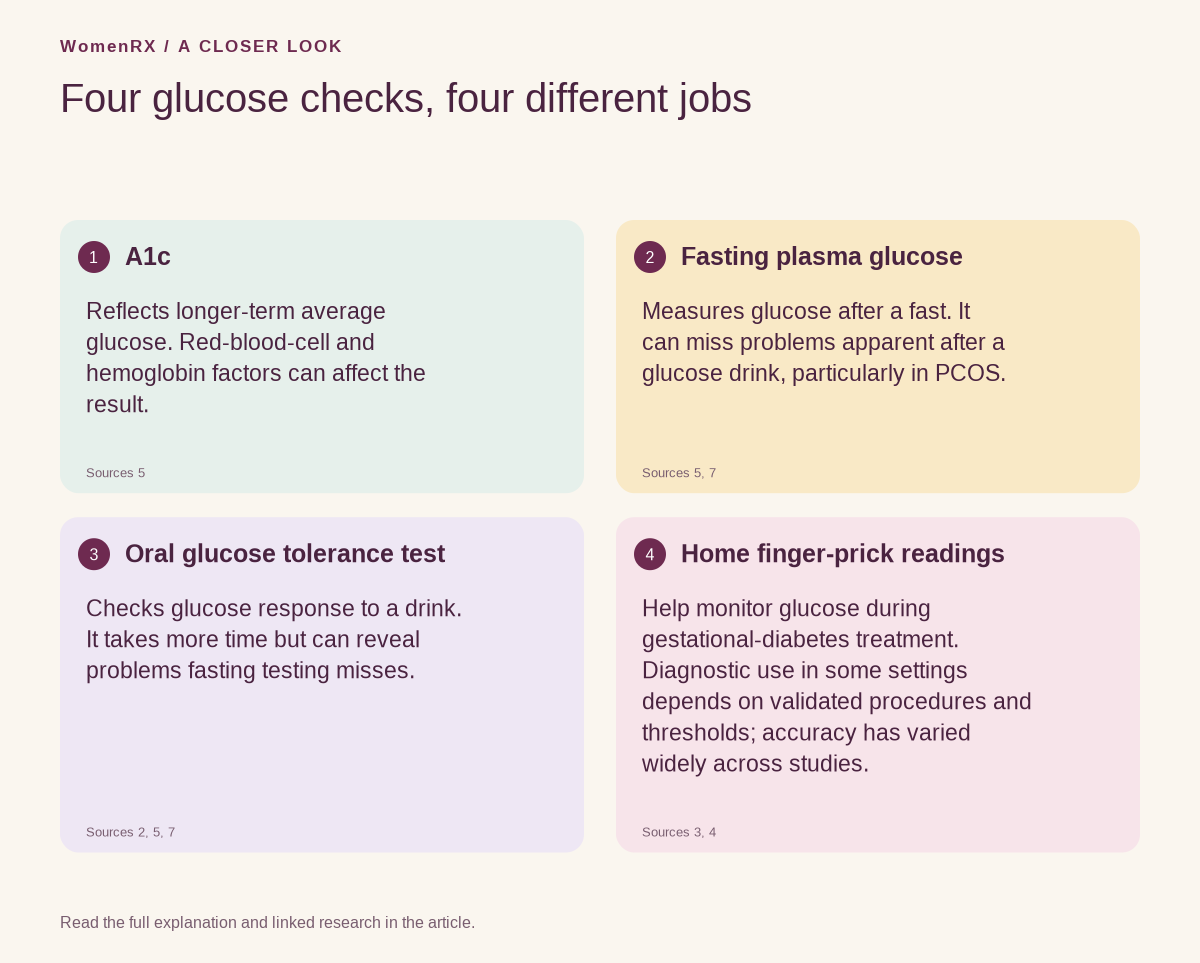
Four glucose checks, four different jobs
A1c: Reflects longer-term average glucose. Red-blood-cell and hemoglobin factors can affect the result.5
Fasting plasma glucose: Measures glucose after a fast. It can miss problems apparent after a glucose drink, particularly in PCOS.57
Oral glucose tolerance test: Checks glucose response to a drink. It takes more time but can reveal problems fasting testing misses.257
Home finger-prick readings: Help monitor glucose during gestational-diabetes treatment. Diagnostic use in some settings depends on validated procedures and thresholds; accuracy has varied widely across studies.34
Read the figure as text
Each method answers a different blood-sugar question; none directly establishes insulin resistance.- A1c: Reflects longer-term average glucose. Red-blood-cell and hemoglobin factors can affect the result.5
- Fasting plasma glucose: Measures glucose after a fast. It can miss problems apparent after a glucose drink, particularly in PCOS.57
- Oral glucose tolerance test: Checks glucose response to a drink. It takes more time but can reveal problems fasting testing misses.257
- Home finger-prick readings: Help monitor glucose during gestational-diabetes treatment. Diagnostic use in some settings depends on validated procedures and thresholds; accuracy has varied widely across studies.34
Sources you can check
- PCOS | Polycystic Ovary Syndrome | MedlinePlusAccessed 2026-09-25Return to first citation
- Gestational diabetes - NHSAccessed 2026-09-25Return to first citation
- Gestational diabetes - Treatment - NHSAccessed 2026-09-25Return to first citation
- Glucometer versus standard enzymatic method for gestational diabetes mellitus: a systematic review for diagnostic test accuracy.Lacorte LH, Quijencio W, Lizarondo L. · International journal for quality in health care : journal of the International Society for Quality in Health Care · 2026Return to first citation
- Comparative accuracy of 1-hour post-load plasma glucose, glycated albumin, and conventional glycemic measures for the diagnosis of type 2 diabetes mellitus: a systematic review and network meta-analysis.Tian J, Yuan P, Tan L, Zhang Y, Wang J, Cui Z, Tang B, Shen J. · Frontiers in endocrinology · 2026Return to first citation
- Prevalence of gestational diabetes mellitus in Sub-Saharan Africa: a systematic review and meta-analysis.Sabbagh IT, Seedat F, Hirose A, Wade AN. · AJOG global reports · 2026Return to first citation
- Diagnostic accuracy of oral glucose tolerance tests, fasting plasma glucose and haemoglobin A1c for type 2 diabetes in women with polycystic ovary syndrome: A systematic review and meta-analysis.Belsti Y, Enticott J, Azumah R, Tay CT, Moran L, Ma RCW, Joham AE, Laven J, Teede H, Mousa A. · Diabetes & metabolic syndrome · 2024Return to first citation