Can Insulin Resistance Improve? What Tests and Changes Matter
Insulin sensitivity and glucose regulation can improve, but a useful plan starts with your risk history and the right blood tests, not a promise of permanent reversal.
Yes. Lifestyle changes can improve estimated insulin sensitivity and reduce the chance of developing type 2 diabetes in adults with prediabetes, though that isn’t a guarantee of permanent reversal.2 If you’re concerned about insulin resistance, A1C, fasting plasma glucose, or an oral glucose tolerance test can show whether you have prediabetes or diabetes. The right test depends in part on whether you’re pregnant.4

Start with the outcome you can measure
“Insulin resistance” describes a reduced response to insulin, the hormone that helps glucose move into cells. It matters partly because insulin resistance and impaired insulin function can contribute to type 2 diabetes.12 But a concern about insulin resistance doesn’t tell you whether your blood glucose is in the usual range, in the prediabetes range, or in the diabetes range. Blood tests can answer that more practical question.4
For a nonpregnant adult, the main options are A1C, which reflects average glucose over about three months; fasting plasma glucose, which measures it at one point after a fast; and an oral glucose tolerance test, which measures how your body handles a glucose drink. They look at different aspects of glucose regulation, so a clinician may choose among them based on your circumstances. A diabetes diagnosis usually needs a second test for confirmation.4
For example, an A1C of 5.7% to 6.4% or a fasting plasma glucose of 100 to 125 mg/dL is in the prediabetes range for someone who isn’t pregnant. A two-hour result of 140 to 199 mg/dL on an oral glucose tolerance test is another way prediabetes can be identified. These are glucose-based categories, not a direct measurement of how resistant your cells are to insulin.4
You may also see fasting insulin or a calculation called HOMA-IR discussed online. Researchers use those measures: a review of exercise trials in women with PCOS, for example, reported changes in both fasting insulin and HOMA-IR.3 That doesn’t make either result interchangeable with the established glucose tests used to diagnose prediabetes or diabetes. If you already have an insulin result, a useful next question is what it changes about your care alongside your glucose results and risk history.34
Your history changes the testing conversation
You can have a reason to test even when you feel well. NIDDK lists age and several other factors, including a history of gestational diabetes, among reasons to consider type 2 diabetes testing. Increased thirst or urination are also reasons to be tested rather than waiting for a routine check.4 If you’ve been told you have PCOS, mention it: PCOS is an endocrine and metabolic condition, but the diagnosis alone doesn’t tell you what your glucose result will be.34
Pregnancy calls for a different conversation. Gestational diabetes has its own screening tests, and some diagnostic cutoffs differ from those used when you aren’t pregnant. A1C may also be less reliable in the second or third trimester. If you had gestational diabetes in a previous pregnancy, that history remains relevant after delivery even if your glucose improved: US guidance recommends testing for type 2 diabetes, usually within 12 weeks after birth.4
What improvement can, and cannot, mean
The strongest evidence here is about lowering diabetes risk in people who already have prediabetes, not proving that everyone with a high insulin result can be “cured.” In the US Diabetes Prevention Program, an intensive lifestyle intervention reduced the relative risk of developing diabetes by 58% compared with placebo over an average of 2.8 years; metformin reduced it by 31%. The lifestyle group had reduced weight, reported more physical activity, and showed improved estimates of insulin sensitivity and insulin secretion.2
That intervention was an organized program, not evidence that one food swap or a particular workout will produce the same result. It does point toward a practical combination: work on food choices and regular activity in a way you can keep doing, then judge progress by glucose results and the health outcomes that matter to you. Some people with type 2 diabetes manage blood glucose with food choices and activity; others also need medicine.12
Improvement is real without having to call it permanent. Over a median 21 years of follow-up, the original lifestyle and metformin groups still had lower cumulative diabetes incidence than the original placebo group, but many participants developed diabetes, and treatment changed over time. The study did not establish that its original interventions prevented cardiovascular or microvascular outcomes over that follow-up.2 If your results are in the prediabetes range, NIDDK advises testing for type 2 diabetes every year. That gives you a way to see where things stand rather than relying on the word “reversed.”4
Metformin may enter the discussion when someone has prediabetes and a particular risk profile; it isn’t a required response to a vague label of insulin resistance. The prevention study also found that its effects varied across groups, including a greater metformin effect among women with a history of gestational diabetes. That finding is context for an individual decision, not an instruction to start a medicine.2
If you have PCOS, there’s a more directly relevant piece of exercise evidence, with a narrower outcome. A systematic review of 22 randomized trials involving 1,044 women with PCOS found that exercise interventions improved fasting insulin and HOMA-IR on average. Those research measures don’t, by themselves, show that exercise permanently reverses PCOS or prevents diabetes in every participant.3 Your glucose results still help answer the question you can act on now: whether you have prediabetes or diabetes, and what follow-up makes sense.4
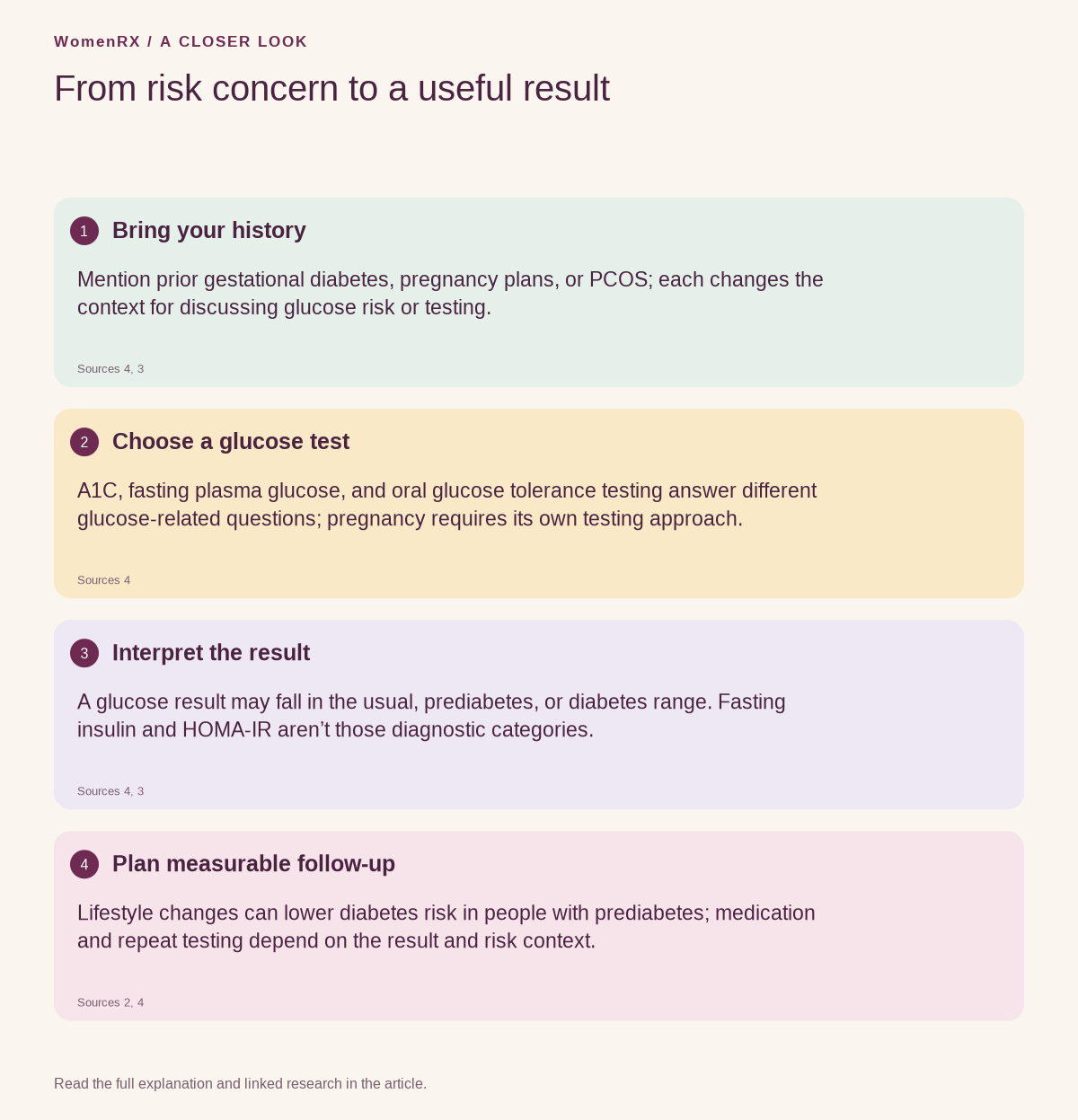
From risk concern to a useful result
Bring your history: Mention prior gestational diabetes, pregnancy plans, or PCOS; each changes the context for discussing glucose risk or testing.43
Choose a glucose test: A1C, fasting plasma glucose, and oral glucose tolerance testing answer different glucose-related questions; pregnancy requires its own testing approach.4
Interpret the result: A glucose result may fall in the usual, prediabetes, or diabetes range. Fasting insulin and HOMA-IR aren’t those diagnostic categories.43
Plan measurable follow-up: Lifestyle changes can lower diabetes risk in people with prediabetes; medication and repeat testing depend on the result and risk context.24
Read the figure as text
The steps separate a concern about insulin resistance from a glucose diagnosis and a way to measure progress.- Bring your history: Mention prior gestational diabetes, pregnancy plans, or PCOS; each changes the context for discussing glucose risk or testing.43
- Choose a glucose test: A1C, fasting plasma glucose, and oral glucose tolerance testing answer different glucose-related questions; pregnancy requires its own testing approach.4
- Interpret the result: A glucose result may fall in the usual, prediabetes, or diabetes range. Fasting insulin and HOMA-IR aren’t those diagnostic categories.43
- Plan measurable follow-up: Lifestyle changes can lower diabetes risk in people with prediabetes; medication and repeat testing depend on the result and risk context.24
More questions, answered
What if my A1C and blood glucose results don’t match?
Ask how the difference should be checked. Certain blood conditions can make A1C less reliable, and NIDDK advises considering that possibility when A1C and glucose results disagree. A clinician may use another glucose test to clarify the picture.4
Sources you can check
- Diabetes Medicine | Insulin | MedlinePlusAccessed 2026-09-25Return to first citation
- The Diabetes Prevention Program and Its Outcomes Study: NIDDK's Journey Into the Prevention of Type 2 Diabetes and Its Public Health Impact.Crandall JP, Dabelea D, Knowler WC, Nathan DM, Temprosa M, DPP Research Group . · Diabetes care · 2025Return to first citation
- The Effect of Exercise on Reproductive and Metabolic Outcomes in Women With Polycystic Ovary Syndrome: A Systematic Review and Meta-Analysis.Zou K, Ping Y, Wei Q, Zhao X, Wang Y, Wu D, Chen L, Wang S, Feng X. · The journal of obstetrics and gynaecology research · 2026Return to first citation
- Diabetes Tests & Diagnosis - NIDDKAccessed 2026-09-25Return to first citation