Prediabetes Tests and What to Do With Your Result
An A1C or fasting blood glucose result can identify prediabetes, but the next step depends on the test, the result, and your history.
Prediabetes is identified through blood testing. An A1C of 5.7% to 6.4% or fasting plasma glucose of 100 to 125 mg/dL falls in the prediabetes range. These results signal increased risk, not a certainty that you’ll develop diabetes. Ask which test you had and whether the finding needs clarification; if you’ve had gestational diabetes, make sure postpartum and later screening are part of the discussion. 513
Start with the name and number on your lab report
A result labeled “high blood sugar” doesn’t tell you the whole story. The test matters because each one measures something different:
- A1C estimates your average blood glucose over about three months. The prediabetes range is 5.7% to 6.4%. 5
- Fasting plasma glucose measures glucose at one point in time after a fast of at least eight hours. The prediabetes range is 100 to 125 mg/dL. 5
- An oral glucose tolerance test (OGTT) checks how your body handles a glucose drink over time. It can identify impaired glucose tolerance, another form of prediabetes. The A1C and fasting ranges above won’t tell you whether an OGTT result is in the prediabetes range. Ask your clinician or lab which cutoff applies to your result. 25
For example, if your report says “glucose: 112 mg/dL,” ask whether the sample was taken after a fast. Without that detail, you can’t apply the fasting range confidently. A glucose measurement taken during an emergency visit is different again: food intake and short-term stress can affect a random result. In a retrospective study at a Canadian emergency department, researchers treated elevated random glucose as a reason to arrange follow-up testing, not as a stand-alone prediabetes diagnosis. 2
Clarifying a result is different from monitoring risk
There are two useful questions after an unexpected or borderline finding. First, does this result need another laboratory test to clarify what it means? That is particularly worth asking when the result came from a random glucose test, the fasting status is unclear, or the result doesn’t fit the rest of your health picture. The type of follow-up test may differ: fasting glucose looks at one moment, A1C looks across months, and an OGTT measures the response to a glucose drink. 25
Second, when should your risk be checked again after the result is understood? Prediabetes raises the likelihood of type 2 diabetes, but it doesn’t mean progression is inevitable. Your result and risk factors, including any history of gestational diabetes, give that conversation more context than the label alone. Ask for a follow-up plan tied to your result and history rather than assuming the next test is due at a particular time. 35
What changes if you’ve had gestational diabetes?
Prediabetes isn’t specific to women. Gestational diabetes does, however, make later type 2 diabetes screening a distinct issue, even if blood sugar improved after delivery. A postpartum-screening study describes clinical guidance recommending an OGTT within 4 to 12 weeks after delivery for people who had gestational diabetes. If that window has passed, the useful next move is still to ask about testing rather than assume it’s too late. 3
A normal postpartum result doesn’t end the screening discussion. NHS guidance in the UK recommends a blood test once every year after a normal post-gestational-diabetes follow-up result. That is a UK recommendation, not a universal U.S. schedule, but it gives you a concrete reason to ask what ongoing screening plan fits your history. 1
That postpartum test and screening in a future pregnancy answer different questions. After a prior gestational-diabetes pregnancy, you’ll also need to raise that history when planning or beginning another pregnancy so the pregnancy care team can decide when to screen. Guidance on gestational diabetes describes earlier screening in a subsequent pregnancy, with another test later if the early result is normal. 1
Prevention is about lowering risk, not promising “reversal”
Food choices and physical activity can help delay or prevent type 2 diabetes for some people with prediabetes. If weight loss is relevant to your health and goals, it can be part of that discussion too. None of these steps guarantees that your next test will be normal or that diabetes will never develop. 5
There’s a practical difference between being told to “eat better and exercise” and getting help with a plan. A systematic review of 18 randomized or cluster-randomized trials in adults with prediabetes found that most studies favored structured diet-and-exercise education over usual care or less intensive advice for outcomes including diabetes incidence. The programs differed, and results for cardiovascular risk markers were less consistent. The review did not establish a separate effect for women. If making changes on your own has been difficult, asking about a structured prevention program is more specific than asking for another general tip. 4
Your next conversation can therefore be short and concrete: Which test produced this result? Is the number in that test’s prediabetes range? Does it need clarification now, and when should I be screened again? If you’ve had gestational diabetes, add that history even if today’s result is normal. 35
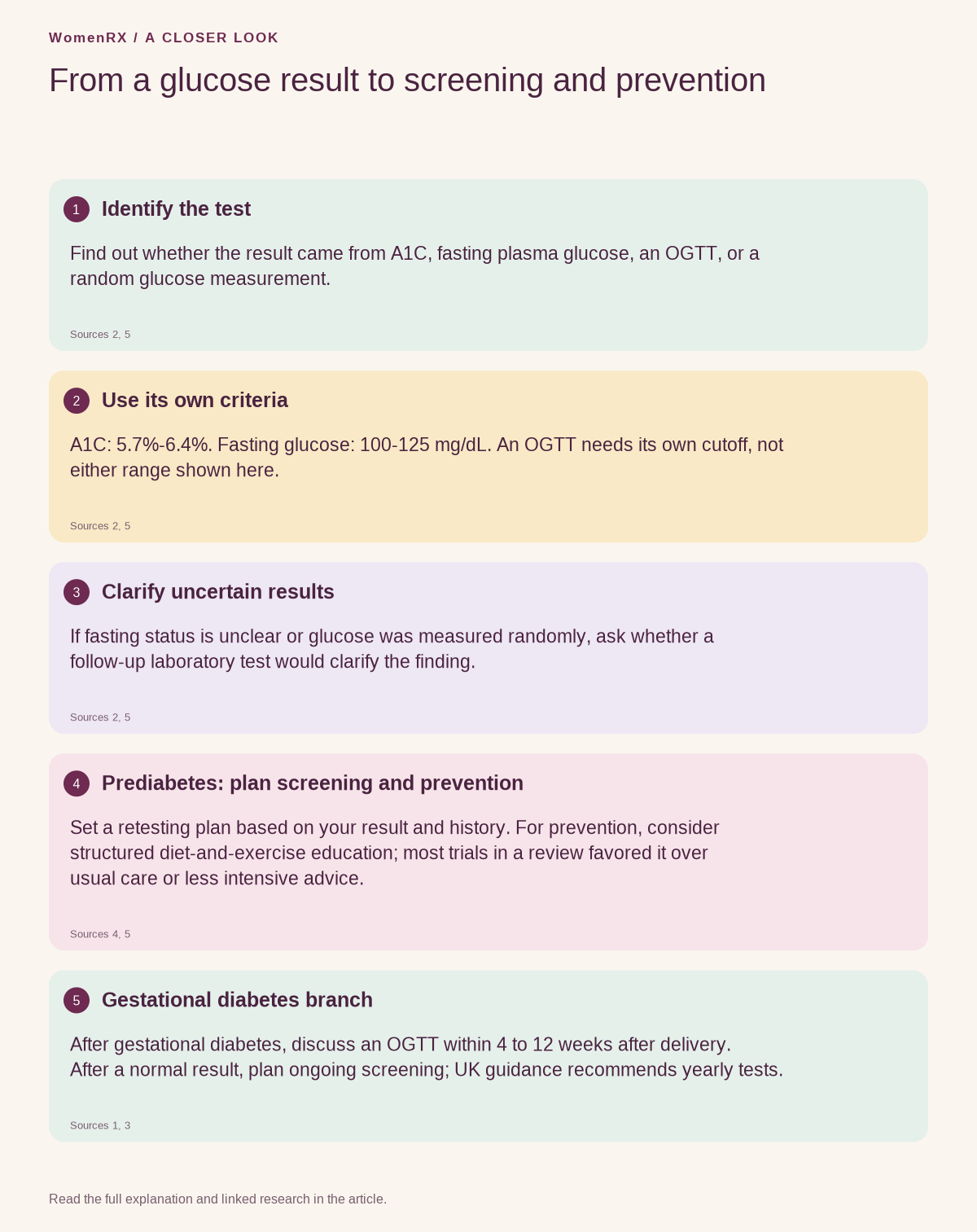
From a glucose result to screening and prevention
Identify the test: Find out whether the result came from A1C, fasting plasma glucose, an OGTT, or a random glucose measurement.25
Use its own criteria: A1C: 5.7%-6.4%. Fasting glucose: 100-125 mg/dL. An OGTT needs its own cutoff, not either range shown here.25
Clarify uncertain results: If fasting status is unclear or glucose was measured randomly, ask whether a follow-up laboratory test would clarify the finding.25
Prediabetes: plan screening and prevention: Set a retesting plan based on your result and history. For prevention, consider structured diet-and-exercise education; most trials in a review favored it over usual care or less intensive advice.45
Gestational diabetes branch: After gestational diabetes, discuss an OGTT within 4 to 12 weeks after delivery. After a normal result, plan ongoing screening; UK guidance recommends yearly tests.13
Read the figure as text
Start with the test you had. A prediabetes result opens a prevention path; a history of gestational diabetes adds postpartum testing with a stated window and a later-screening path.- Identify the test: Find out whether the result came from A1C, fasting plasma glucose, an OGTT, or a random glucose measurement.25
- Use its own criteria: A1C: 5.7%-6.4%. Fasting glucose: 100-125 mg/dL. An OGTT needs its own cutoff, not either range shown here.25
- Clarify uncertain results: If fasting status is unclear or glucose was measured randomly, ask whether a follow-up laboratory test would clarify the finding.25
- Prediabetes: plan screening and prevention: Set a retesting plan based on your result and history. For prevention, consider structured diet-and-exercise education; most trials in a review favored it over usual care or less intensive advice.45
- Gestational diabetes branch: After gestational diabetes, discuss an OGTT within 4 to 12 weeks after delivery. After a normal result, plan ongoing screening; UK guidance recommends yearly tests.13
More questions, answered
Does feeling well mean I don’t have prediabetes?
No. How you feel can’t tell you whether your blood test falls in the prediabetes range. Check which test was done and how its result was interpreted. 5
Sources you can check
- Gestational diabetes - NHSAccessed 2026-09-25Return to first citation
- Incidental findings of elevated random plasma glucose in the ED as a prompt for outpatient diabetes screening: a retrospective study.Friedman SM, Vallipuram J, Baswick B. · BMJ open · 2013Return to first citation
- Digital health outreach to promote postpartum screening after gestational diabetes: A randomized factorial pilot study.Brown SD, Garcia BL, Ritchie JL, Tsai AL, Millman A, Greenberg M, Quesenberry CP, Ferrara A. · PEC innovation · 2024Return to first citation
- Effectiveness of Structured Education Programmes on Diet and Exercise for Preventing Type 2 Diabetes in Adults With Prediabetes: A Systematic Review.Muoghalu CG, Nwafor GI, Onyegbule C, Ofoegbu CC, Ekong NE, Ohiri J, Abraham G, Ebirim DA. · Cureus · 2026Return to first citation
- Prediabetes | Hyperglycemia | MedlinePlusAccessed 2026-09-25Return to first citation