Prenatal Tests: What a Result Can Tell You
A screening result estimates a chance; a diagnostic test can answer a more specific question.
Prenatal screening looks for signs that you or your fetus may have certain health conditions, but it cannot establish a diagnosis. A higher-chance result may lead to a conversation about diagnostic testing; it does not mean a condition is present. Diagnostic tests can examine a specific concern more directly. Which tests make sense depends on what you want to learn, your pregnancy, and when you’re offered them. 62
Start with the question behind the test
“Prenatal testing” covers more than one kind of question. Some routine blood and other tests check your health, including signs of infection. Other tests look for possible conditions in the fetus. A result about your health and a result about a fetal chromosome condition need different explanations and may lead to different next steps. 6
The most useful distinction is screening versus diagnosis. A screening test estimates whether a particular condition may be more or less likely. An abnormal result means more information may be needed, not that your fetus has the condition. A diagnostic test is used to determine whether a specific health problem is present. Neither category tells you everything about a baby’s future health. 62
What the common screening categories look for
Maternal blood screening and ultrasound are prenatal screening methods. Blood screening can estimate the chance of certain fetal chromosomal conditions; ultrasound can also identify a finding that calls for closer assessment. These are not interchangeable views of the pregnancy. If you’re offered either one, ask which condition or finding it assesses and whether your result will be reported as a chance, a specific finding, or both. A concerning ultrasound finding may change which diagnostic analysis is discussed. 24
Cell-free DNA screening, sometimes called NIPT, analyzes DNA in your blood that largely comes from the placenta. It screens for common chromosome conditions, particularly trisomy 21, 18, and 13. It is a strong screening method for those conditions, but its performance varies for other chromosome findings. A higher-chance result still needs diagnostic testing if you want to establish whether the fetus has the condition. 134
The placental connection explains a result that can otherwise feel contradictory: the DNA assessed by cell-free DNA screening may not always reflect the fetus’s chromosomes in the same way. Placental mosaicism, a vanished twin, and other biological factors can contribute to unexpected or non-reportable results. A result that cannot be reported is not a diagnosis; ask what prevented an answer and which options could provide useful information next. 1
What changes after a higher-chance result?
A higher-chance screening result opens a decision, not a requirement. You can ask how likely the result is to represent the condition in your pregnancy, what the test actually screened for, and what another test would resolve. A lower-chance result is reassuring about the conditions screened for, but screening can miss a condition and does not assess every possible health outcome. 136
For a fetal chromosome question, diagnostic options may include chorionic villus sampling (CVS), which samples placental tissue, or amniocentesis, which samples amniotic fluid. These are invasive procedures, unlike a blood-based screening test, and their benefits and procedure risks belong in the decision. If a result raises the possibility that a chromosome difference is confined to the placenta, amniocentesis may help distinguish that from a finding in the fetus. Which procedure is discussed depends in part on gestational age and the question being investigated. 2
A diagnostic result is more definitive for the condition tested. It still has a scope: confirming or ruling out a chromosome finding does not predict every aspect of development or health. An ultrasound finding may also prompt discussion of a different diagnostic analysis than a cell-free DNA result would. 24
Choose how much information you want
You don’t have to want every available test, or a prenatal diagnosis, to take screening seriously. For example, one person might want a screening result to help prepare for birth but decide against an invasive procedure. Another might prefer a diagnostic answer rather than living with an uncertain screening result. Both choices begin with the same practical question: What would I do differently with the information this test could give me? Prenatal testing is your choice, and the risks, benefits, and possible answers are worth discussing before you decide. 65
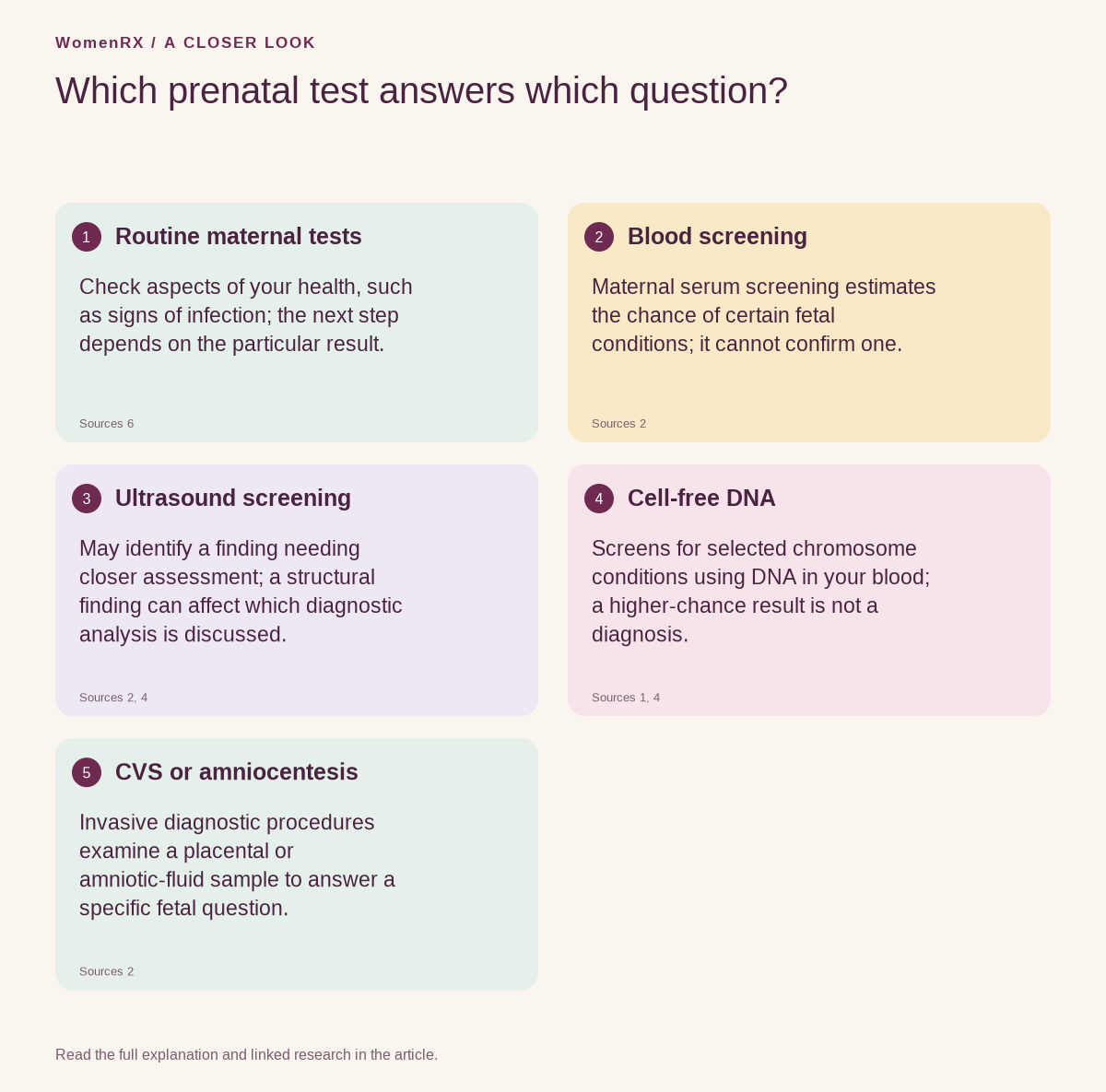
Which prenatal test answers which question?
Routine maternal tests: Check aspects of your health, such as signs of infection; the next step depends on the particular result.6
Blood screening: Maternal serum screening estimates the chance of certain fetal conditions; it cannot confirm one.2
Ultrasound screening: May identify a finding needing closer assessment; a structural finding can affect which diagnostic analysis is discussed.24
Cell-free DNA: Screens for selected chromosome conditions using DNA in your blood; a higher-chance result is not a diagnosis.14
CVS or amniocentesis: Invasive diagnostic procedures examine a placental or amniotic-fluid sample to answer a specific fetal question.2
Read the figure as text
These test categories differ in what they assess and whether a result can establish a diagnosis.- Routine maternal tests: Check aspects of your health, such as signs of infection; the next step depends on the particular result.6
- Blood screening: Maternal serum screening estimates the chance of certain fetal conditions; it cannot confirm one.2
- Ultrasound screening: May identify a finding needing closer assessment; a structural finding can affect which diagnostic analysis is discussed.24
- Cell-free DNA: Screens for selected chromosome conditions using DNA in your blood; a higher-chance result is not a diagnosis.14
- CVS or amniocentesis: Invasive diagnostic procedures examine a placental or amniotic-fluid sample to answer a specific fetal question.2
More questions, answered
Does a higher-chance cell-free DNA result mean my baby has the condition?
No. Cell-free DNA is screening, even when it performs well for a condition. False-positive results occur, so diagnostic testing is the way to establish whether the specific condition is present in the fetus. 14
Why might I be offered amniocentesis after another test?
One reason is to clarify a chromosome finding that could come from the placenta rather than the fetus. Amniocentesis samples amniotic fluid, while CVS samples placental tissue. The appropriate follow-up depends on the finding and your stage of pregnancy. 2
Sources you can check
- Causes of aberrant non-invasive prenatal testing for aneuploidy: A systematic review.Samura O, Okamoto A. · Taiwanese journal of obstetrics & gynecology · 2020Return to first citation
- Clinical Practice Guidelines for Prenatal Aneuploidy Screening and Diagnostic Testing from Korean Society of Maternal-Fetal Medicine: (2) Invasive Diagnostic Testing for Fetal Chromosomal Abnormalities.Lee JY, Kwon JY, Na S, Choe SA, Seol HJ, Kim M, Kim MA, Park CW, Kim K, Ryu HM, Hwang HS, Shim JY. · Journal of Korean medical science · 2021Return to first citation
- Diagnostic accuracy of cell-free DNA-based non-invasive prenatal testing for fetal aneuploidies: a systematic review.Alhajlah S. · Frontiers in genetics · 2026Return to first citation
- Prenatal screening and diagnostic strategies for fetal genetic abnormalities: Comparison of international clinical guidelines.Veras GS, Bennini JR. · International journal of gynaecology and obstetrics: the official organ of the International Federation of Gynaecology and Obstetrics · 2026Return to first citation
- Diagnostic Testing After Positive Cell-Free DNA Screening for Sex Chromosome Aneuploidies: Clinical and Socioeconomic Determinants.Stevens BK, Araji S, Maktabi MA, Liu R, Westerfield L, Wassef M, Lai D, Van den Veyver IB, Krishnan M, Lawrence C, Prakash SK. · Prenatal diagnosis · 2026Return to first citation
- Prenatal Testing | Gestational Diabetes | MedlinePlusAccessed 2026-09-25Return to first citation