Gestational Diabetes Screening: What Your Results Mean
The first glucose test may be a screen or a diagnostic test, and that difference determines what happens next.
Gestational diabetes screening checks how your body handles glucose during pregnancy. In a two-step approach, an elevated first result means you may need a diagnostic test; it isn’t a diagnosis by itself. In a one-step approach, the oral glucose tolerance test can establish the diagnosis. If you’re diagnosed, care usually includes blood sugar monitoring, support with food and activity, and follow-up after birth. 147
Why pregnancy changes the picture
Gestational diabetes means blood sugar has become high during pregnancy. Your body needs more insulin while you’re pregnant, and gestational diabetes develops when it can’t make enough to meet that added need. A result is information about how your body is responding, not a verdict on what you ate. Managing blood sugar can reduce the chances of problems during pregnancy. 34
Testing commonly takes place around 24 to 28 weeks. Your history may change the timing: for example, a previous pregnancy with gestational diabetes may prompt earlier testing, with testing again at 24 to 28 weeks if the early result is normal. The exact approach depends on your care team’s protocol. 367
First find out which test you’re having
The word screening can describe the whole testing process, but the first result does not mean the same thing in every pathway. That’s the key to reading your result correctly. Guidelines differ on whether to use one test or two, and on the criteria used to interpret an oral glucose tolerance test, or OGTT. 17
Two-step testing starts with a glucose challenge. In a commonly described version, you drink a glucose solution and have blood drawn an hour later. If that result meets the clinic’s screening cutoff, the next step is a longer OGTT. The first test identifies who needs more testing; an elevated screen alone does not establish gestational diabetes. The follow-up OGTT uses its own measurements and diagnostic criteria. 17
One-step testing uses an OGTT as the diagnostic test. A commonly described version measures glucose while fasting and again after a glucose drink. A 75-gram OGTT and a 100-gram OGTT are not interchangeable: they involve different testing schedules and may use different rules for what counts as a diagnosis. A number called “high” on one report cannot be interpreted using a cutoff from another pathway. 78
This difference can affect more than the paperwork. In an analysis of 463,881 singleton pregnancies in British Columbia from 2004 to 2019, a policy change allowing a mix of one-step and two-step testing was followed by more diagnoses treated with lifestyle changes. The study did not detect a change in the newborn birth-weight outcomes it measured. That finding doesn’t settle which approach is best for you, but it shows why the test and criteria used matter when comparing results. 5
If you’re told your result is abnormal, ask: Was this the initial screen or the diagnostic OGTT? What test, if any, comes next? If it was an OGTT, ask which of its measurements met your clinic’s diagnostic criteria. These questions are more useful than trying to interpret a single number without the test name. 17
What care may look like after a diagnosis
A diagnosis usually shifts the focus from testing for gestational diabetes to seeing how your blood sugar responds day to day. Your team may give you a meter and explain when to check, what results they’re looking for, and how to share readings. Food changes and physical activity can help manage blood sugar. You may also have additional pregnancy appointments to check how you and your baby are doing. 4
Sometimes those steps aren’t enough, or blood sugar is high when gestational diabetes is first diagnosed. Medicine may then be discussed. Metformin and insulin are treatment options; which is appropriate depends on your situation and your care team’s plan. Blood sugar can rise as pregnancy progresses, so needing medicine later does not mean earlier efforts failed. 24
Keep the follow-up on your calendar after birth
Gestational diabetes usually goes away after delivery, but that doesn’t make the last pregnancy reading the final answer. A blood test after birth checks whether blood sugar has returned to the expected range. A history of gestational diabetes also raises the chance of type 2 diabetes later, so ongoing testing matters even when that first follow-up result is normal. Ask before delivery how your postpartum test will be arranged and when you should expect it; follow-up schedules can differ. 34
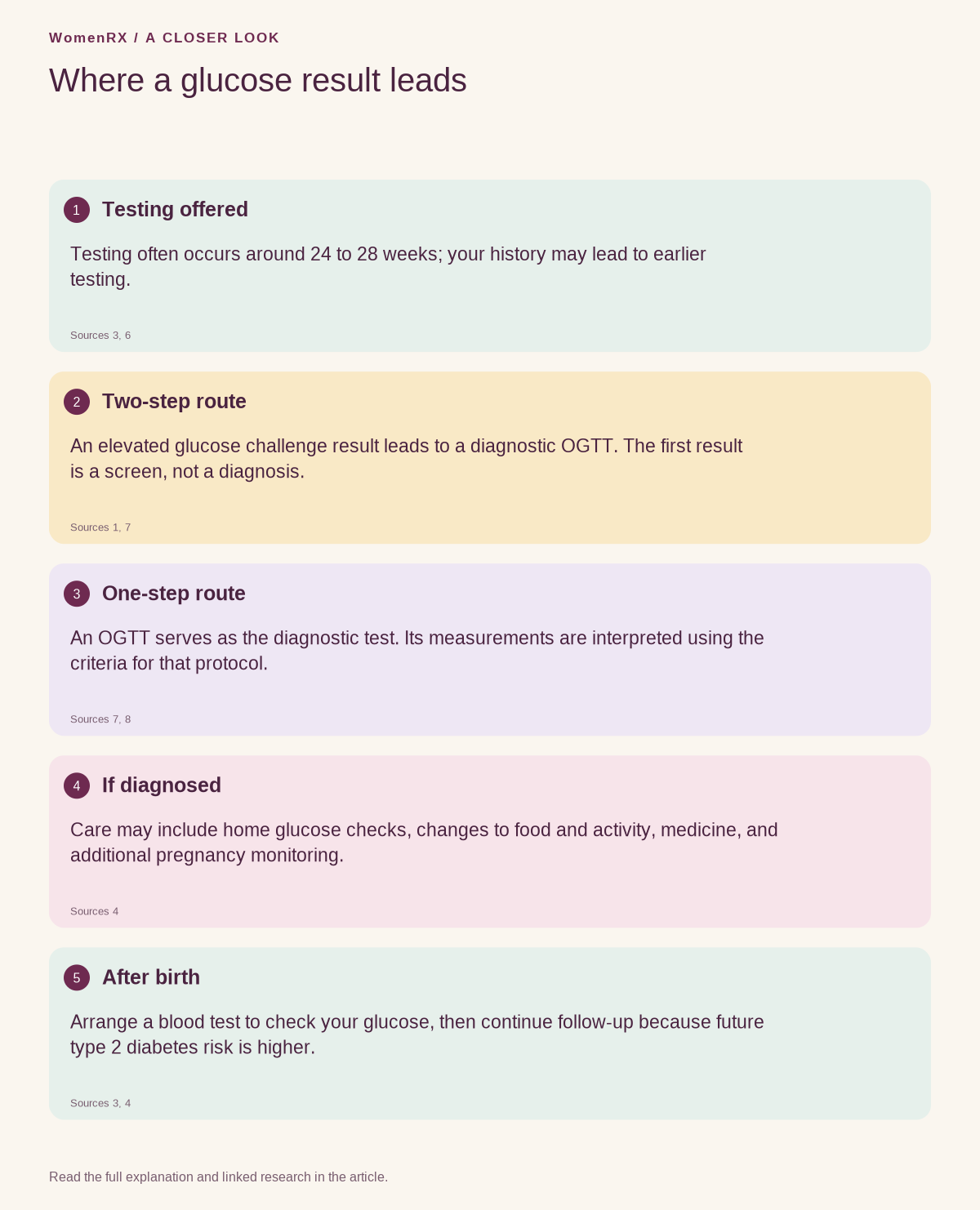
Where a glucose result leads
Testing offered: Testing often occurs around 24 to 28 weeks; your history may lead to earlier testing.36
Two-step route: An elevated glucose challenge result leads to a diagnostic OGTT. The first result is a screen, not a diagnosis.17
One-step route: An OGTT serves as the diagnostic test. Its measurements are interpreted using the criteria for that protocol.78
If diagnosed: Care may include home glucose checks, changes to food and activity, medicine, and additional pregnancy monitoring.4
After birth: Arrange a blood test to check your glucose, then continue follow-up because future type 2 diabetes risk is higher.34
Read the figure as text
The route depends on whether the first test is a screen or a diagnostic OGTT.- Testing offered: Testing often occurs around 24 to 28 weeks; your history may lead to earlier testing.36
- Two-step route: An elevated glucose challenge result leads to a diagnostic OGTT. The first result is a screen, not a diagnosis.17
- One-step route: An OGTT serves as the diagnostic test. Its measurements are interpreted using the criteria for that protocol.78
- If diagnosed: Care may include home glucose checks, changes to food and activity, medicine, and additional pregnancy monitoring.4
- After birth: Arrange a blood test to check your glucose, then continue follow-up because future type 2 diabetes risk is higher.34
More questions, answered
Do I need to fast before the glucose test?
Check the instructions for the specific test you’ve been offered rather than assuming every glucose drink test is the same. An OGTT may include a fasting blood glucose measurement; the first glucose challenge in a two-step pathway is a different test. If your instructions aren’t clear, ask the testing site before your appointment. 37
Sources you can check
- Prenatal Testing | Gestational Diabetes | MedlinePlusAccessed 2026-09-25Return to first citation
- Insulin for gestational diabetes - NHSAccessed 2026-09-25Return to first citation
- Gestational diabetes - NHSAccessed 2026-09-25Return to first citation
- Gestational diabetes - Treatment - NHSAccessed 2026-09-25Return to first citation
- Effects of a Province-Wide Change in Gestational Diabetes Mellitus Screening Policy on Treatment and Newborn Birth Weight.Nethery E, Hutcheon JA, Lee J, Janssen PA, Schummers L. · Diabetes care · 2025Return to first citation
- Epidemiology and management of gestational diabetes.Sweeting A, Hannah W, Backman H, Catalano P, Feghali M, Herman WH, Hivert MF, Immanuel J, Meek C, Oppermann ML, Nolan CJ, Ram U, Schmidt MI, Simmons D, Chivese T, Benhalima K. · Lancet (London, England) · 2024Return to first citation
- Evaluation of guidelines on the screening and diagnosis of gestational diabetes mellitus: systematic review.Li-Zhen L, Yun X, Xiao-Dong Z, Shu-Bin H, Zi-Lian W, Adrian Sandra D, Bin L. · BMJ open · 2019Return to first citation
- Risk factors for gestational diabetes mellitus and postpartum glucose intolerance: a retrospective study from a hospital specializing in infertility treatment.Kishimoto M, Tamaru S, Odawara M. · Scientific reports · 2025Return to first citation