Insulin Resistance and Fertility: What the Evidence Shows
In women with PCOS, insulin-resistance measures have been linked with fertility outcomes, but that association does not show that a single result predicts your chances or that lowering it will help you conceive.
A study of women with PCOS receiving ovulation-induction treatment found that higher insulin resistance was associated with lower ovulation, pregnancy, and live-birth rates. That does not prove insulin resistance caused those outcomes or that treating a lab result improves fertility. If you’re being assessed for PCOS or irregular ovulation, ask what a metabolic test is meant to clarify and how its result would affect your plan. 4
An insulin-resistance result is not a fertility forecast
Insulin resistance describes how the body responds to insulin, a hormone involved in moving glucose into cells. It can be part of a broader metabolic picture, but the label alone does not tell you whether you will ovulate or become pregnant. PCOS is one reason clinicians may consider metabolic health: people with PCOS have increased risk of metabolic syndrome, a cluster of risk factors for diabetes and heart disease. 1
The fertility evidence is more specific than the label. A secondary analysis of a multicenter trial looked at 746 women ages 18-40 with PCOS who were having ovulation induction. Researchers found that higher screening HOMA-IR, a measure used in the study, was associated with lower rates of ovulation, clinical pregnancy, and live birth across the measure’s quartiles. This is an association in a particular group receiving fertility treatment, not proof that insulin resistance caused the differences or that the same pattern applies to everyone trying to conceive. 4
The researchers also found that improvement in HOMA-IR during treatment was associated with higher odds of clinical pregnancy and lower risk of preeclampsia. Because this was a secondary analysis, that relationship does not establish that deliberately lowering HOMA-IR would produce those outcomes. 4
Why ovulation may be the more immediate question
If your periods are irregular, ovulation may not happen regularly, which can make it harder to time conception. Irregular cycles can have more than one cause; PCOS and thyroid problems are among the possibilities described in clinical guidance. 3
That makes it useful to separate two questions: Is there a metabolic concern worth assessing for your overall health? And is irregular or absent ovulation affecting your chances of conception now? A result related to metabolism does not answer the second question by itself. In the study above, all participants had PCOS and were undergoing ovulation induction, so its findings should not be treated as a fertility prediction for people without PCOS or for people not receiving that treatment. 4
Ask what the test is meant to change
If testing comes up, you can ask:
- What concern are we checking: blood-glucose health, other metabolic risks, or something related to my PCOS assessment?
- What does this particular test measure, and how would its result affect my care?
- Given my cycle pattern, how are we assessing whether I ovulate and whether another cause of irregular periods should be considered?
- If a result is outside the expected range, what would that mean for my fertility plan versus my general metabolic health?
- If a medicine is suggested, what specific goal is it intended to address, and what evidence supports that goal for someone in my situation?
These questions help connect a test to a decision instead of treating the phrase “insulin resistance” as a complete explanation. Metabolic syndrome assessment can include blood-glucose and blood-fat tests, but that does not mean those tests alone determine fertility. 2
Keep the evidence in proportion
The clearest fertility finding here is an association in women with PCOS who were undergoing ovulation induction. It gives a reason to discuss metabolic health in that setting, but it does not establish that an insulin-resistance result predicts an individual’s fertility, that insulin resistance is the cause of infertility, or that a particular treatment will improve the chance of live birth. 4
If your cycles are irregular and you’re having trouble conceiving, the cycle pattern itself is worth bringing up. The useful next step is to understand what may be affecting ovulation and what each proposed test or treatment is meant to clarify. 3
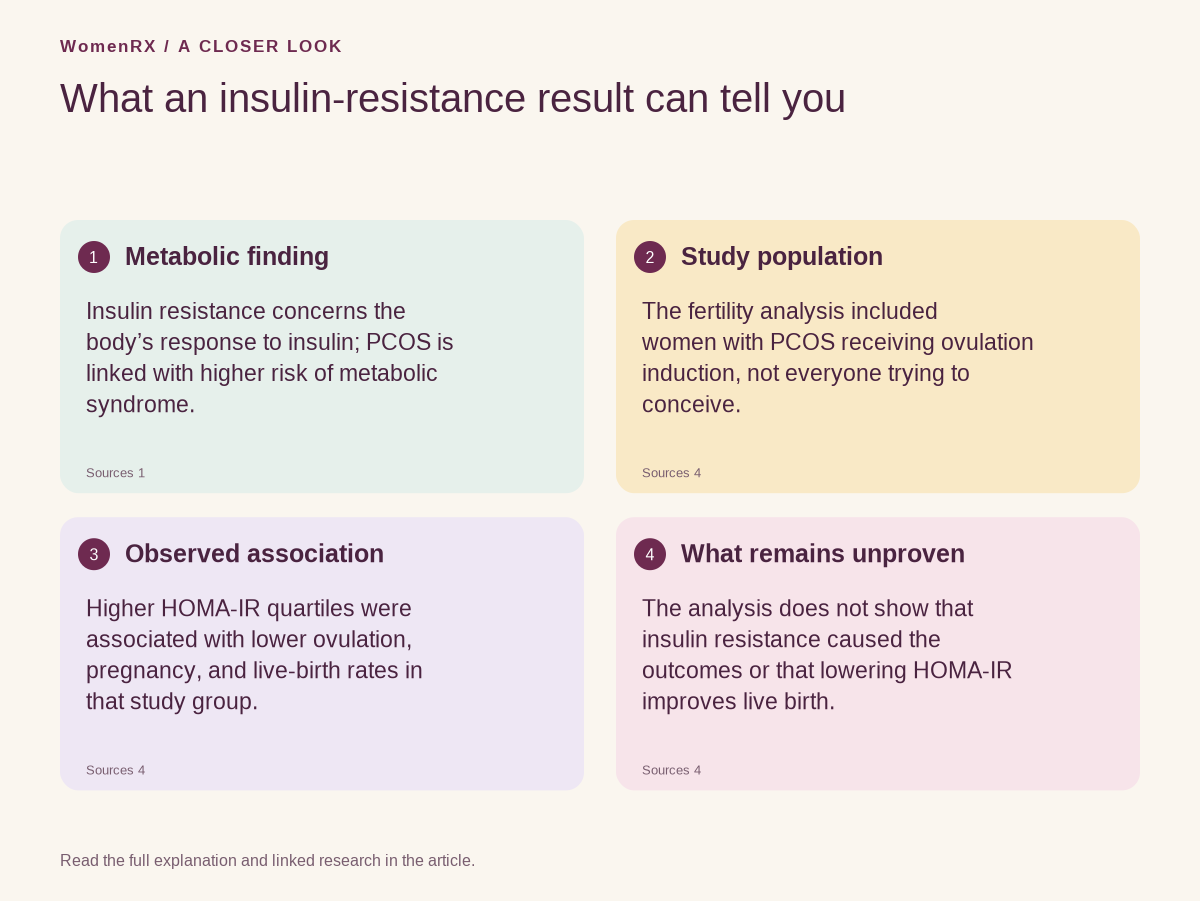
What an insulin-resistance result can tell you
Metabolic finding: Insulin resistance concerns the body’s response to insulin; PCOS is linked with higher risk of metabolic syndrome.1
Study population: The fertility analysis included women with PCOS receiving ovulation induction, not everyone trying to conceive.4
Observed association: Higher HOMA-IR quartiles were associated with lower ovulation, pregnancy, and live-birth rates in that study group.4
What remains unproven: The analysis does not show that insulin resistance caused the outcomes or that lowering HOMA-IR improves live birth.4
Read the figure as text
The finding, the fertility association, and the limits of what can be concluded are different things.- Metabolic finding: Insulin resistance concerns the body’s response to insulin; PCOS is linked with higher risk of metabolic syndrome.1
- Study population: The fertility analysis included women with PCOS receiving ovulation induction, not everyone trying to conceive.4
- Observed association: Higher HOMA-IR quartiles were associated with lower ovulation, pregnancy, and live-birth rates in that study group.4
- What remains unproven: The analysis does not show that insulin resistance caused the outcomes or that lowering HOMA-IR improves live birth.4
More questions, answered
Does insulin resistance mean I won’t get pregnant?
No. The available fertility finding is an association among women with PCOS receiving ovulation-induction treatment; it is not an individual prediction and does not establish cause and effect. 4
Can irregular periods affect conception even without an insulin-resistance result?
Yes. Irregular periods can mean you do not ovulate regularly, which can make conception harder. PCOS is one possible cause, but thyroid problems are another. 3
Sources you can check
- Metabolic Syndrome | MedlinePlusAccessed 2026-09-25Return to first citation
- Metabolic syndrome - NHSAccessed 2026-09-25Return to first citation
- Irregular periods - NHSAccessed 2026-09-25Return to first citation
- Prepregnancy Insulin Resistance and Fertility and Pregnancy Outcomes in Women With Polycystic Ovarian Syndrome.Yun BH, Seo SK, Maher JY, Dowlut-McElroy T, Gomez-Lobo V. · Obstetrics and gynecology · 2026Return to first citation