Insulin Resistance in PCOS: What the Label Means
Insulin resistance is a possible part of PCOS, but the label alone doesn’t tell you whether your blood sugar is high or what care is right for you.
Insulin resistance means the body doesn’t respond to insulin as effectively as it should. It’s often discussed as part of PCOS, but the useful next step is to clarify what was actually measured and whether it shows a glucose or other metabolic concern. Ask how your results affect monitoring, treatment choices, and plans for pregnancy. 1 5
Start with what the result measures
Insulin helps move glucose from the blood into the body’s cells. When cells respond less effectively, the body may have trouble keeping blood glucose in a healthy range. Insulin resistance is one factor thought to contribute to PCOS, but PCOS has more than one feature and its exact cause isn’t known. 1
That makes the phrase “insulin-resistant PCOS” useful as a way to discuss a possible mechanism, but incomplete as a description of your individual metabolic health. A label by itself doesn’t tell you whether you have prediabetes, diabetes, or another metabolic risk factor.
Ask which test led to the label and what it measures. A review of PCOS guidance describes assessing blood glucose with fasting glucose, hemoglobin A1c, or an oral glucose tolerance test. These tests look at glucose status; they aren’t interchangeable with a general statement that insulin resistance may be involved in PCOS. 5
Look beyond one number
The care question isn’t only whether insulin resistance is present. It’s also whether there are measurable concerns that need attention. PCOS is associated with a higher risk of metabolic syndrome, a group of risk factors linked to diabetes and heart disease. That’s why a discussion may include glucose, blood fats, blood pressure, and other risk factors, rather than focusing only on an insulin-related result. 3 4
A practical question is: “What does this result change for me?” If a test shows abnormal glucose, ask what the result means and what follow-up is appropriate. If glucose is normal, ask whether other risk factors or your overall health still affect the plan. The answer may depend on the test, the result, and your circumstances, not just the PCOS label.
Match care to your goals
For adults with PCOS, a review of international guidance says metformin may be considered alongside lifestyle changes for weight and metabolic outcomes, particularly for people with a BMI of 25 or higher. The review also notes that the guidance does not define “metabolic outcomes” in detail. That leaves room for a useful conversation about the goal in your case, such as addressing a glucose concern or another metabolic outcome, rather than treating the medicine as an automatic response to an insulin-resistance label. 5
Metformin and combined oral contraceptive pills aren’t interchangeable tools. A systematic review found that, in the studies it analyzed, combined oral contraceptives had benefits for menstrual regulation, while metformin had metabolic and other potential benefits. The evidence quality was low for some comparisons, so the right discussion depends on what you want to address, including cycle symptoms, metabolic health, or both. 6
Ask what benefit is expected, what result would be followed, and how the choice fits your priorities. You can also discuss non-medication approaches without assuming there is one required diet or routine. The goal is a plan that addresses your health, not a number in isolation.
Bring pregnancy plans into the discussion
If you’re planning pregnancy or fertility treatment, say so before deciding on a monitoring or treatment plan. A review of international PCOS guidance reports that an oral glucose tolerance test should be considered for women with PCOS who are planning pregnancy or seeking fertility treatment, because of concern about gestational diabetes and related pregnancy complications. The same review notes that evidence about the risk, especially among women without obesity, is not settled. 5
If you’re already pregnant, or thinking about trying soon, ask how glucose assessment and any current medication fit into preconception or pregnancy care. General preconception care includes addressing health problems such as diabetes or high blood pressure before pregnancy, but PCOS-specific decisions still need to reflect your situation. 2
Questions that can clarify your next step
- Which test or finding led to the insulin-resistance label?
- What does the result say about my glucose status and other metabolic risks?
- Which result should we follow over time, and when should it be checked again?
- If we discuss metformin, what specific outcome are we aiming to improve?
- Do my plans for pregnancy or fertility treatment change which tests or options we should discuss?
These questions help connect a broad explanation of PCOS to the result and goal that matter to you.
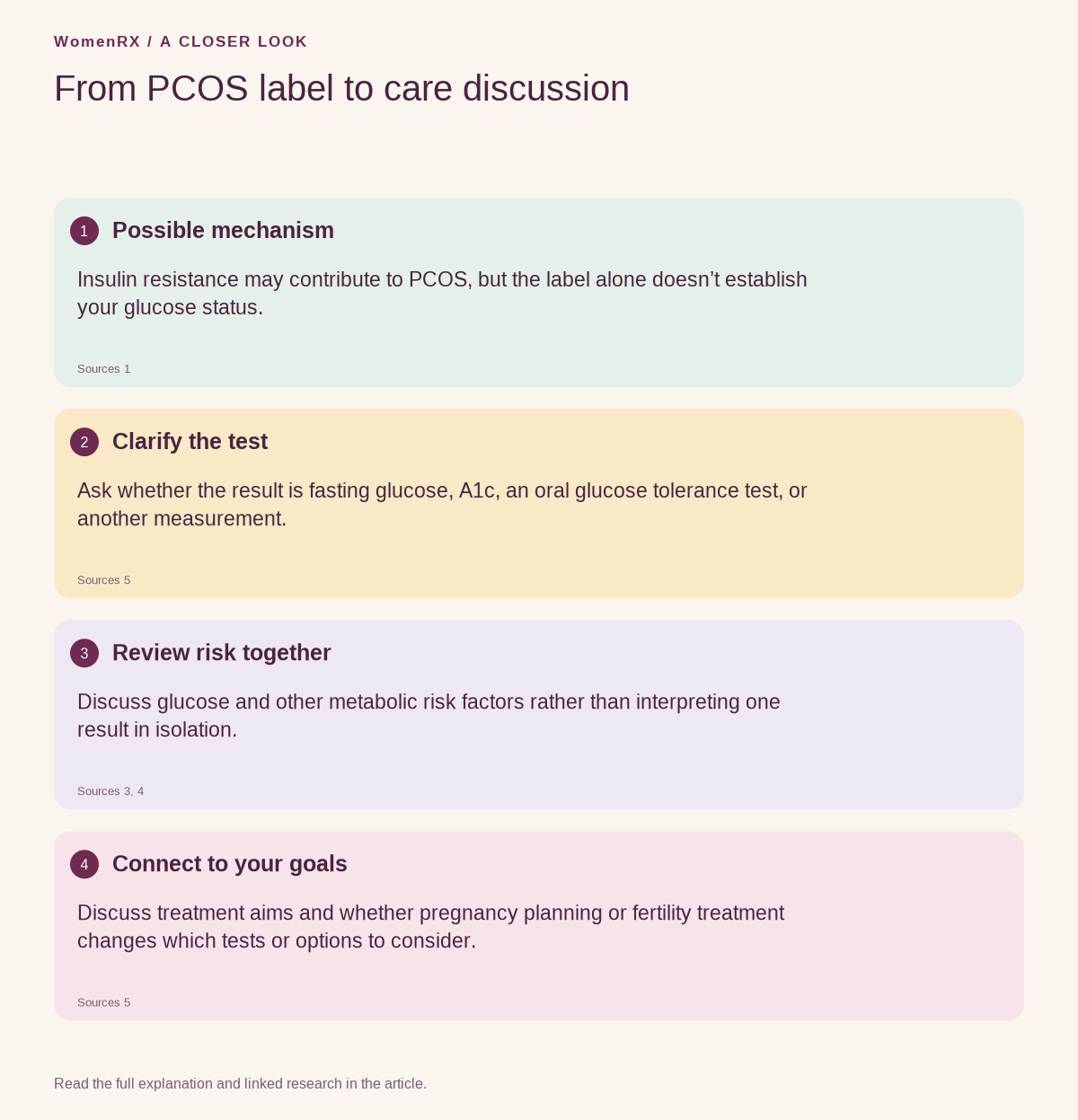
From PCOS label to care discussion
Possible mechanism: Insulin resistance may contribute to PCOS, but the label alone doesn’t establish your glucose status.1
Clarify the test: Ask whether the result is fasting glucose, A1c, an oral glucose tolerance test, or another measurement.5
Review risk together: Discuss glucose and other metabolic risk factors rather than interpreting one result in isolation.34
Connect to your goals: Discuss treatment aims and whether pregnancy planning or fertility treatment changes which tests or options to consider.5
Read the figure as text
Follow the distinction between a possible PCOS mechanism, measurable metabolic findings, and decisions shaped by your goals.- Possible mechanism: Insulin resistance may contribute to PCOS, but the label alone doesn’t establish your glucose status.1
- Clarify the test: Ask whether the result is fasting glucose, A1c, an oral glucose tolerance test, or another measurement.5
- Review risk together: Discuss glucose and other metabolic risk factors rather than interpreting one result in isolation.34
- Connect to your goals: Discuss treatment aims and whether pregnancy planning or fertility treatment changes which tests or options to consider.5
More questions, answered
Does an insulin-resistance label mean I have diabetes?
No. The label describes a possible mechanism associated with PCOS; it doesn’t by itself establish diabetes. Ask what your glucose tests show. PCOS guidance discussed in a clinical review includes fasting glucose, hemoglobin A1c, and an oral glucose tolerance test for assessing glycemic status. 1 5
Does everyone with PCOS need metformin?
No. An insulin-resistance label alone isn’t an automatic reason to take metformin. A review of international guidance says it may be considered for adults with PCOS for weight and metabolic outcomes, particularly at a BMI of 25 or higher, while noting that the guidance leaves “metabolic outcomes” loosely defined. 5
Sources you can check
- PCOS | Polycystic Ovary Syndrome | MedlinePlusAccessed 2026-09-25Return to first citation
- Preconception Care: MedlinePlusAccessed 2026-09-25Return to first citation
- Metabolic Syndrome | MedlinePlusAccessed 2026-09-25Return to first citation
- Metabolic syndrome - NHSAccessed 2026-09-25Return to first citation
- Update on polycystic ovary syndrome.Kim JJ. · Clinical and experimental reproductive medicine · 2021Return to first citation
- Effect of the combined oral contraceptive pill and/or metformin in the management of polycystic ovary syndrome: A systematic review with meta-analyses.Teede H, Tassone EC, Piltonen T, Malhotra J, Mol BW, Peña A, Witchel SF, Joham A, McAllister V, Romualdi D, Thondan M, Costello M, Misso ML. · Clinical endocrinology · 2019Return to first citation