PCOS and Insulin Resistance: What the Link Means
PCOS is linked to insulin resistance and higher blood-sugar risk, but neither affects every woman in the same way.
Insulin resistance means the body responds less effectively to insulin, the hormone that helps move glucose from the blood into cells. It’s associated with PCOS and may occur alongside higher androgen levels, but PCOS doesn’t mean you automatically have insulin resistance or diabetes. Glucose tests assess blood-sugar problems; HOMA-IR is an indirect estimate of insulin resistance, not an interchangeable glucose test. 1 4 7
The connection is real, but it isn’t universal
Insulin helps move glucose from your bloodstream into your cells. With insulin resistance, cells respond less effectively, so the body may need to produce more insulin to manage glucose. Over time, glucose can become elevated, increasing the possibility of prediabetes or type 2 diabetes. 1 2 4
Insulin resistance is one feature associated with PCOS, alongside hormonal and reproductive features such as higher androgen levels and irregular or absent ovulation. These features can overlap, but they don’t show up in the same combination for everyone. PCOS is also linked to metabolic risks without every person with PCOS having every related condition. 1 4
Researchers describe insulin resistance and androgen excess as closely connected parts of PCOS. That relationship is complex: an association does not establish one simple chain of cause and effect in every woman. A review of younger women with PCOS describes insulin resistance and androgen excess as central features, while studies report differences across PCOS groups and populations. 4 5 6
Blood-sugar tests answer a different question
A glucose test looks at blood sugar, not insulin resistance itself. Common ways to evaluate glucose status include fasting plasma glucose, an oral glucose tolerance test (OGTT), and A1C. A review of young women with PCOS notes that A1C did not match OGTT findings well in two studies. 4
HOMA-IR is different: researchers use it as a surrogate, or indirect estimate, of insulin resistance. In one retrospective study of reproductive-age women with PCOS, researchers measured fasting glucose and fasting insulin and used HOMA-IR to assess insulin resistance. It isn’t interchangeable with a glucose test used to assess diabetes. 7 2
That distinction can make test results easier to interpret. A normal glucose result doesn’t itself answer every question about insulin sensitivity; an insulin-resistance estimate, in turn, doesn’t diagnose diabetes. If a test is being suggested, ask what it measures and what decision its result is meant to inform. 2 7
What changes with pregnancy or menopause?
If you’re planning pregnancy, the context changes because PCOS is listed among risk factors for gestational diabetes. That makes it reasonable to discuss your glucose history and pregnancy screening with your care team; that risk factor alone doesn’t specify a PCOS-specific preconception test or schedule. For pregnancy generally, MedlinePlus says screening for gestational diabetes usually takes place between 24 and 28 weeks. 2
After menopause, periods and ovarian appearance can no longer help establish a new PCOS diagnosis. An EMAS clinical guide recommends basing recognition on a prior diagnosis or a well-characterized reproductive history, while keeping cardiometabolic risk assessment in view. It notes evidence gaps specifically in postmenopausal women, so the long-term relevance of risk does not mean every detail is equally well studied at every life stage. 3
The useful takeaway
PCOS is a reason to take metabolic health seriously, not proof that you have insulin resistance or diabetes. The practical distinction is between tests that assess glucose and measures that estimate insulin resistance. Which assessment makes sense depends on your circumstances, including pregnancy plans and life stage; that doesn’t mean one testing schedule fits everyone with PCOS.
How insulin and PCOS can overlap
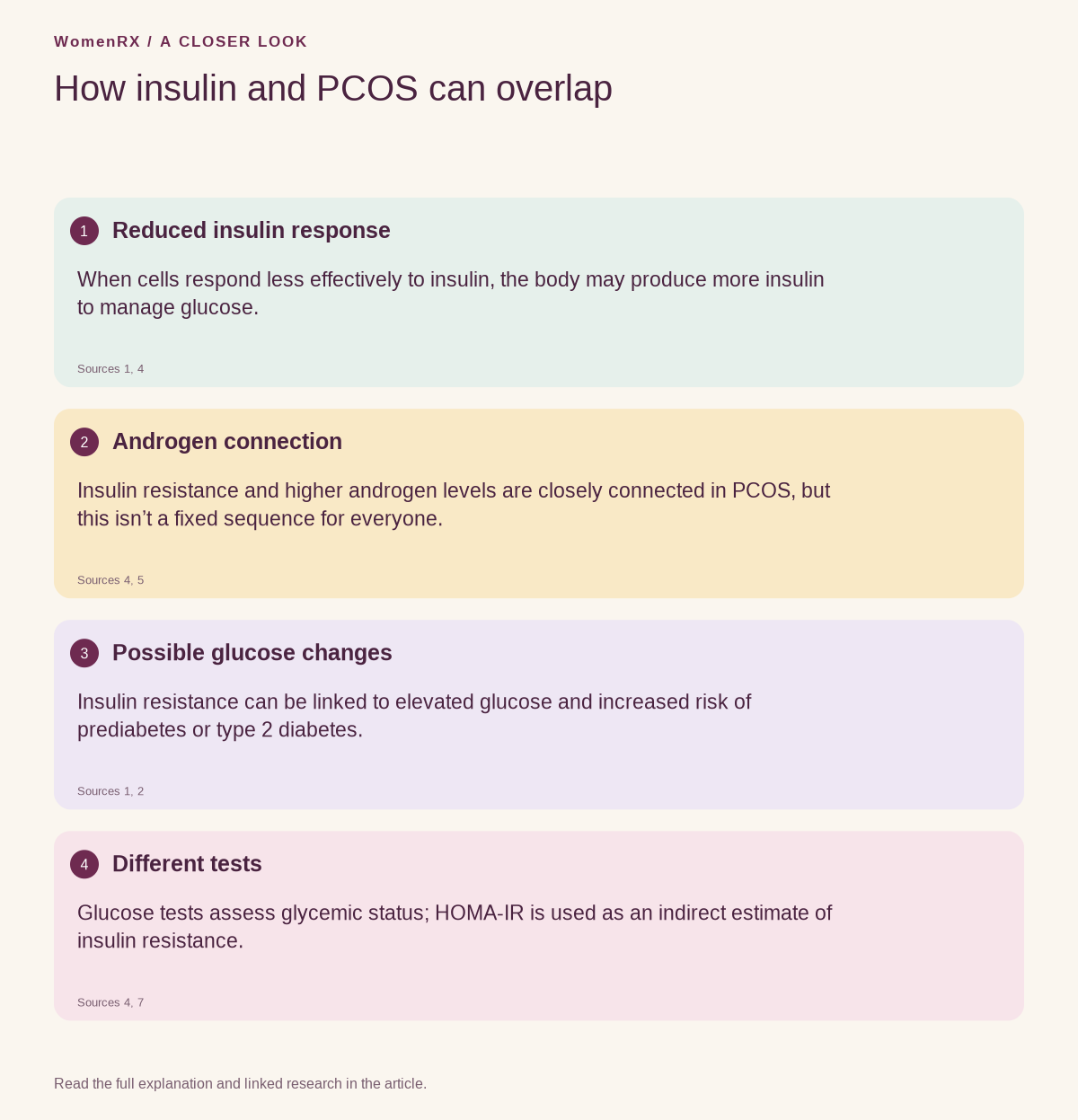
Reduced insulin response: When cells respond less effectively to insulin, the body may produce more insulin to manage glucose.14
Androgen connection: Insulin resistance and higher androgen levels are closely connected in PCOS, but this isn’t a fixed sequence for everyone.45
Possible glucose changes: Insulin resistance can be linked to elevated glucose and increased risk of prediabetes or type 2 diabetes.12
Different tests: Glucose tests assess glycemic status; HOMA-IR is used as an indirect estimate of insulin resistance.47
Read the figure as text
Follow the proposed connections from insulin response to androgen activity and possible glucose changes, without assuming they happen to everyone.- Reduced insulin response: When cells respond less effectively to insulin, the body may produce more insulin to manage glucose.14
- Androgen connection: Insulin resistance and higher androgen levels are closely connected in PCOS, but this isn’t a fixed sequence for everyone.45
- Possible glucose changes: Insulin resistance can be linked to elevated glucose and increased risk of prediabetes or type 2 diabetes.12
- Different tests: Glucose tests assess glycemic status; HOMA-IR is used as an indirect estimate of insulin resistance.47
Sources you can check
- PCOS | Polycystic Ovary Syndrome | MedlinePlusAccessed 2026-09-25Return to first citation
- Diabetes | Type 1 Diabetes | Type 2 Diabetes | MedlinePlusAccessed 2026-09-25Return to first citation
- From PCOS to PMOS: An EMAS clinical guide to the proposed terminology and its relevance to menopause care.Aktoz F, Erel CT, Ozcivit Erkan IB, Armeni E, Boban J, Ceausu I, van Dijken D, Hillard T, Hirschberg AL, Kiesel L, Lambrinoudaki I, Simoncini T, Smetnik A, Goldstajn MS, Stute P, R... · Maturitas · 2026Return to first citation
- Assessment of Type 2 Diabetes Risk in Young Women with Polycystic Ovary Syndrome.Livadas S, Paparodis R, Anagnostis P, Gambineri A, Bjekić-Macut J, Petrović T, Yildiz BO, Micić D, Mastorakos G, Macut D. · Diagnostics (Basel, Switzerland) · 2023Return to first citation
- Indicators for metabolic disturbances in anovulatory women with polycystic ovary syndrome diagnosed according to the Rotterdam consensus criteria.Goverde AJ, van Koert AJ, Eijkemans MJ, Knauff EA, Westerveld HE, Fauser BC, Broekmans FJ. · Human reproduction (Oxford, England) · 2009Return to first citation
- Cardiovascular and metabolic characteristics of infertile Chinese women with PCOS diagnosed according to the Rotterdam consensus criteria.Guo M, Chen ZJ, Macklon NS, Shi YH, Westerveld HE, Eijkemans MJ, Fauser BC, Goverde AJ. · Reproductive biomedicine online · 2010Return to first citation
- Beyond BMI: insulin resistance emerges as the key metabolic correlate of AMH in PCOS.Gorzko A, Nawrocka-Rutkowska J, Śliwak E, Starczewski A, Szydłowska I. · Frontiers in endocrinology · 2026Return to first citation