PCOS and Weight: What the Connection Really Means
PCOS is associated with higher weight in research, but a change on the scale can’t tell you whether PCOS caused it.
PCOS is associated with obesity in research, but that doesn’t establish whether PCOS caused your weight gain. Insulin resistance may influence hormone production in PCOS; that pathway doesn’t, by itself, explain a change in weight. PCOS occurs across body sizes, and weight isn’t a diagnostic feature, so gaining weight can’t confirm PCOS and a lower weight can’t rule it out. 1 3 4
A relationship, not a verdict
PCOS is associated with obesity and insulin resistance in research. But an association doesn’t tell us whether PCOS caused a particular person’s weight gain, whether weight influenced their PCOS, or whether other factors contributed to both. The exact cause of PCOS is not known, and its features vary from person to person. 1 4
That distinction matters in everyday care. If your weight changes, it’s reasonable to wonder whether PCOS is involved. But the change alone can’t answer that question. Weight is influenced by more than body fat, too: muscle, bone, water, and everyday factors all contribute to the number on the scale. 2
How insulin may connect metabolism and hormones
Insulin helps move glucose from the blood into cells. With insulin resistance, the body doesn’t use insulin as effectively. In PCOS, higher insulin levels may work alongside luteinizing hormone to stimulate ovarian cells to produce androgens. Insulin may also lower sex hormone-binding globulin, which can increase the amount of androgen available in the body. These are plausible biological links between metabolism and some PCOS features. They don’t show that insulin resistance caused your weight gain, or that weight gain caused PCOS. 1 4
Insulin resistance is associated with PCOS, but it isn’t a synonym for PCOS. A review of PCOS research describes insulin resistance in women with PCOS at different body sizes, while noting it is especially reported among women with overweight or obesity. That supports taking metabolic health seriously without assuming every person with PCOS has insulin resistance. 4
Body size doesn’t diagnose PCOS
The diagnostic criteria described in the Rotterdam-based international guideline require two of three features: ovulatory dysfunction; clinical or biochemical signs of high androgens; and polycystic ovarian morphology or elevated anti-Müllerian hormone. Body weight isn’t one of those features. 3
In a nationwide Japanese study of 270 patients being assessed for PCOS, researchers identified patients who were not overweight or obese as well as those who were. It was a selected clinical group, so it doesn’t tell us how common PCOS is at different body sizes in the wider population. Still, it illustrates why a particular body size shouldn’t be treated as a requirement for the diagnosis. 3
This cuts both ways: weight change by itself doesn’t confirm PCOS, and a lower weight doesn’t rule it out. The relevant question is whether the reproductive and hormone-related features fit the diagnostic criteria, with other possible explanations considered as appropriate. 3
Assess metabolic health separately from weight
PCOS is linked with metabolic health concerns, but not everyone with PCOS has every associated condition. MedlinePlus notes that health concerns vary and that monitoring can help identify problems early. In practice, that means asking about metabolic health as its own part of care, rather than using appearance or the scale as a substitute for assessment. 1
If a conversation about PCOS turns immediately to your weight, you can bring it back to the concern you want addressed: for example, “Can we assess my metabolic health without assuming what it is from my body size?” That leaves room to discuss weight change without making it the explanation for every symptom. 1 3
If you’re experiencing weight change, it may help to describe what changed and when, alongside any changes in your periods or other PCOS-related features. A sudden or unexplained change deserves attention rather than an automatic assumption that PCOS is responsible. Weight alone can’t show whether the change reflects fat, muscle, or fluid, and unexpected weight gain or loss can have other causes. 2
What the evidence can, and can’t, say
The observed association between PCOS and higher weight is one finding; the insulin-androgen pathway is another. That pathway helps explain why PCOS can have both reproductive and metabolic features, but it doesn’t establish why an individual gained weight. Nor does the association establish a single direction of cause between body weight and PCOS. The useful distinction is to take weight changes and metabolic health seriously without reducing PCOS, or your health, to a number on the scale. 1 2 4
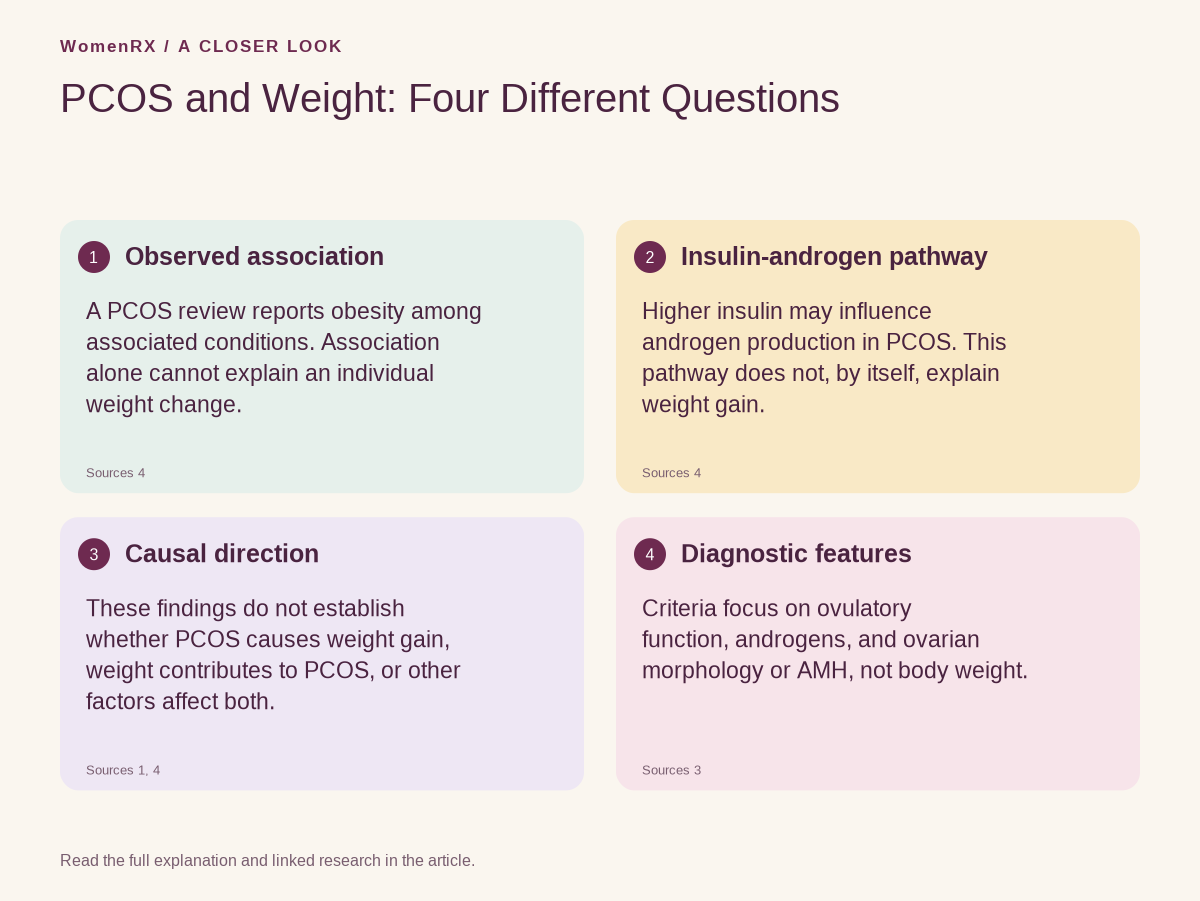
PCOS and Weight: Four Different Questions
Observed association: A PCOS review reports obesity among associated conditions. Association alone cannot explain an individual weight change.4
Insulin-androgen pathway: Higher insulin may influence androgen production in PCOS. This pathway does not, by itself, explain weight gain.4
Causal direction: These findings do not establish whether PCOS causes weight gain, weight contributes to PCOS, or other factors affect both.14
Diagnostic features: Criteria focus on ovulatory function, androgens, and ovarian morphology or AMH, not body weight.3
Read the figure as text
This evidence map separates what has been observed from a possible hormone pathway, an unanswered causal question, and the features used for diagnosis.- Observed association: A PCOS review reports obesity among associated conditions. Association alone cannot explain an individual weight change.4
- Insulin-androgen pathway: Higher insulin may influence androgen production in PCOS. This pathway does not, by itself, explain weight gain.4
- Causal direction: These findings do not establish whether PCOS causes weight gain, weight contributes to PCOS, or other factors affect both.14
- Diagnostic features: Criteria focus on ovulatory function, androgens, and ovarian morphology or AMH, not body weight.3
More questions, answered
Can you have PCOS at a lower body weight?
Yes. Body weight is not one of the diagnostic features described in the Rotterdam-based criteria, and PCOS has been identified in people who are not overweight or obese. 3
Does everyone with PCOS have insulin resistance?
No. Insulin resistance is associated with PCOS, but PCOS features differ, and not everyone has every linked health concern. Metabolic health needs to be considered individually rather than inferred from a diagnosis or body size alone. 1 4
Sources you can check
- PCOS | Polycystic Ovary Syndrome | MedlinePlusAccessed 2026-09-25Return to first citation
- Body Weight: MedlinePlusAccessed 2026-09-25Return to first citation
- A New Diagnostic Strategy for Polycystic Ovary Syndrome Combining Japanese and International Diagnostic Criteria Using Anti-Müllerian Hormone.Noguchi H, Iwasa T, Iwase A, Kanasaki H, Kimura F, Kugu K, Saito K, Baba T, Hara T, Matsuzaki T. · The journal of obstetrics and gynaecology research · 2026Return to first citation
- Diagnostic Criteria and Genetic Basis of Polycystic Ovary Syndrome: A Narrative Review.Cepero-González MLA, Aguilar-Galarza A, Rodríguez-García VM, García-Gasca T, Moreno Celis U. · Metabolites · 2026Return to first citation