Does Metformin Affect Weight in PCOS?
Metformin may be accompanied by a modest weight decrease for some women with PCOS, but weight change varies and isn’t the only reason it may be prescribed.
Metformin can be associated with some weight loss in women with PCOS, but it doesn’t guarantee weight change, and it isn’t prescribed to everyone for that purpose. In one small, short trial of women with PCOS and higher weight, the metformin-only group lost an average of 1.7 kg over 16 weeks. That group average can’t predict what you’ll experience, and weight isn’t the only outcome to discuss. 3
The short answer: possible, not predictable
If your clinician prescribed metformin for PCOS, the expected benefit may have more to do with metabolic or reproductive goals than with the scale. Metformin is used as an insulin-sensitizing medicine in PCOS, and research in women with higher weight has measured outcomes such as blood sugar, hormones, and body weight separately. A change in weight may happen, but it shouldn’t be treated as a guaranteed effect or the measure of whether treatment is worthwhile. 2 3
One small randomized trial offers a concrete reference point. It included 60 women with PCOS and overweight or obesity in China, assigned to metformin alone or metformin with tirzepatide. After 16 weeks, the metformin-only group’s average weight change was −1.7 kg. The combination group’s average change was −10.4 kg, but that larger result belongs to the combination treatment, not metformin alone. Neither group average tells you what an individual woman will lose or whether she will lose weight. 3
Weight is one outcome, not the whole treatment
PCOS treatment can focus on different concerns. A clinician may be looking at blood sugar or other metabolic measures, menstrual patterns, or hormone-related outcomes. In a separate 12-week study of 60 overweight or obese women with PCOS, metformin-treated participants showed reductions in body weight, blood glucose, blood lipids, and the LH/FSH ratio. The study summary reports improvements in several outcomes, but doesn’t provide the metformin group’s exact weight change. 2
That distinction matters: a scale reading can change without showing everything happening with metabolism or cycles. And a stable weight doesn’t, by itself, show whether a treatment is helping the reason it was prescribed. Body weight includes more than body fat and can’t give a complete picture of health on its own. 1
If weight loss isn’t your goal, say so. It’s reasonable to clarify what your clinician hopes metformin will address and how you’ll judge progress on that goal. PCOS treatment doesn’t have to be framed around weight change for every person.
Why a trial average isn’t your forecast
The metformin-only result came from a small, short study of women with PCOS who had overweight or obesity. It doesn’t establish what to expect for women at other body sizes, for people with different PCOS symptoms or treatment goals, or over a longer period. Another small study also found weight reductions in its metformin group, but it likewise involved women with overweight or obesity and lasted 12 weeks. These studies offer examples of what happened in particular groups, not a reliable way to predict an individual response. 2 3
It’s also easy to misread a combination-treatment result. When another medicine is taken alongside metformin, the combined effect cannot be credited to metformin alone. In the 16-week trial, the much larger average reduction occurred in the group taking both metformin and tirzepatide. 3
What to track, based on your goal
Rather than tracking everything, agree on a few outcomes that match your reason for taking metformin. For example, if the goal is metabolic, ask which blood-sugar or other metabolic measures your clinician plans to follow. If the goal relates to periods or hormones, ask which changes are relevant in your case. If you do want to monitor weight, discuss whether a trend is more useful than reacting to individual readings. Weight is one health measure, not a complete account of your health. 1 2
A practical conversation might start with: “What are we hoping metformin will improve for me, and what would count as progress besides weight?” You can also ask how long you’ll assess the agreed outcomes before revisiting the plan. Those questions help keep treatment focused on your needs, whether or not the scale changes.
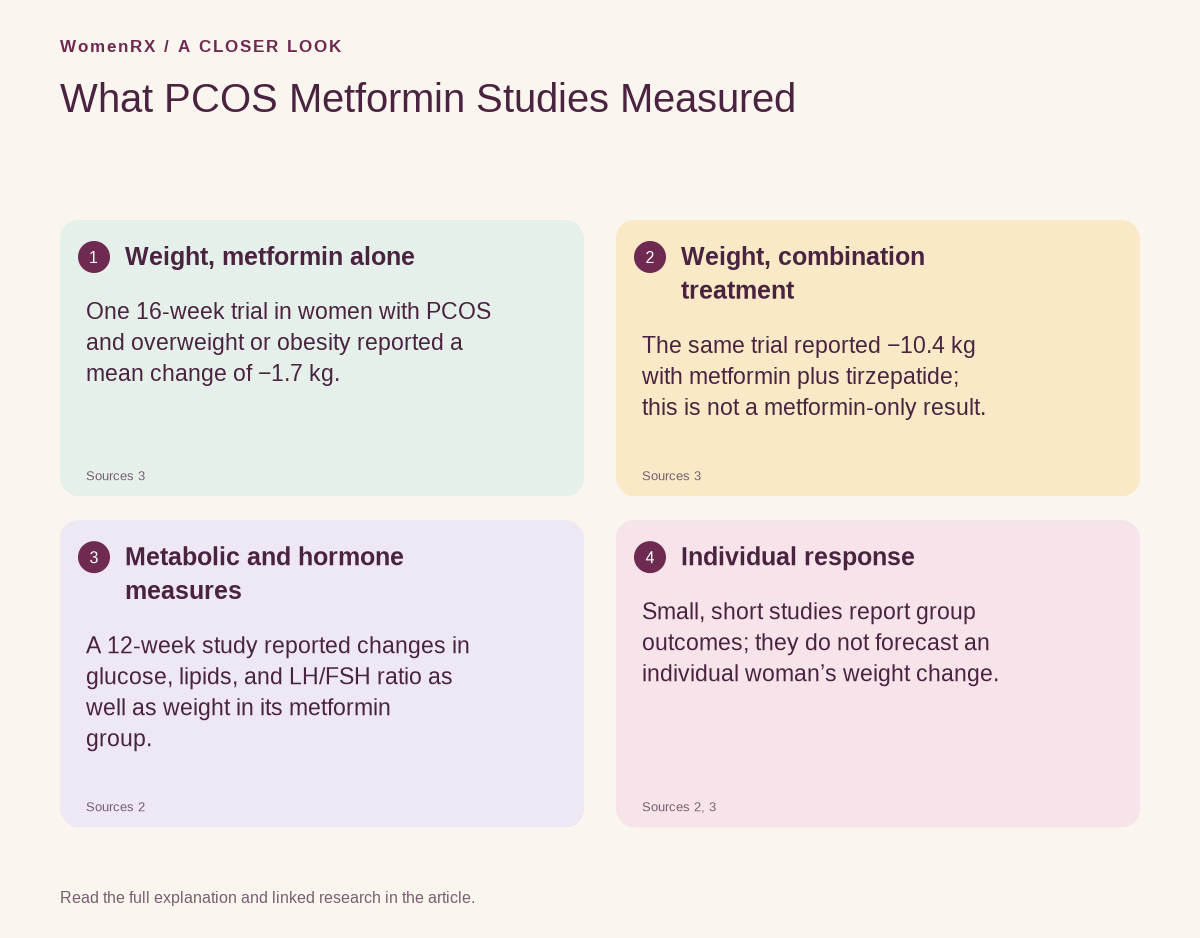
What PCOS Metformin Studies Measured
Weight, metformin alone: One 16-week trial in women with PCOS and overweight or obesity reported a mean change of −1.7 kg.3
Weight, combination treatment: The same trial reported −10.4 kg with metformin plus tirzepatide; this is not a metformin-only result.3
Metabolic and hormone measures: A 12-week study reported changes in glucose, lipids, and LH/FSH ratio as well as weight in its metformin group.2
Individual response: Small, short studies report group outcomes; they do not forecast an individual woman’s weight change.23
Read the figure as text
These study outcomes are related, but a result on one measure is not the same as a result on another.- Weight, metformin alone: One 16-week trial in women with PCOS and overweight or obesity reported a mean change of −1.7 kg.3
- Weight, combination treatment: The same trial reported −10.4 kg with metformin plus tirzepatide; this is not a metformin-only result.3
- Metabolic and hormone measures: A 12-week study reported changes in glucose, lipids, and LH/FSH ratio as well as weight in its metformin group.2
- Individual response: Small, short studies report group outcomes; they do not forecast an individual woman’s weight change.23
More questions, answered
Does no weight change mean metformin isn’t helping my PCOS?
Not necessarily. Weight is only one measured outcome in PCOS studies; metformin has also been studied in relation to blood glucose, lipids, and hormone measures. Ask which outcomes your treatment is meant to address and how you’ll assess them. 2
Sources you can check
- Body Weight: MedlinePlusAccessed 2026-09-25Return to first citation
- Combination metformin and liraglutide in PCOS: clinical efficacy in women and preclinical insights from gut microbiome modulation in rats.Long XF, Fang YQ, Li YH, Li JY, Wang XP, Wang XL, Zhang L, Liu Y. · Frontiers in endocrinology · 2025Return to first citation
- Short-Term Combined Treatment With Tirzepatide and Metformin for Overweight/Obese Chinese Women With Polycystic Ovary Syndrome: A Prospective, Open-Label, Randomised Controlled Trial.Yang Z, Xu Y, Du H, Liu W, Chen H, Liu D, Zhang L, Wang C. · Diabetes, obesity & metabolism · 2026Return to first citation